Jean de La Rochebrochard runs Kima Ventures, Xavier Niel's seed fund, which backs around a hundred startups a year with single tickets of €150,000. What sets him apart is less the size of the check than the pace. Deciding quickly, across a deal volume very few European funds come close to, calls for a specific evaluation method and a different kind of post-investment support than a traditional fund offers. He took over the fund in 2015, after five years in investment banking and two at TheFamily. This article covers his background, his thesis, the criteria that come up again and again in his public talks, and what this high-volume model means in practice when you are the founder sitting across from him.
Who is Jean de La Rochebrochard
Start with his background, because it explains the method.
Before Kima
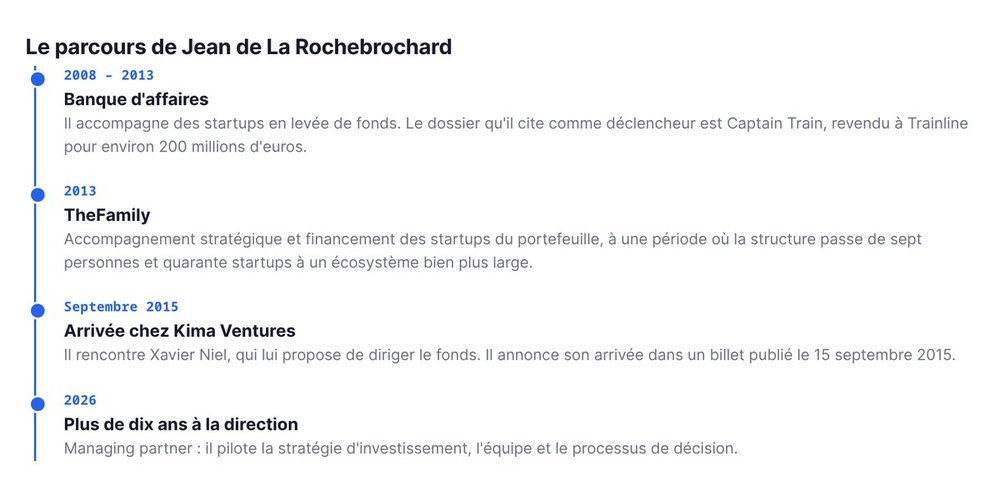
From 2008 to 2013, he worked as an investment banker, helping startups raise money. He describes that period in an interview with Décideurs Magazine: "I was often frustrated in my dealings with investors, whom I didn't always find to be very good decision-makers or very pleasant." The deal he cites as the trigger is Captain Train, later sold to Trainline. His conclusion at the time: do the same job as those investors, only better.
He then joined TheFamily in 2013, working on strategic support and fundraising for portfolio startups, during a period when the organization grew from seven people and forty startups into a much larger ecosystem.
His exact role at Kima Ventures
In 2015, he met Xavier Niel, who offered him the job of running Kima Ventures. He announced the move in a post published on September 15, 2015. He has been the fund's managing partner ever since, leading its investment strategy, its team and its decision process.
Keep this in mind for your approach: Kima belongs to Xavier Niel, but Xavier Niel does not make the day-to-day decisions. Targeting the owner instead of the team is the most costly targeting mistake you can make.
Other vehicles and roles
He also invests personally in Kima. His second visible activity is editorial: newsletters, interviews, social media and a book. He describes this output as an exercise in introspection. After meetings with founders, he records voice notes, then synthesizes and shares them.
For anyone preparing an approach, this is a real resource: his criteria are written down, so you can read them instead of guessing.
Jean de La Rochebrochard's investment thesis
His thesis is public and fits in a few lines.
Stage and ticket size
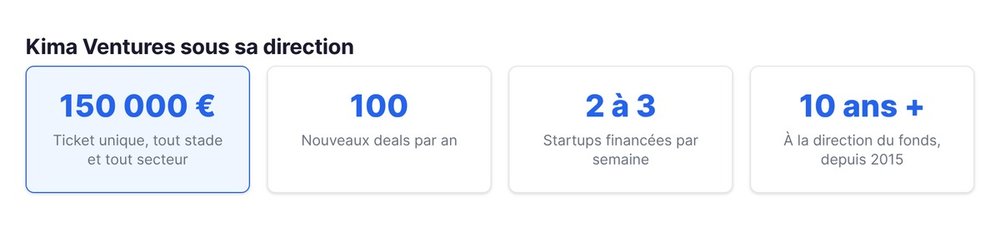
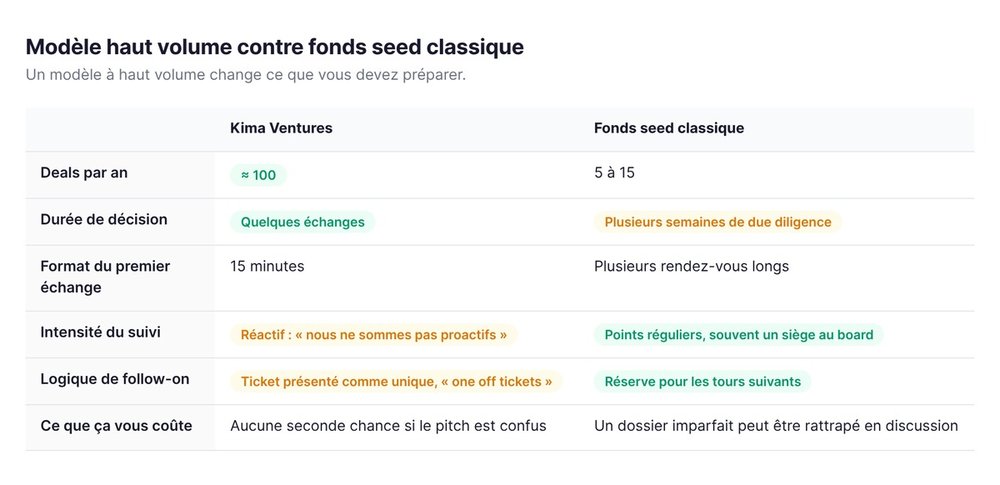
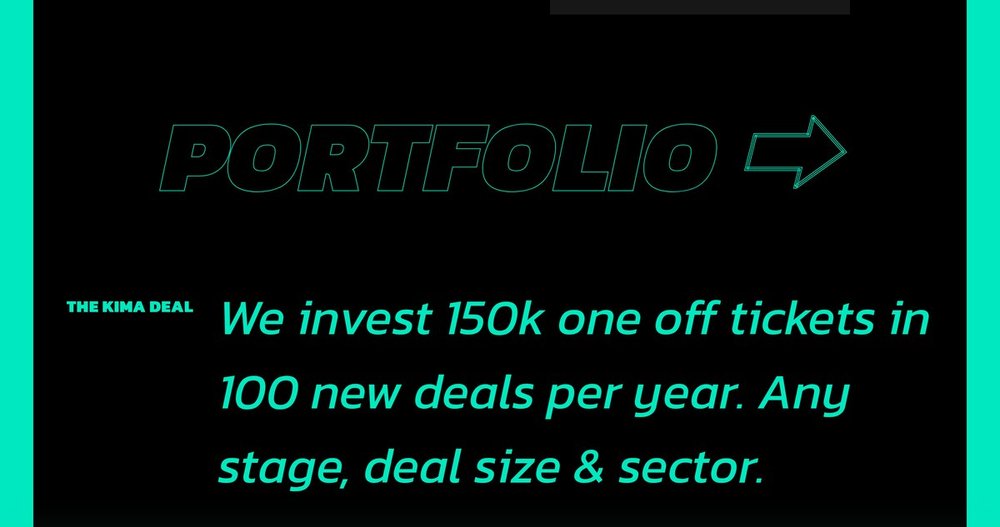
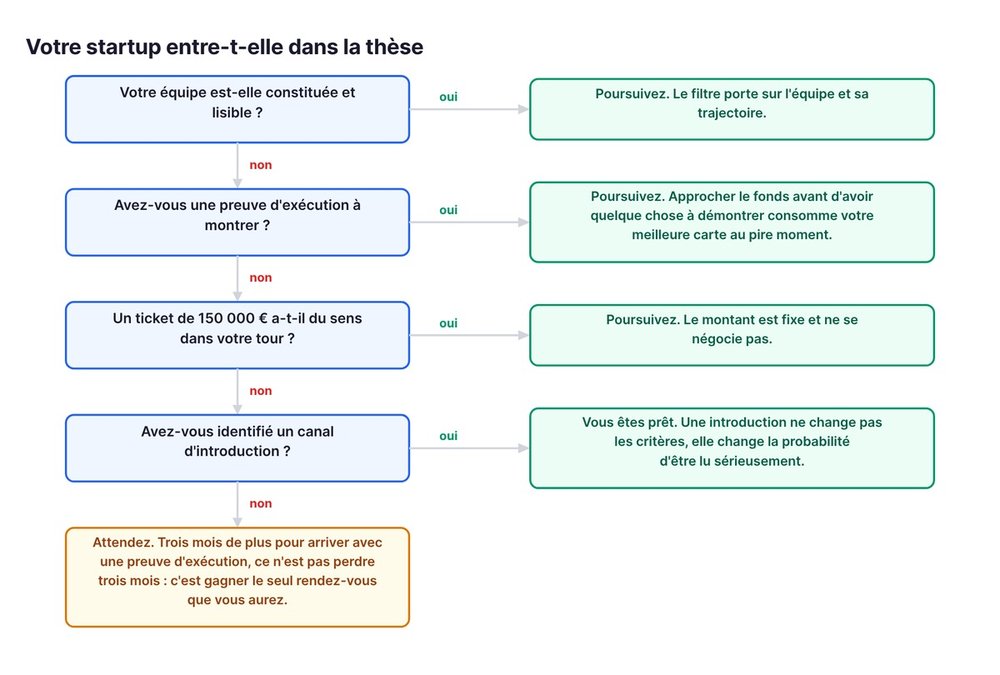
Kima writes single tickets of €150,000 into 100 new deals a year, at any stage and in any sector. The fund states its line clearly: back ambitious, tight-knit teams with steep learning and execution curves, at a pace of two to three startups a week, anywhere in the world.
So there is no vertical thesis to satisfy and no sector box to tick. The filter is the team and its trajectory.
His first criterion for a founder
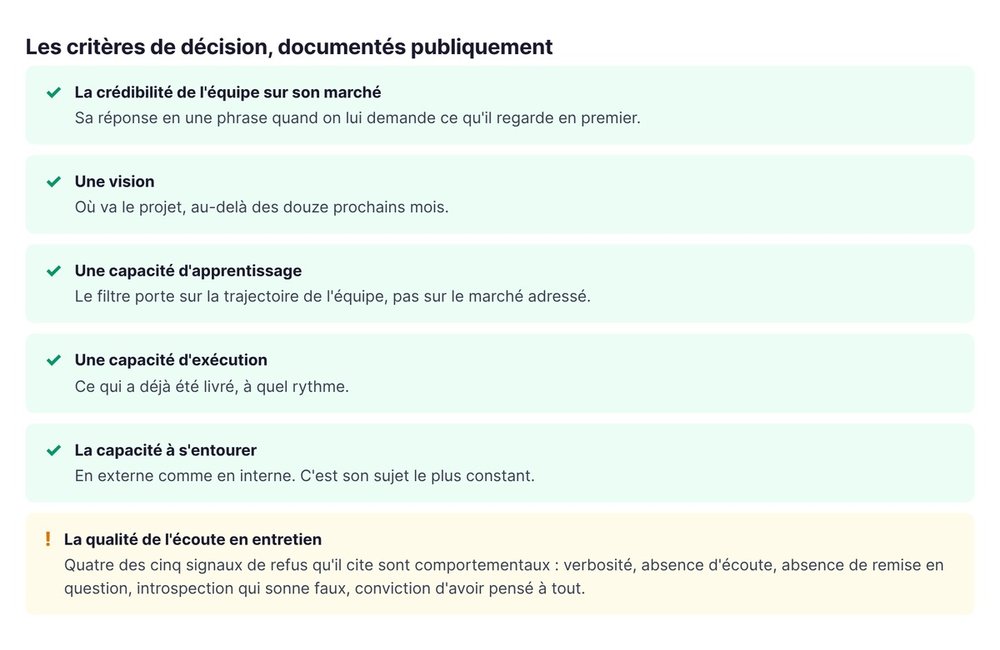
His answer, in one sentence: is the team credible in its market? He breaks that down into three expectations: vision, the ability to learn and execute, and the ability to build a strong circle around them, both externally and internally.
His interview technique is documented, and it is worth knowing before you go through it. He opens with questions he knows the founder can answer, such as "how did you meet your cofounders?" Then he moves on to questions without a ready-made answer: "how are you going to stand out?", "what key growth milestones do you expect to hit?"
The goal is to watch how you react at the exact moment you run out of prepared answers. He is not trying to trap you.
Red flags
This list is public too. The signals that put him on alert: the long-winded entrepreneur, the founder who ignores objections, a lack of self-questioning, reflection on one's own mistakes that rings false, and the belief that you have thought of everything.
Four of those five signals are behavioral and play out in the meeting itself. A founder can therefore lose a Kima deal with a good startup, simply by taking up all the airtime.
Volume explains this imbalance. A team handling around a hundred deals a year cannot validate a market with a six-week study. What it can assess in fifteen minutes is the quality of your reasoning when an unexpected question lands. Behavior works as a proxy for everything else: learning, correcting course, hiring, taking bad news without dressing it up.
Hence a piece of advice that is less obvious than it sounds: prepare your silences as carefully as your pitch. "I don't know yet, and here's how I plan to find out" beats an improvised answer.
How he decides at a pace of more than a hundred deals a year
Kima's model stands out for its decision speed.
The meeting format
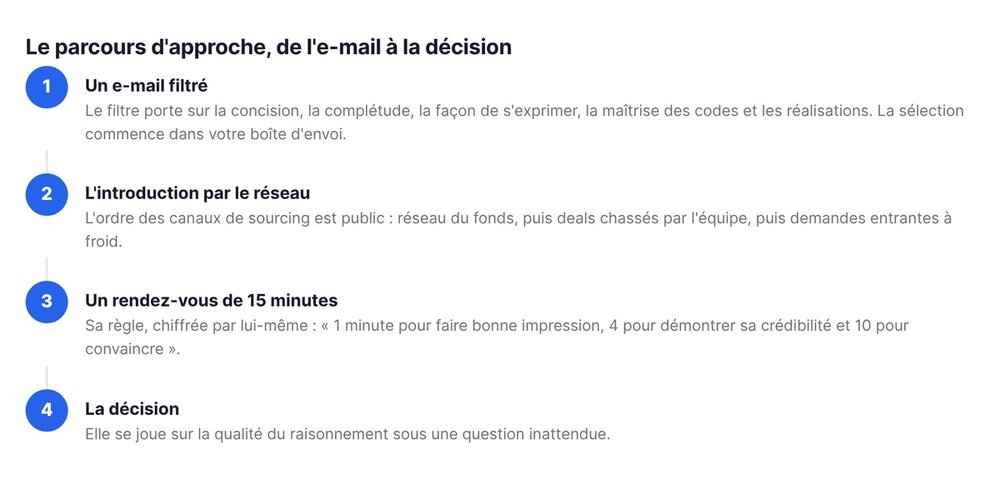
He puts numbers on the rule himself: "The entrepreneur has 15 minutes: 1 minute to make a good impression, 4 to show credibility and 10 to convince."
A filter comes before that meeting, and it applies to your email: concision, completeness, how you express yourself, command of the codes, achievements. Selection starts in your outbox.
The order of sourcing channels is public: deals brought in by the fund's network first, then deals the team goes out and finds, then cold inbound requests. An introduction leaves the criteria unchanged. What it changes is the likelihood of being read seriously.
What volume means for post-investment support
He openly owns a support model that few funds describe so candidly: "we are not proactive. But we are always there when they call us."
The example he gives: a SaaS founder in his portfolio asked him for nothing during the three years after the investment. When it came time to sell, he connected her with the right person to get a good offer.
What this means for you: don't count on monthly check-ins or structured support. Count on availability on demand, backed by a very large network. If you need an investor who pushes you, look elsewhere. If you need fast access when it matters, this is exactly the right fit.
Many founders learn this too late: in a reactive model, the value you get from the investor depends on your ability to make a precise request. "Can you help us with hiring?" produces nothing. "We're looking for a first VP Sales with experience of enterprise sales cycles in fintech. Do you know three people we should talk to?" produces three introductions.
Follow-on policy
Kima presents its ticket as a one-off. There is no publicly formalized policy of systematic reinvestment, and it would be dishonest to suggest otherwise.
So build your funding plan treating that €150,000 as starting capital and a signal, rather than the first stage of a multi-round relationship.
His public messages to founders
On the founder's circle
This is his most consistent theme: "you need entrepreneurs who know how to surround themselves with the right people, externally and internally." The ability to build that circle is an evaluation criterion on the same level as vision or execution.
He applies the same standard to his own profession. His definition of a good business angel: someone who never tires of talking with entrepreneurs, knows how to ask the right questions, doesn't judge, accepts that there is more than one way to do things, and knows their place.
On founder-investor alignment
His position on availability is clear: "there's no such thing as an overloaded investor." Making time for entrepreneurs is part of the job.
The other side of that alignment is tougher. He explicitly distinguishes between people who move forward and people who find excuses, and sees that as how the sorting happens. An investor who is available on demand is still a demanding one.
On raising too early
No sourced public statement addresses this point specifically.
You get one filtered email and fifteen minutes, and cold inbound requests are the lowest-priority channel. Approaching the fund before you have anything to show burns your best card at the worst moment. Waiting three more months to arrive with proof of execution earns you the only meeting you will get.
How to reach him, and what to have ready
The channels that actually work
Kima accepts applications through its website: an open channel, and the lowest priority one.
The channel that works is an introduction from a portfolio founder. With close to a thousand investments listed on the fund's website, there is often a path somewhere in your extended network. Map the portfolio before you go looking for an email address.
His public output is a third, underrated channel: it gives you his criteria, his vocabulary and his interview method before your first conversation.
An approach format that works
Write for his filters. A concise, complete email: what you do, for whom, proof that it works, how much you're raising, and why Kima now. Skip the attachments and the forty-page deck.
For the meeting, prepare the opening minute and the four minutes of credibility as two separate blocks. Above all, prepare for the questions you can't answer yet, since those are the ones that decide.
The fund's full context is covered in our Kima Ventures profile, and the group's other vehicles in our map of Xavier Niel's investment funds. To see where Kima sits among other French investors, check our overview of venture capital funds in France. For other figures whose thinking circulates widely among founders, our Naval Ravikant fast-track follows the same format.
FAQ
What is Jean de La Rochebrochard's role at Kima Ventures?
He has been managing partner of Kima Ventures since 2015. He leads the investment strategy, the team and the decision process of the fund, which is owned by Xavier Niel. Early-stage investment decisions are made by this team, rather than by the fund's owner.
What ticket size does Kima Ventures invest?
Kima writes single tickets of €150,000 into around 100 new deals a year, at any stage and in any sector. The amount is a standard publicly announced by the fund, rather than an average, and it is not negotiable.
Are Kima's terms founder-friendly?
Kima does not publish its detailed terms. What is public and verifiable: a single €150,000 ticket, a high volume of investments and a non-proactive support stance. This format is structurally incompatible with heavy governance rights, since a fund cannot actively sit on several hundred boards. As with any seed round, have the documents reviewed before signing.