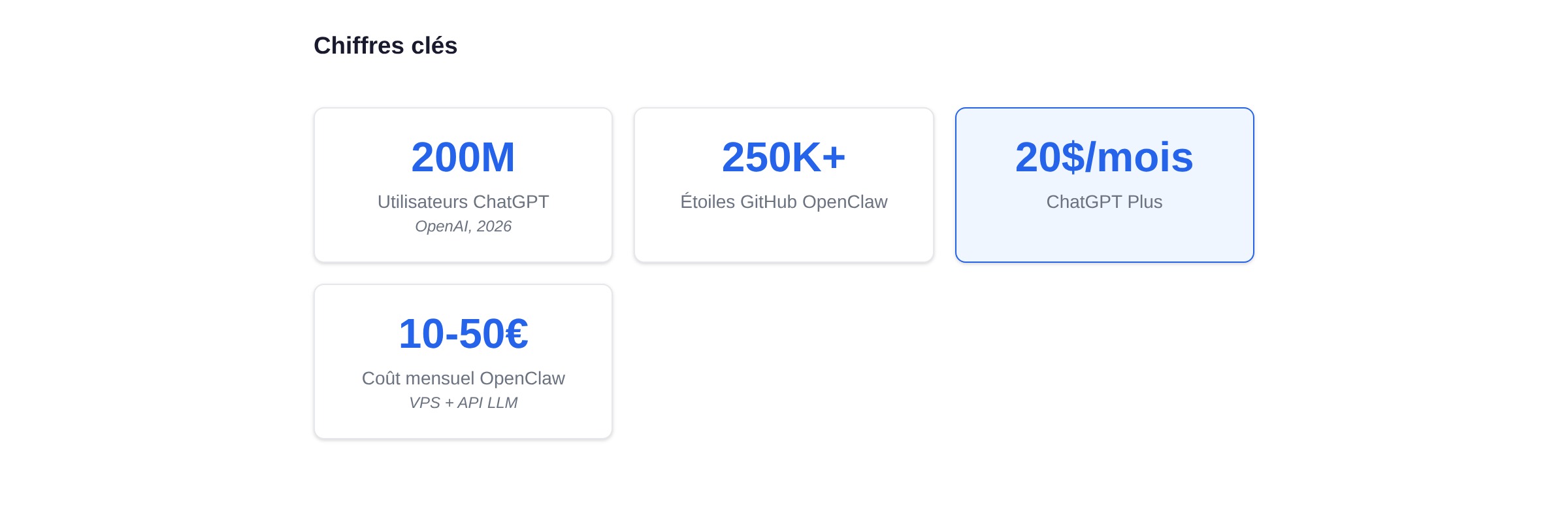
On one side, ChatGPT: 200 million users, a web interface you can reach in 30 seconds, a $20/month subscription. On the other, OpenClaw: 250,000+ GitHub stars, an AI agent that runs on your own machine, zero data sent to the cloud. Both use large language models. Both answer your questions. But that's where the comparison ends. ChatGPT is a reactive chatbot. OpenClaw is a proactive, autonomous agent. For a startup founder, the choice comes down to three things: your technical skill level, how you feel about data privacy, and what you actually want to automate.
OpenClaw and ChatGPT: two philosophies of AI
ChatGPT: conversational AI for everyone
ChatGPT is OpenAI's conversational Swiss Army knife. You open a browser, type a question, and get an answer. No installation, no configuration, no server to maintain.
Since 2026, ChatGPT has evolved well beyond a simple chatbot. Agent mode, Operator (automated web browsing), file analysis, image generation with DALL-E, and plugin access all extend its capabilities. With ChatGPT Pro at $200/month, you get access to the most powerful models and advanced features like Computer Use.
But ChatGPT is still fundamentally reactive. You ask it something, it answers. You close the tab, it stops. It doesn't run in the background, it doesn't monitor your communication channels, and it doesn't carry out tasks on its own.
OpenClaw: the autonomous agent you control
OpenClaw takes a radically different approach. It's an open source AI agent that installs on your machine (Mac, Linux, or a VPS) and connects to your existing messaging platforms: WhatsApp, Telegram, Discord, Slack, Signal.
The core difference: OpenClaw is proactive. It runs in the background 24/7, keeps a persistent memory of your conversations, and can execute commands on your system. It doesn't live in a browser tab. It lives on your server, like a system service.
Jensen Huang, CEO of NVIDIA, compared it to Linux at GTC 2026. The analogy fits: like Linux, OpenClaw is open source, self-hosted, and gives the user full control. And like Linux, it also demands more technical skill to run.
The 5 concrete differences
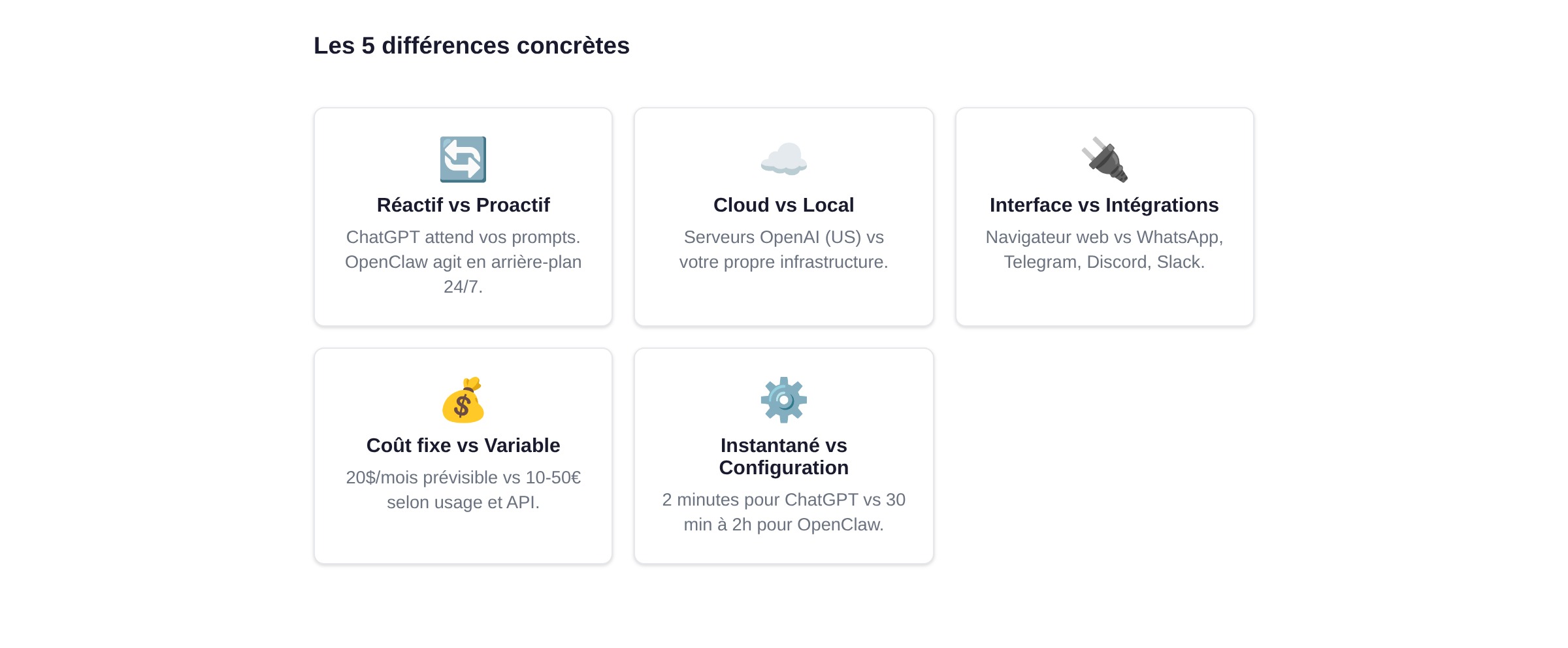
Reactive vs proactive
ChatGPT waits for your prompts. You ask a question, it answers. That's it. If you don't talk to it for a week, nothing happens.
OpenClaw can act without your direct involvement. Set it up to monitor a Slack channel, summarize the important discussions every morning, or automatically respond to certain types of messages on Telegram. It's the difference between an assistant waiting in the hallway and an assistant who anticipates your needs.
Cloud vs local
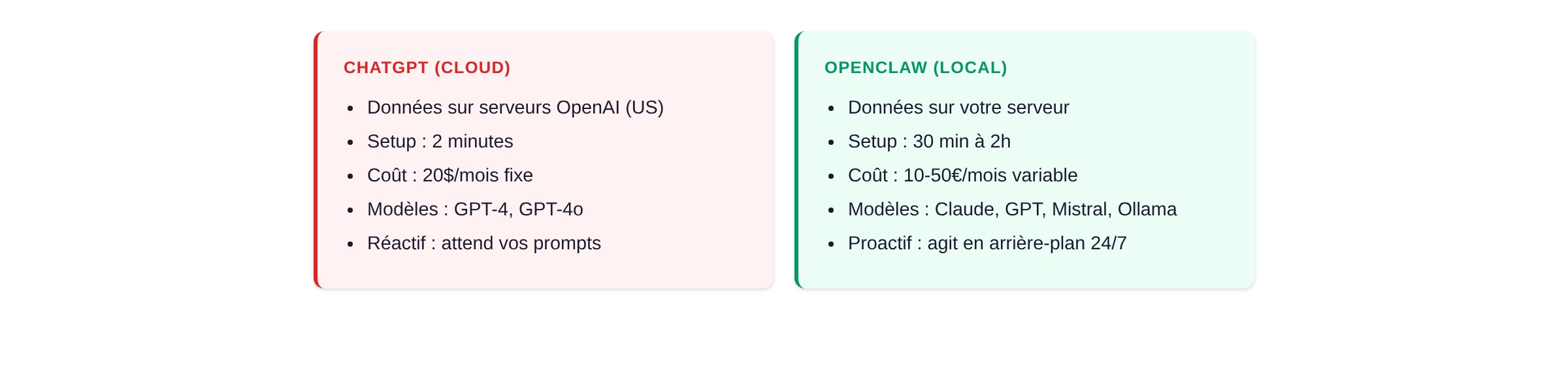
When you use ChatGPT, your conversations pass through OpenAI's servers in the United States. For many uses, that's not a problem. For a startup working with confidential data (strategy, customer data, intellectual property), it's a fair concern.
OpenClaw runs entirely on your own infrastructure. The conversations, the memory, the files it processes: everything stays with you. No data leaves your machine (except the API calls to the LLM you chose, if you're not using a local model).
Interface vs integrations
ChatGPT lives in your browser (or the mobile app). It's one more tab among your 47 open tabs.
OpenClaw lives where you already communicate. It replies on WhatsApp when you send it a voice message. It's available in your team's Discord server. It answers on Telegram while you're on the move. No need to open another app.
Real cost
ChatGPT: $20/month for ChatGPT Plus (GPT-4, DALL-E, web browsing). $200/month for ChatGPT Pro (advanced models, Computer Use). Predictable and simple.
OpenClaw: free as software. But you need to add:
- Hosting: a VPS from €5/month (Hetzner, OVH) up to €20+ for something comfortable
- LLM API: Anthropic Claude or OpenAI GPT, billed by usage. Budget €5 to €30/month depending on how heavily you use it
- Setup and maintenance time
For light use, OpenClaw can end up cheaper than ChatGPT Plus. For heavy use, API costs can far exceed the ChatGPT subscription. The real savings come if you use local models via Ollama, but that requires suitable hardware.
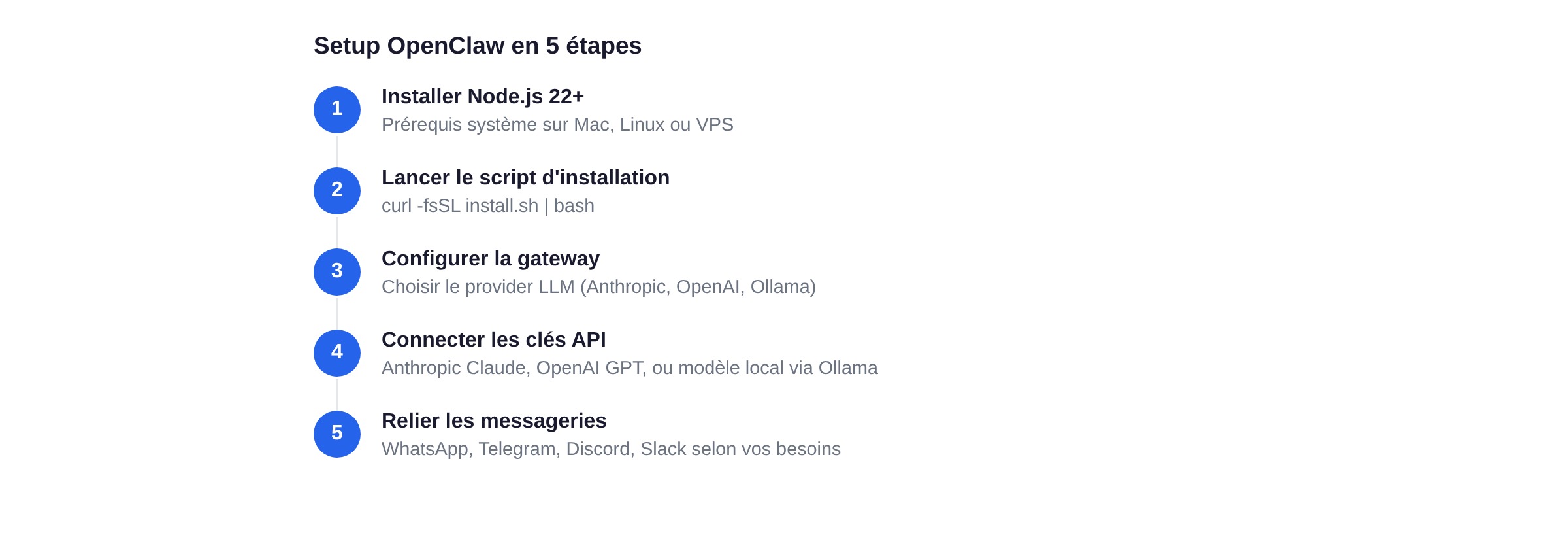
Instant setup vs technical configuration
ChatGPT: you create an account and start. Setup time: 2 minutes.
OpenClaw: you install Node.js 24 (recommended) or 22.16+, run the install script, configure your gateway, connect your API keys, link your messaging platforms, and set up your security policies. Realistic setup time: 30 minutes to 2 hours (if everything goes smoothly).
That's the trade-off for full control: full responsibility.
Quick comparison table
| Criterion | ChatGPT | OpenClaw |
|---|---|---|
| Type | Cloud chatbot | Self-hosted autonomous agent |
| Installation | 0 (browser) | 30 min to 2h |
| Data | OpenAI servers (US) | Your machine |
| Monthly cost | $20 (Plus) / $200 (Pro) | €10 to €50 (VPS + API) |
| Models | GPT-4, GPT-4o | Claude, GPT, Mistral, Ollama |
| Messaging apps | No (app/web only) | WhatsApp, Telegram, Discord, Slack |
| Autonomy | Reactive (prompt then response) | Proactive (background tasks) |
| Open source | No | Yes (MIT) |
| Memory | Limited to the session | Persistent across sessions |
When to choose ChatGPT
ChatGPT is the right choice when:
- You want to start right now. No setup, no server, no configuration. You pay, you use it.
- Your need is conversational. Writing, brainstorming, research, document analysis, image generation. ChatGPT shines in one-off interactions.
- Your team isn't technical. Everyone knows how to use ChatGPT. Nobody needs to know what Docker or an API key is.
- You don't have strong privacy constraints. For marketing brainstorming or content writing, the data question is less critical.
For most early-stage founders, ChatGPT is more than enough for everyday use.
When to choose OpenClaw
OpenClaw comes into its own when:
- You want to automate recurring tasks. Summarizing Slack discussions every morning, answering frequently asked questions on Telegram, processing emails by specific rules. OpenClaw does this in the background, hands-off.
- Data privacy is non-negotiable. Customer data, strategy, intellectual property. With OpenClaw, nothing leaves your server.
- You want an assistant inside your existing tools. No desire to open yet another tab. You want AI right there in WhatsApp, Discord, or Slack.
- You want to control the model and the costs. Choose between Claude, GPT-4, Mistral, or a local model. Tune the settings. Pay only for what you use.
If at least two of these points describe you, OpenClaw is worth a look. Our complete OpenClaw guide walks through the installation step by step. And if you're torn between several open source tools, check out our comparison of OpenClaw alternatives.

Where does Claude Code fit in?
In the landscape of AI tools for founders, there's a third path worth mentioning: Claude Code.
Claude Code is neither a chatbot like ChatGPT nor a multi-platform agent like OpenClaw. It's a development assistant that lives in your terminal. It understands your codebase, suggests changes, runs commands, and helps you build faster.
The distinction matters:
- ChatGPT = general-purpose conversational AI (cloud)
- OpenClaw = autonomous multi-platform agent (self-hosted)
- Claude Code = coding assistant in the terminal (cloud + local)
These tools aren't in direct competition. A technical founder could easily use Claude Code to develop, ChatGPT for brainstorming, and OpenClaw to automate customer support on Telegram. The era of "one AI tool for everything" is over. The right question is no longer "which one should I choose," but "how do I combine them."
For a detailed look at what vibe coding changes for startups, check out our dedicated guide.
FAQ
Can OpenClaw replace ChatGPT?
Not really, and that's not its goal. OpenClaw excels at automating recurring tasks and integrating with your messaging apps. ChatGPT excels at one-off conversational interactions and content generation. For most founders, the two tools are complementary. Use ChatGPT when you need a quick answer, and OpenClaw when you want to automate a process.
Is ChatGPT safer than OpenClaw?
It depends on your perspective. ChatGPT sends your data to OpenAI's servers, but it benefits from professional security infrastructure, regular audits, and SOC 2 compliance. OpenClaw keeps your data local, but researchers have identified 42,900 publicly exposed instances and significant security vulnerabilities. In short: ChatGPT carries a privacy risk (your data sits with a third party), while OpenClaw carries an operational security risk (your setup can be misconfigured).
What's the real monthly cost of OpenClaw?
For moderate personal use: budget between €10 and €30/month. That covers a VPS (€5 to €10 at Hetzner or OVH), the API calls to the LLM of your choice (€5 to €20 depending on usage), and possibly a free Brave Search key. If you use local models via Ollama, you save on APIs but need more powerful hardware. ChatGPT Plus at $20/month is often comparable in total cost, but without the control or the autonomy.