Kima Ventures: A Portrait of the World's Most Active VC Fund
Paris, a Tuesday afternoon. A founder sends their deck at 2pm. By 4pm, they already have feedback. By 6pm, a term sheet. No, this isn't fiction: it's the speed at which Kima Ventures, Xavier Niel's investment vehicle, can decide to back your startup. With more than 1,288 companies in its portfolio, 21 unicorns and a pace of 2 to 3 investments a week, Kima is the world's most active venture capital fund in early-stage. A one-of-a-kind case in the French ecosystem, and a first check that thousands of founders are trying to land.
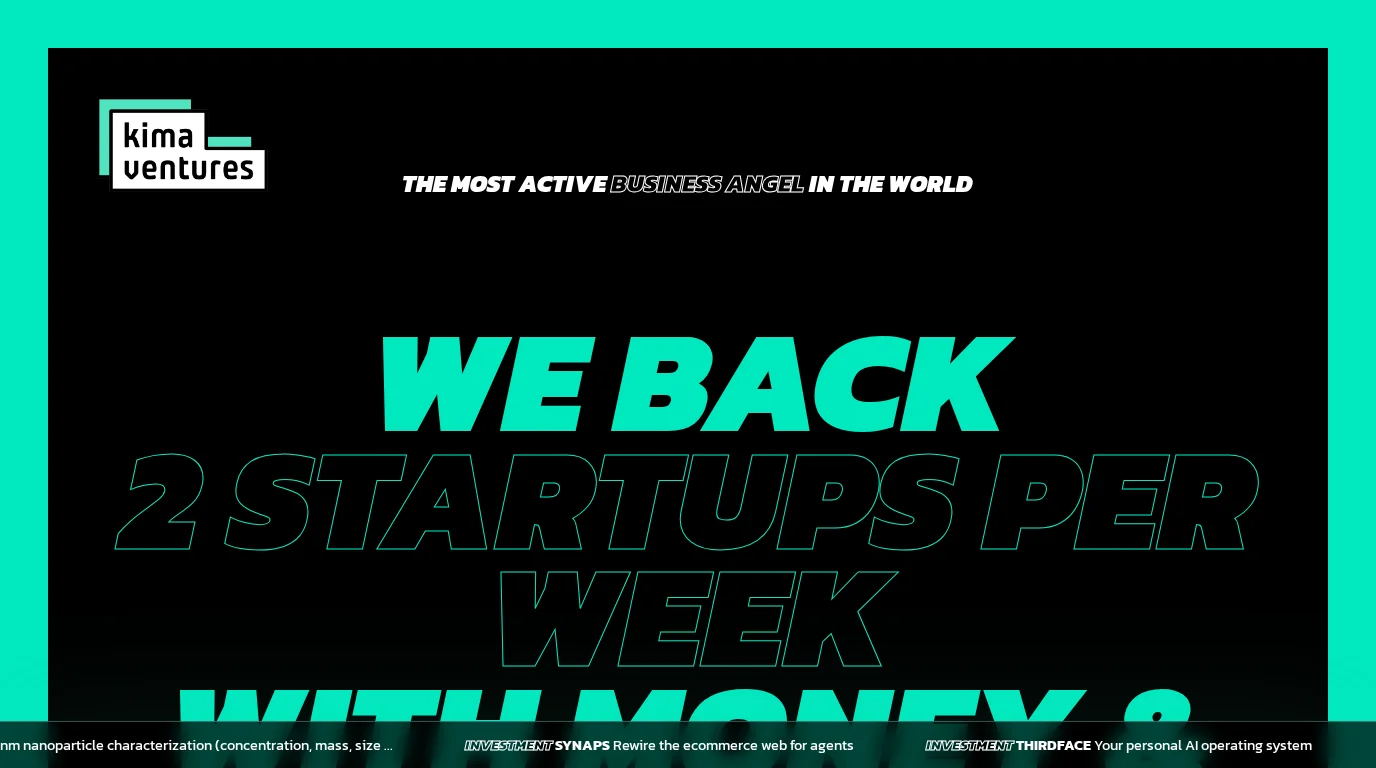 Screenshot of the kimaventures.com homepage (March 2026)
The story of Kima Ventures
Kima Ventures was born in 2010, at a pivotal moment for French tech. The Paris startup ecosystem was still in its infancy. Station F didn't exist. La French Tech was only a distant concept. Xavier Niel, already a billionaire thanks to Free and Iliad, decided to structure his personal investments in technology startups.
He co-founded Kima Ventures with Jérémie Berrebi, an entrepreneur and active business angel. The name "Kima" comes from Japanese: it means "precious." The founding idea was radical for its time: invest in a massive number of startups, with relatively modest tickets, at a decision speed traditional funds simply can't match.
An unconventional model from the start
Unlike classic funds that raise from institutional Limited Partners, Kima is a family office. The capital comes directly from Xavier Niel. No investment committee to win over, no four-month process, no 12 slides of formal due diligence. The conviction is simple: at this stage (pre-seed, seed), the team matters more than the metrics. And portfolio diversification offsets individual risk.
In 2015, Jean de La Rochebrochard joined Kima as Managing Partner. He took charge of the day-to-day management of investments and became the operational face of the fund. Under his leadership, the pace intensified further: Kima went from a few dozen to several hundred investments.
2020 and beyond: a machine at global scale
In 2024-2025, Kima passed 1,200 companies in its portfolio. The fund claims the title of most active VC in the world by number of early-stage deals, a title few dispute. The team stays deliberately small: 3 to 4 people manage a portfolio estimated at 750 million euros in value. An assets-per-person ratio unheard of in the industry.
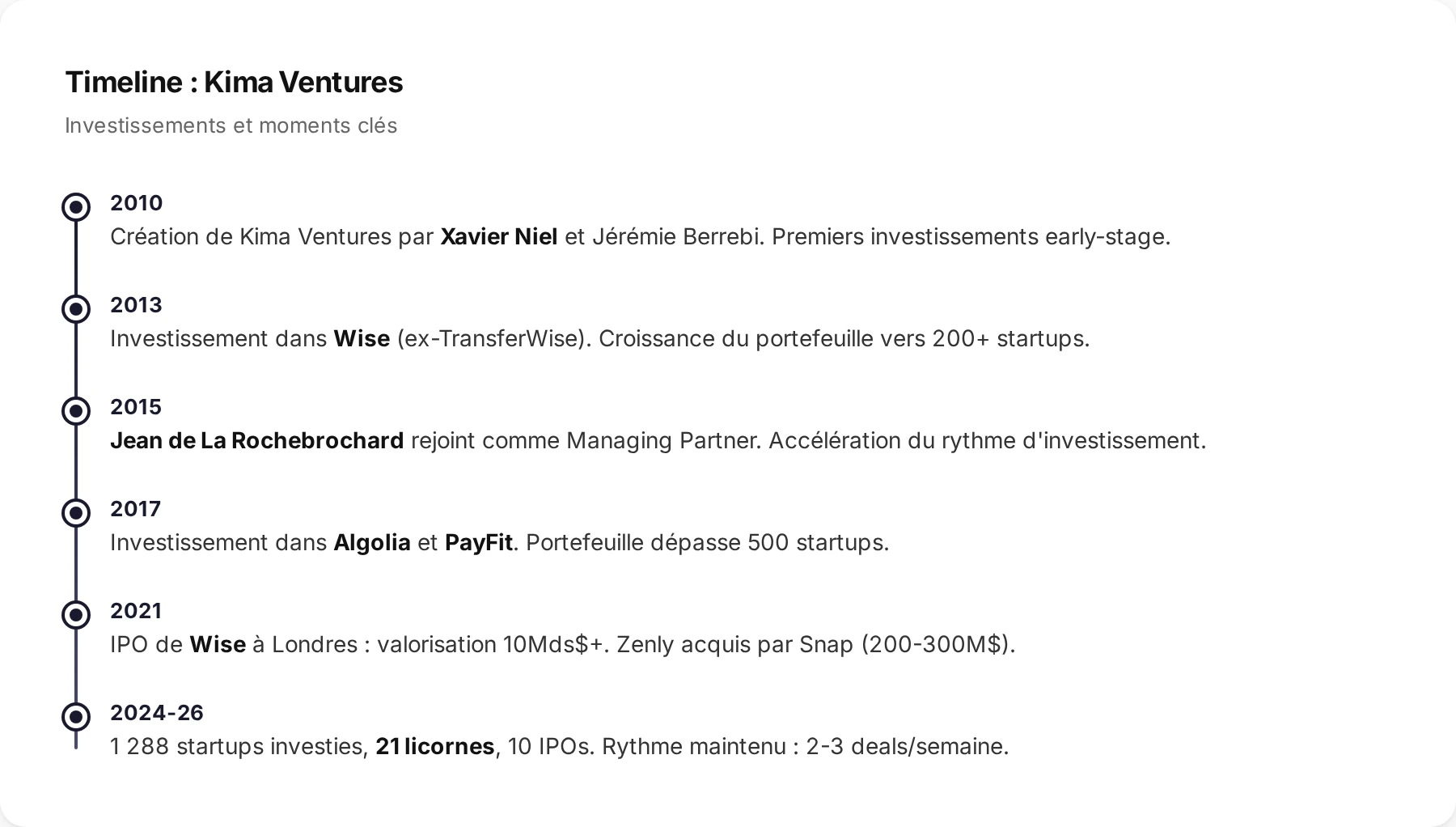 Timeline of Kima Ventures' investments and key moments
The founders and the team
Xavier Niel: the architect
Xavier Niel is France's 7th-largest fortune. Founder of Iliad (Free), creator of Station F (the world's largest startup campus), co-founder of the 42 school, and investor in Le Monde. He doesn't get involved in Kima's day-to-day decisions, but his reputation opens doors that money alone cannot. Being in Niel's portfolio means access to a network that spans tech to politics, media to real estate.
Jean de La Rochebrochard: the operational lead
A veteran of TheFamily (the accelerator founded by Alice Zagury and Oussama Ammar), Jean de La Rochebrochard joined Kima in 2015. He has been the Managing Partner ever since, responsible for sourcing, evaluation and the investment decision. His approach rests on speed and intuition: he meets hundreds of founders a year and makes decisions in a few days, sometimes a few hours.
The small team
Kima's permanent team is made up of 3 to 4 people: Alexis Robert, Felix de Breucker and Edouard Goût round out the roster. This minimal size is a deliberate choice: less process, less bureaucracy, more responsiveness. Each team member manages hundreds of relationships with portfolio companies.
Kima's investment thesis
Kima's thesis boils down to a single phrase: "Invest early, invest often, never reinvest."
Agnostic by conviction
Kima has no favorite sector. Tech, fintech, SaaS, biotech, marketplace, deeptech, consumer: everything is on the table, as long as the DNA is technological. This agnostic approach isn't indecision. It's a statistical conviction: at this stage, no one can predict which sector will produce the next unicorn. Maximum diversification is the best strategy.
The "one shot" model
Kima's most distinctive rule: a single check per startup. No follow-on, ever. If you raise a Series A later, Kima doesn't put more into the pot. This principle has a mathematical logic: rather than concentrating capital on the apparent "winners" (who aren't always the real winners), Kima maximizes the number of bets. Across 1,288 startups, a handful of massive successes (Wise, Algolia, PayFit) is enough to make the model work.
Ticket and pace
The standard ticket is around 150,000 euros per deal. It's fixed, predictable and non-negotiable. The annual budget runs at about 15 to 20 million euros, spread across roughly 100 investments a year, or 2 to 3 a week. Geographically, Kima invests worldwide: Europe, the United States, Asia, Africa. The only requirement is that the founder has global ambition.
Speed as a competitive edge
Where a classic fund takes 2 to 4 months between the first contact and the wire, Kima aims for 48 to 72 hours. This speed isn't recklessness: it's a structural advantage. At pre-seed, founders need speed, not 17 committee meetings. And for Kima, speed means seeing more deals, reacting faster, and never missing an opportunity through slowness.
The notable portfolio
With more than 1,288 companies backed, Kima's portfolio is enormous. Here are the most striking success stories:
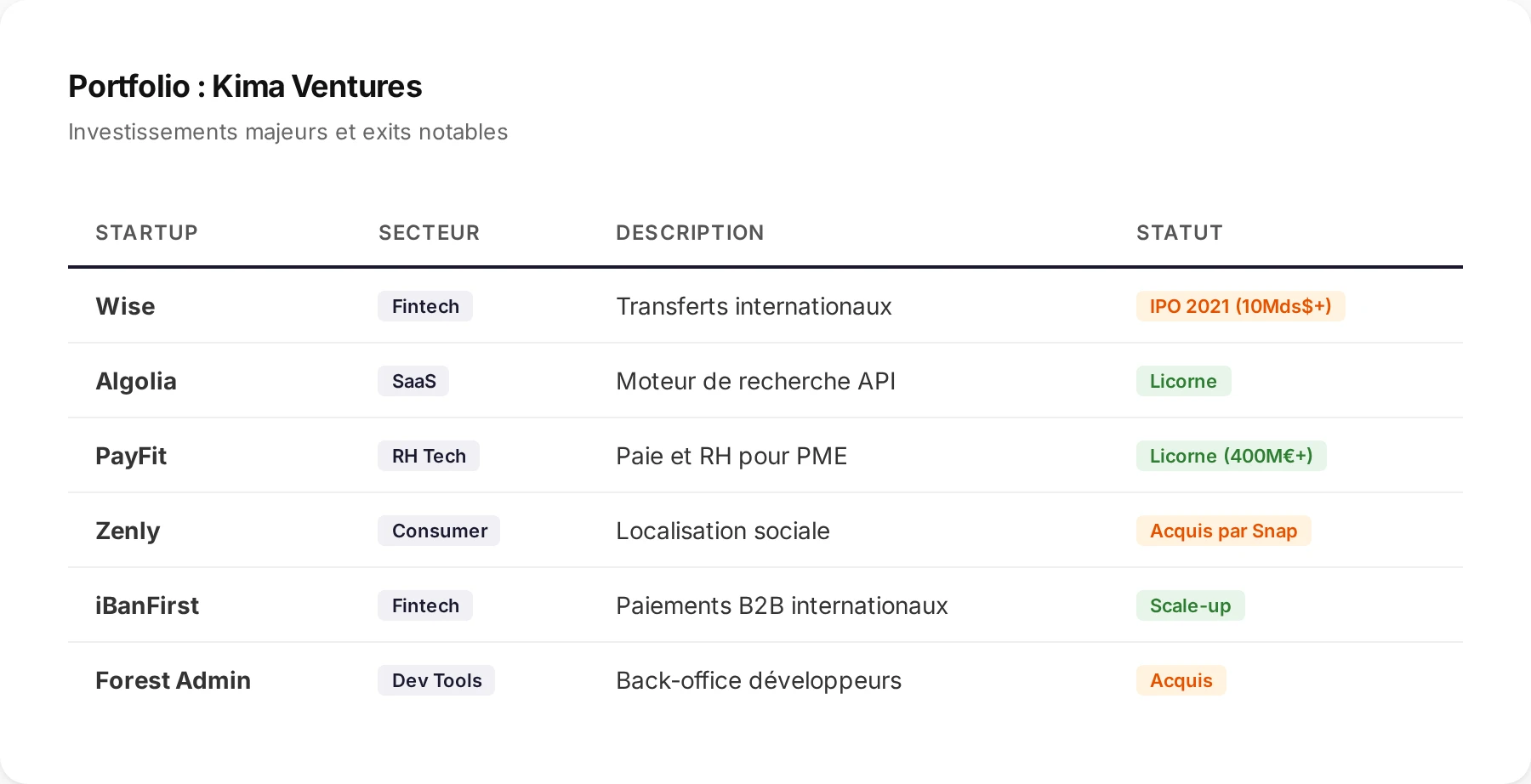 Kima Ventures' main investments and notable exits
Wise (formerly TransferWise): an international money transfer platform. IPO in London in 2021 at a valuation topping 10 billion dollars. One of the biggest European fintech successes.
Algolia: a SaaS search engine. A French unicorn used by more than 17,000 companies worldwide, including Stripe, Slack and Lacoste. Kima invested at the very beginning.
PayFit: payroll and HR software for SMEs. A French unicorn that has raised more than 400 million euros in total. One of the classic "first Kima check" use cases.
Zenly: a social location app. Acquired by Snap (Snapchat) for an estimated 200 to 300 million dollars.
iBanFirst: a B2B neobank specializing in international payments for businesses.
Forest Admin: a back-office tool for developers. Acquired and growing fast.
In total, Kima counts 21 unicorns, 10 IPOs and 183 acquisitions in its portfolio. Figures that very few funds in the world can claim.
Key figures
Here are Kima Ventures' essential metrics in 2026:
- Founded: 2010
- Headquarters: Paris
- Capital deployed: more than 200 million euros since inception
- Estimated portfolio value: around 750 million euros
- Number of startups backed: 1,288+
- Unicorns: 21
- IPOs: 10
- Acquisitions: 183
- Average ticket: ~150,000 euros (fixed)
- Pace: 2-3 investments per week (~100/year)
- Team size: 3-4 people
- Stage: Pre-Seed, Seed, Series A
- Geography: global
- Sector: agnostic (tech DNA required)
- Structure: family office (Xavier Niel's capital)
FAQ
What is Kima Ventures' average ticket?
Kima Ventures' standard ticket is around 150,000 euros per investment. This amount is fixed and doesn't vary by startup or sector. Kima invests exclusively in early-stage (pre-seed, seed, Series A).
How many startups has Kima Ventures funded?
As of March 2026, Kima Ventures has invested in more than 1,288 startups around the world. The fund keeps up a pace of 2 to 3 new investments a week, or about 100 a year.
Does Kima Ventures do follow-on?
No. Kima's core rule is "one shot": a single check per startup, never a reinvestment. If you raise a later round, Kima won't take part. This rule lets the fund maximize the number of startups in its portfolio rather than concentrate capital.
How do you contact Kima Ventures to pitch?
The most effective route is an introduction from a founder already in the Kima portfolio or from a recognized figure in the ecosystem (an accelerator, a business angel). Cold applications do happen but convert at a noticeably lower rate.
Who runs Kima Ventures day to day?
Jean de La Rochebrochard has been Kima Ventures' Managing Partner since 2015. He runs the fund's daily operations with a small team of 3 to 4 people. Xavier Niel remains the funder but doesn't get involved in individual investment decisions.