The 12 Best Startup Incubators and Accelerators in Paris (2026)
Paris, a Tuesday evening at Station F. Halle Freyssinet, 34,000 m², 1,000 resident startups. A SaaS founder wraps up a call with a Series A VC. Three floors up, a researcher out of Agoranov pitches her deeptech prototype to a corporate. Outside, the city hums, electric scooters cut through traffic, and 12,000 startups fight for oxygen. Paris is home to 66 accelerators and more than 250 support programs, from Station F (the world's largest startup campus) to Agoranov (deeptech since 2000, 540 companies created, with Doctolib and Alan on the list). With over 10,000 startups and an ecosystem that captures the bulk of French venture capital, the Paris incubation market is the largest in Europe. Which is exactly the problem: it's too large. This guide doesn't list 250 programs. It helps founders navigate the field in 2026: the must-know players, the specialist programs, and above all how to pick the right incubator for your profile.
The 12 programs that matter
Twelve programs cover almost everything a Paris founder needs. The table below ranks them by target stage, from research project to growth. Each one has a detailed profile further down.
| Program | Target stage | Focus | What it costs you |
|---|---|---|---|
| Agoranov | Research-based project | Deeptech, health, industry, digital | Free, 0% equity |
| Paris&Co | Idea to seed | 12 sector platforms, pilots with the City of Paris | Free, 0% equity, grants up to €30,000 |
| School incubators (HEC, ESSEC, Polytechnique, CentraleSupélec) | Idea to seed | Generalist, alumni network strength | Free for alumni, 0% equity |
| La Ruche | Idea to seed | Social innovation, hybrid models | Not disclosed |
| makesense | Idea to seed | Social and environmental impact | Not disclosed |
| swanbase | First product to first channels | Growth, marketing, acquisition, sector-agnostic | €0 up front, 2% equity contingent on traction |
| Station F | Idea to growth | 30+ hosted programs, including F/ai for AI | €195/month for a desk, 0% on in-house programs |
| Le Cargo | Idea to growth | Workspace, 15,000 m² in the 19th | Pricing not public |
| Hexa | Pre-incorporation | SaaS, fintech, web3, co-founded from scratch | €0, the studio holds a co-founder stake |
| Founders Future | Early stage | Fundraise prep, investor network | Variable stake |
| 50 Partners | Growth | IT and tech, mentoring by entrepreneurs | Not disclosed |
| WILCO | Post-product-market fit | Industry, Healthcare, Digital | €20,000 over 3 years, honor loan up to €150,000 |
Public programs and school incubators take no equity at all. Private programs make their money on your success. The "Costs and equity" section below covers how to weigh one against the other.
Paris, a global capital of incubation
Paris isn't just France's tech capital. It's one of the world's three incubation capitals, alongside San Francisco and London. And contrary to what you might assume, that density isn't saturation. It's a mature ecosystem with real specializations, distinct selection paths and varied business models. The problem isn't a lack of choice. It's too much of it.
The ecosystem in numbers (12,000+ startups, 250+ programs)
The Paris landscape in data:
- 12,000+ active startups in the Paris region, out of 15,000+ across France (source: plateya.fr, 2024-2025 data).
- 250+ incubators and accelerators in Île-de-France as of 2025 (source: Choose Paris Region).
- 66 accelerators based in Paris or Île-de-France, out of the 133 identified nationwide (source: magstartup.com).
- Station F: 1,000+ resident startups, 30+ partner programs, with the AI-focused F/ai program launched in 2025 (source: linkeat.club, Forbes France).
- Paris&Co: 400 startups supported per year, 12 sector innovation platforms, FPI label, grants up to €30,000 (source: parisandco.com, OECD).
- Agoranov: 540+ companies created, 20,000+ jobs, €6 billion raised, 7 IPOs (source: agoranov.com).
- European venture funding: $58 billion in 2025 (+9% year on year), with France taking a growing share (source: Forbes France).
Paris concentrates the money, the talent and the investors. But that density also creates noise. Two founders out of three have no idea which incubator to pick. That's understandable: the market is opaque, the positioning overlaps, and the websites all read the same.
66 accelerators in Paris: saturation or opportunity for founders?
At first glance, 66 accelerators reads like saturation. What that variety actually means is that every founder can find a program matched to their stage and sector. The risk sits elsewhere: the wrong program costs you twelve months.
A few markers to navigate by:
- Public programs (Paris&Co, Le Cargo): publicly funded, no equity, broad access
- School programs (HEC, ESSEC, Polytechnique): alumni network, usually free, access tied to your background
- Corporate programs (large-company programs inside Station F): market access, customer pilots, sometimes equity
- Private programs (WILCO, Hexa, 50 Partners, Founders Future): expert mentoring, often with investment
Each category answers a different need. The rest of this guide breaks them down.
The must-know incubators
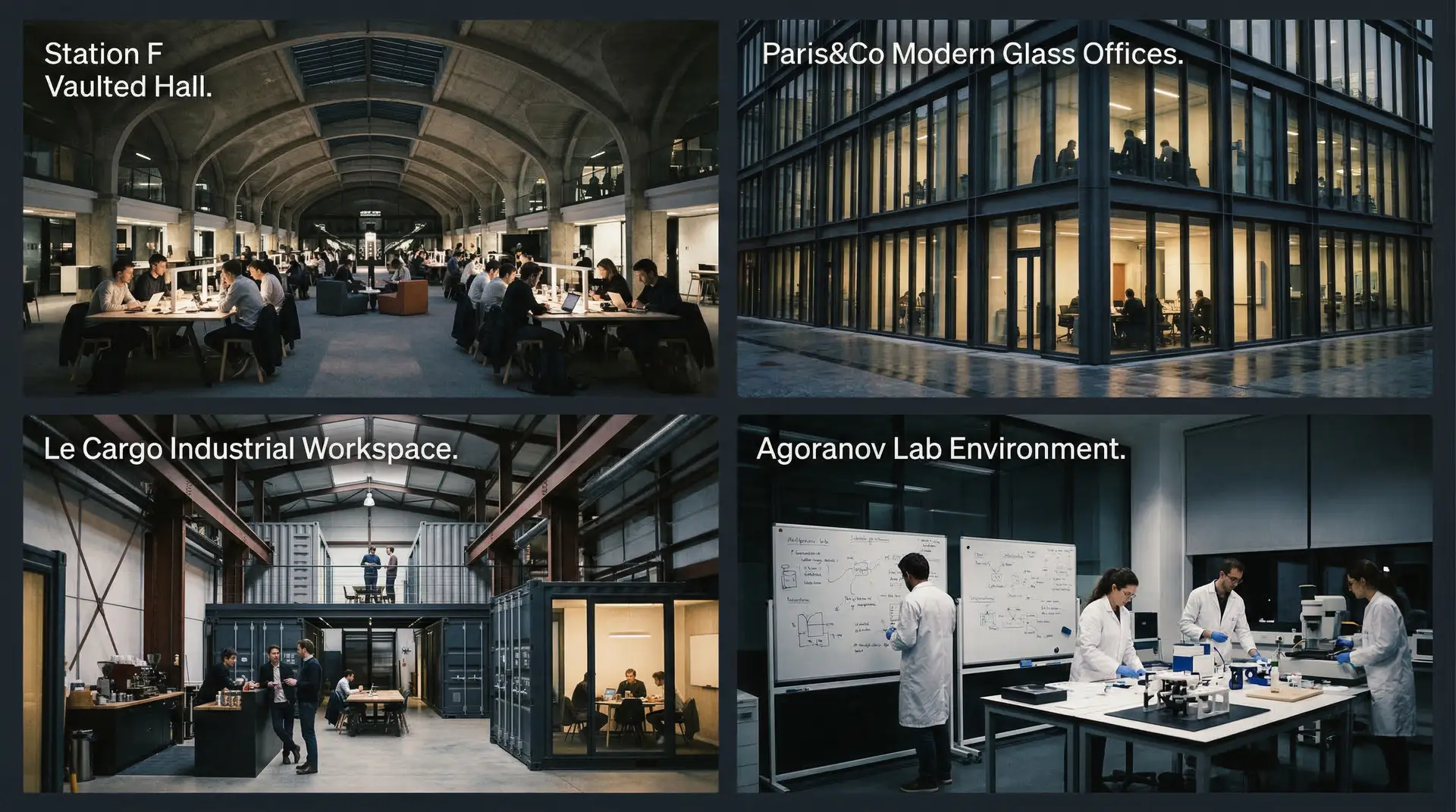
Four programs dominate the Paris landscape by size, longevity and track record. If you're new to the ecosystem, start here.
Station F (the world's largest startup campus, dozens of programs)
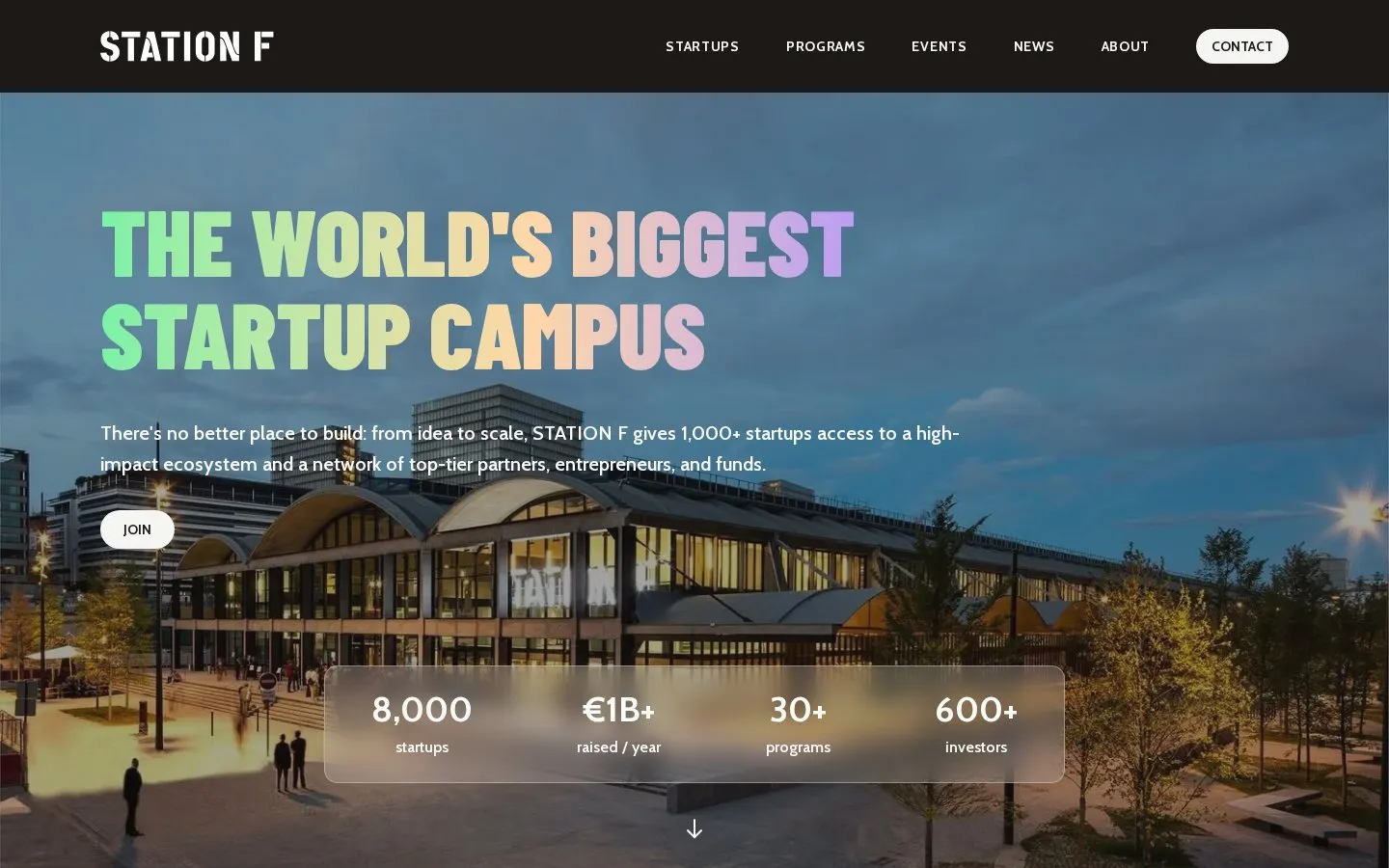
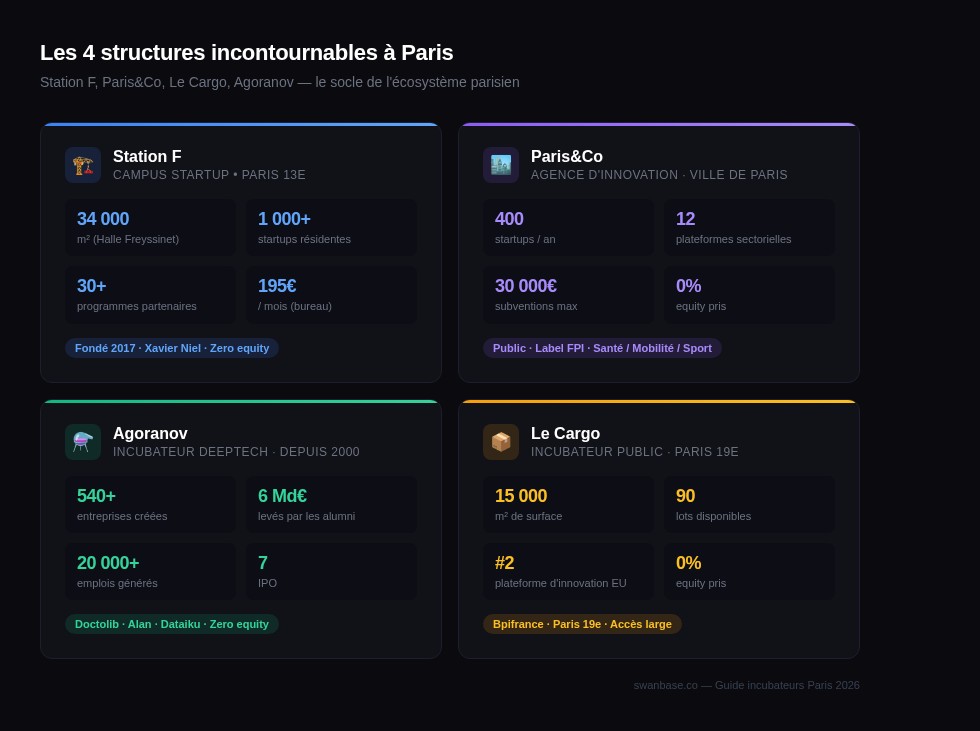
Station F is the largest startup campus in the world: 34,000 m² inside the Halle Freyssinet (13th arrondissement), 1,000+ resident startups, 30+ partner programs. Founded in 2017 by Xavier Niel, the campus runs in-house programs (Founders, Fighters) alongside programs operated by outside partners: Facebook, Microsoft, Ubisoft, HEC, L'Oréal, LVMH and many more (source: appwrite.io, linkeat.club).
By the numbers:
- 34,000 m² (Halle Freyssinet, Paris 13th)
- 1,000+ resident startups
- 30+ partner programs
- F/ai program launched on January 13, 2026: 20 startups per batch, 0% equity, selection by fund referral, no open application
- International programs: IndiaAI, KISED (Korea), emlyon at Station F
Who it's for: Station F hosts dozens of distinct programs, each with its own operator. You don't "apply to Station F" as such. You apply to a specific program hosted at Station F (Founders, Fighters, HEC, Facebook, and so on). Which program fits depends on your profile and your sector.
How to get into Station F: Find the program that matches your profile on stationf.co. Each one has its own criteria and its own calendar. The in-house programs (Founders, Fighters) are the most selective. Partner programs apply criteria specific to their sponsor. F/ai is the exception: Station F recruits there purely on referral from investment funds, and the second batch starts in September 2026.
Station F is the address. But the address alone isn't enough. The program you join is what makes the difference.
Paris&Co (12 sector platforms, 400 startups a year)
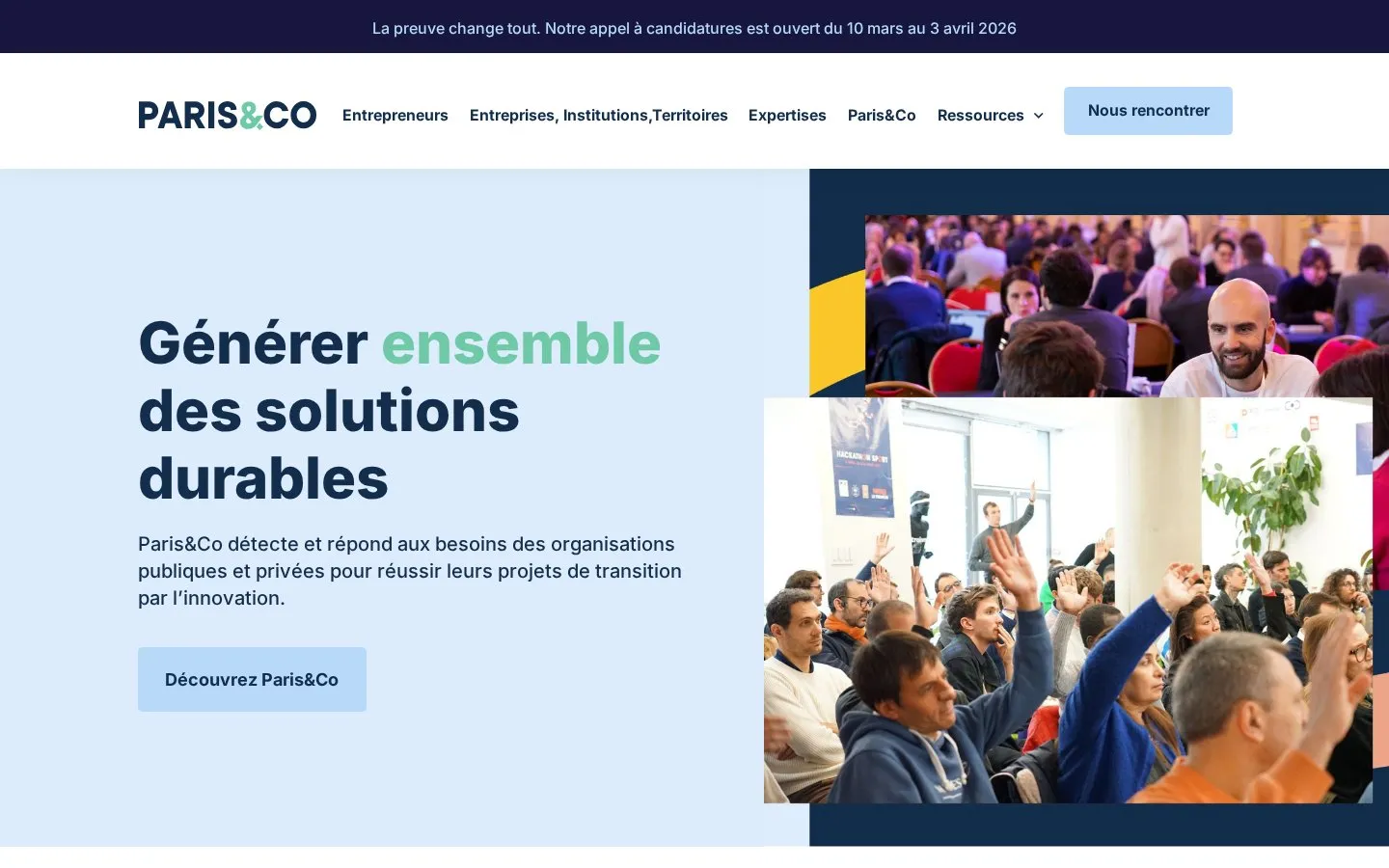
Paris&Co is the largest incubation network in Europe and the innovation agency of the City of Paris. It runs 12 sector innovation platforms and supports 400 startups a year through its incubation, experimentation and social innovation programs (source: parisandco.com, paris-hospitality.com, OECD).
By the numbers:
- 12 innovation platforms (sport, health, mobility, tourism, smart city and more)
- 400 startups supported per year (2024 figure)
- FPI label (France Pôle d'Innovation)
- Grants up to €30,000 (Bpifrance + City of Paris)
- Call for applications: regular sessions (e.g. March 10 to April 3, 2026)
Who it's for: Startups targeting a specific sector covered by one of the 12 platforms. Paris&Co is ideal if your startup works in sport, health, tourism, mobility or smart city. The upside: sharp sector-specific support, pilot programs with the City of Paris (testing your product in real conditions), and non-dilutive grants.
How to apply: Respond to the calls for applications on parisandco.com. Each platform runs its own sessions. Selection weighs innovation, market potential and fit with the target sector.
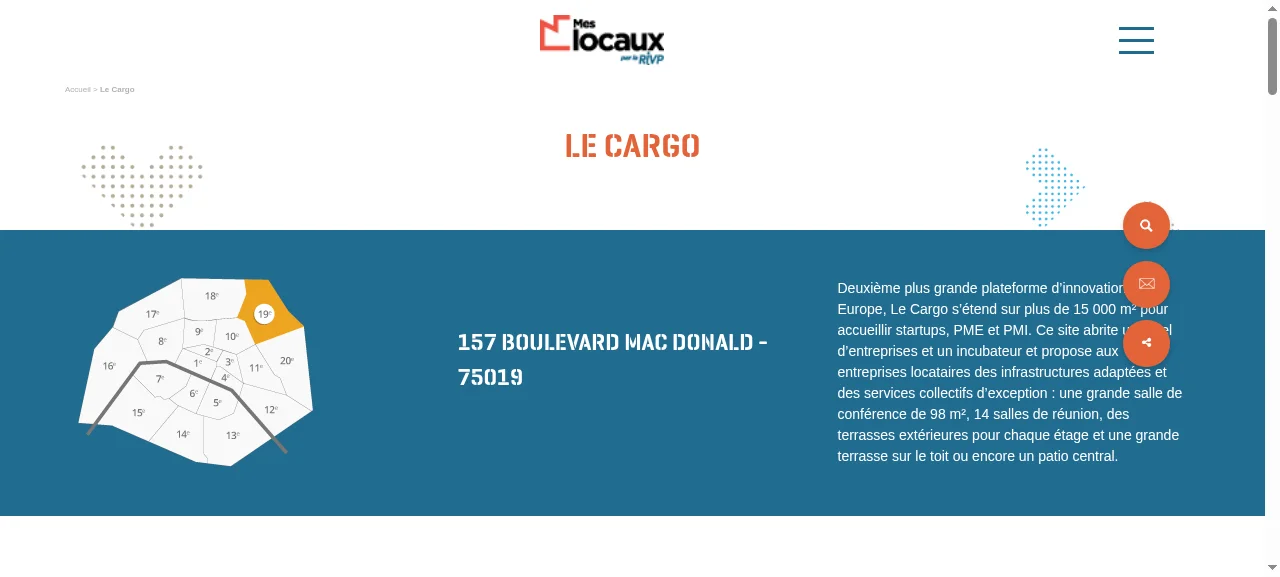
Le Cargo (15,000 m², the largest incubator in Île-de-France)
Le Cargo is the largest incubator in the capital, with 15,000 m² and 90 units at 157 boulevard MacDonald in the 19th arrondissement. Described as the "second-largest innovation hub in Europe" after Station F, Le Cargo brings together startups, nonprofits and innovation players in a vast, open space (source: Bpifrance, apollosportingclub.com).
By the numbers:
- 15,000 m² of space
- 90 units available
- Location: 157 bd MacDonald, Paris 19th
- Run with backing from Bpifrance and the City of Paris
Who it's for: Startups and innovation organizations that need physical space in Paris without paying city-center rents. Le Cargo often gets left out of these guides (everyone talks about Station F), but it offers competitive terms and a genuinely good place to work.
Agoranov (deeptech, science and technology since 2000)
Agoranov is the reference deeptech incubator in Paris. Founded in 2000, it's the oldest incubator in the Paris ecosystem and the one with the most impressive track record in France (source: agoranov.com, tool-advisor.fr, Région Île-de-France).
By the numbers:
- 540+ companies created since 2000
- 20,000+ jobs generated
- €6 billion raised by alumni
- 7 IPOs
- Notable alumni: Doctolib, Alan, Dataiku
- 3 verticals: Industry & Greentech, Digital, Health
- 30 to 40 startups incubated per year
- New site: 3,900 m² at Sorbonne University's Cité de l'Innovation (100 startups)
Who it's for: Deeptech founders coming out of research (CNRS, INSERM, universities, grandes écoles). Agoranov is the obvious route if your startup rests on IP developed in a lab. The team understands deeptech's long cycles, the realities of tech transfer and the specific funding needs involved (French Tech Seed, EIC Accelerator).
Doctolib, Alan and Dataiku all went through Agoranov. Three unicorns, one incubator. That's not a coincidence.
The tech and business accelerators
Beyond the household names, Paris hosts scale-oriented accelerators aimed at startups with a live product and early revenue.
WILCO (generalist, powerful network)
WILCO (formerly Scientipôle) is one of the most active accelerators in France: founded in 2001, it has accelerated 1,500+ startups since 2012, 100 a year, with alumni raising €300 million annually. The WILCO One program runs 3 years and costs €20,000, of which €6,000 is paid before onboarding, with an honor loan of up to €150,000 available (source: wilco-ambitions.com, WILCO LinkedIn).
By the numbers:
- 1,500+ startups accelerated since 2012
- 100 startups accelerated per year
- €300 million raised per year by alumni
- Program: 3 years, €20,000, of which €6,000 before onboarding
- Honor loan: up to €150,000
- 3 sectors: Industry, Healthcare, Digital
- Backed by: Région Île-de-France, Caisse des Dépôts, AXA, EDF, Air Liquide
Who it's for: Post-product-market-fit tech startups that want long-horizon support (3 years) with non-dilutive funding (the honor loan). WILCO suits founders who value depth over speed. Three years is enough time to build something solid.
Hexa / eFounders (startup studio for SaaS, fintech, web3)
Hexa (formerly eFounders) is the most prolific startup studio in France. Founded in 2011, it co-builds SaaS startups from the idea up: hiring the CEO, building the product, landing the first customers. Aircall and Swan both came out of it (source: TechCrunch).
The model:
- Type: Startup studio (co-creation, not support)
- Sectors: SaaS, fintech, web3, B2B tools
- Founded: 2011
- Notable alumni: Aircall (valued at $1B+), Swan, Spendesk, Yousign
Who it's for: Hexa isn't a conventional incubator. You don't apply with your idea. Hexa generates the ideas and recruits CEOs to execute them. If you're an experienced operator (ex-founder, ex-VP) looking for a validated SaaS project to run, Hexa is a genuinely unusual option. The model is demanding: you're a co-founder, but you're executing the studio's vision.
50 Partners (IT accelerator, mentoring, funding, central Paris)
50 Partners is a Paris accelerator founded in 2012, specialized in IT and tech startups. It combines mentoring from experienced entrepreneurs, funding and access to a network of business partners in central Paris (source: basetemplates.com).
Who it's for: Growth-stage IT startups looking for hands-on mentoring. 50 Partners bets on mentor quality rather than volume: each startup gets tailored support from entrepreneurs who have already succeeded (or failed, which is often more instructive).
Founders Future (early stage, investor network)
Founders Future is an early-stage accelerator founded in 2018, specialized in funding and investor introductions (source: basetemplates.com).
Who it's for: Early-stage startups looking for a first round. Founders Future is fundraising-oriented: the program gets founders ready to raise and connects them directly to the right investors.
swanbase (growth and acquisition, open-ended support)
swanbase works with early-stage founders on growth, marketing and acquisition, out of 180 m² in the 2nd arrondissement. The way in is the Piscine, a live trial period open all year round. swanbase publishes this guide: you're reading the profile of its author, filled in against the same grid as the other eleven programs.
The model:
- Location: Paris 2nd
- Stage: from first product to first acquisition channels
- Sectors: e-commerce and DNVB, SaaS, marketplaces, AI, fintech, health, climate, deeptech
- What it costs you: €0 up front, 2% equity contingent on traction
- Duration: no batches, no cohorts, support continues as long as it's useful
- Application: 3 fields, 800 characters, then a 20-minute video call, any time of year
Who it's for: Founders with a product who are hunting for their first acquisition channels. The program includes unlimited 1:1 office hours with Vincent and Théo, talks and workshops, free access to paid swanbase events, and intros to VCs, partners and first customers. During the Piscine, your traction decides what comes next: keep delivering and you keep your place. The full details of the deal and the process are on the Apply page.
The specialist programs
The real strength of Paris is the depth of the offering. Beyond the generalists, some programs target specific sectors or specific founder profiles.
Agoranov / SATT (deeptech, technology transfer)
Agoranov, covered above, is the anchor of the Paris deeptech ecosystem. It works alongside the SATTs (technology transfer acceleration companies) to turn scientific discoveries into companies. The new 3,900 m² site at Sorbonne University's Cité de l'Innovation, designed to host 100 startups, marks a significant step up in scale (source: Région Île-de-France).
La Ruche (social innovation, impact)
La Ruche is an incubator dedicated to social innovation and impact entrepreneurship. Founded in Paris, it supports projects that address social or environmental problems with a viable business model.
Who it's for: Impact founders who want support specialized in social innovation. La Ruche understands hybrid models (nonprofit/company), impact measurement and social-economy funding.
makesense (social and environmental impact, multiple cities)
makesense is an international impact entrepreneurship movement, present in Paris and several other cities. It supports social entrepreneurs with training, mentoring and networking programs.
Who it's for: Social entrepreneurs and impact founders who want a committed community and an international network. makesense is less a structured incubator than a support ecosystem.
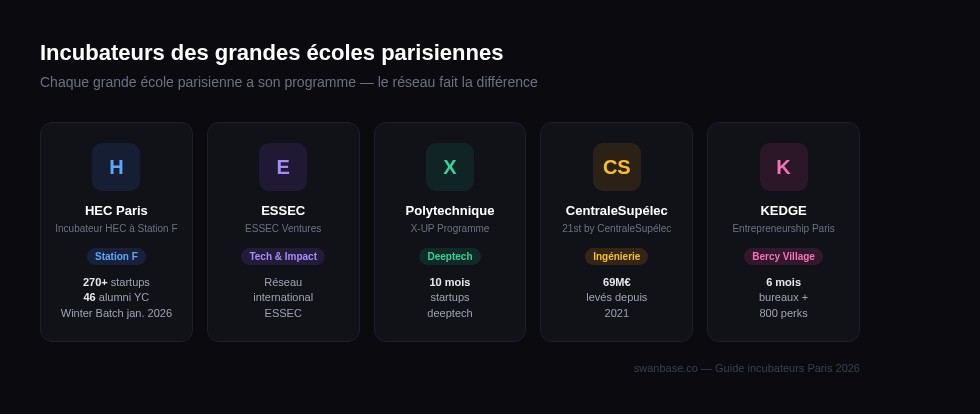
School incubators (HEC, ESSEC, Polytechnique, CentraleSupélec)
Paris is home to France's top grandes écoles, and each one has its incubator:
- HEC Paris Incubator: 270+ alumni startups, 1,000+ experts, based at Station F. A 13-startup batch in January 2026 (Winter Batch). 46 alumni accepted into Y Combinator over 20 years, a French record. Runs the X-HEC Entrepreneurs and Startup Launchpad programs (source: hec.edu).
- ESSEC Ventures: tech and impact startups, international ESSEC network.
- X-UP (Polytechnique): a 10-month program for deeptech startups (source: ensta.fr).
- 21st by CentraleSupélec: €69 million raised by its startups since 2021 (source: centralesupelec.fr).
- KEDGE Entrepreneurship Paris: a 6-month program at Bercy Village, offices + coaching + 800 perks (source: entrepreneurship.kedge.edu).
Who it's for: Alumni and students of the respective schools. The programs all look alike. The advantage is the network: HEC's opens doors that Polytechnique's doesn't, and vice versa. Pick your own school's incubator. If you're not an alum, apply anyway: most of them accept outside profiles (HEC at Station F especially).
How to choose among 250+ programs in Paris
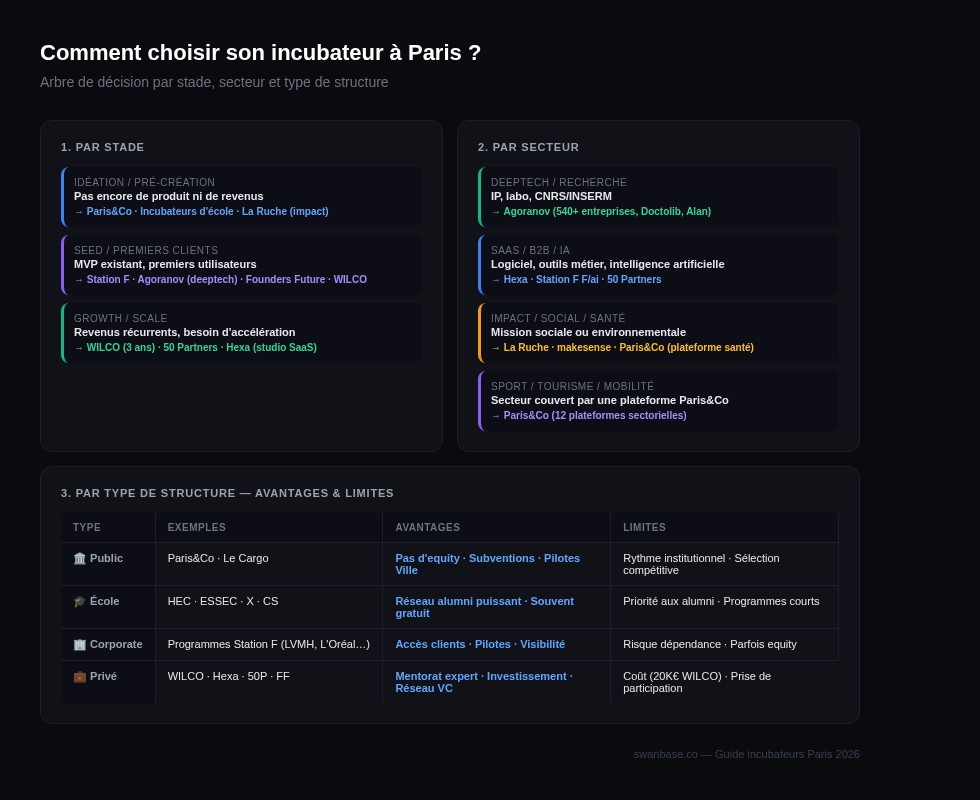
Every Paris founder ends up asking this. With 250+ options, the choice is paralyzing. Here's a decision tree that cuts through it.
By stage (ideation → seed → growth)
Ideation / pre-incorporation:
- Paris&Co (sector platforms, grants)
- School incubators (if you're an alum)
- La Ruche / makesense (if impact)
Seed / first customers:
- Station F (whichever program fits your profile)
- Agoranov (if deeptech/research)
- WILCO (3-year program, honor loan)
- Founders Future (fundraise prep)
Growth / scale:
- WILCO (long-term support)
- 50 Partners (hands-on mentoring)
- Hexa (if SaaS startup studio)
By sector (deeptech, SaaS, impact, fintech, health)
- Deeptech / research: Agoranov (540+ companies, Doctolib, Alan)
- SaaS / B2B: Hexa (startup studio), 50 Partners, Station F (Founders)
- Impact / social: La Ruche, makesense, Paris&Co (impact platforms)
- Health: Paris&Co (health platform), Agoranov (health vertical)
- Fintech: Hexa, Station F (fintech programs)
- Sport / tourism / mobility: Paris&Co (dedicated platforms)
- AI: Station F (F/ai program, zero equity)
By type (public, school, corporate, private): upsides and limits
Public programs (Paris&Co, Le Cargo):
- Upsides: no equity, grants, access to the City of Paris
- Limits: bureaucratic selection process, institutional pace
School incubators (HEC, X, ESSEC):
- Upsides: powerful alumni network, often free, Station F
- Limits: conditional access (alumni first), short programs
Corporate programs (inside Station F or standalone):
- Upsides: customer access, pilots, visibility
- Limits: risk of depending on the sponsor, sometimes equity or exclusivity
Private programs (WILCO, Hexa, 50 Partners, Founders Future):
- Upsides: expert mentoring, investment, investor network
- Limits: cost (WILCO: €20K), sometimes an equity stake
Costs and equity: what you need to know
The business models vary widely:
- Free, no equity: Paris&Co, Le Cargo, school incubators, Station F (in-house Founders/Fighters programs: €195/month for a desk)
- Paid, no equity: WILCO (€20,000 over 3 years)
- With equity: Hexa (startup studio, co-founder stake), Founders Future (variable), swanbase (2% contingent on traction, €0 up front), some corporate programs
- With investment: WILCO (honor loan up to €150K), Founders Future
Always weigh the percentage asked against two things: what you get in return, and how long you keep getting it. 2% for support that runs for several years is defensible. 8% for twelve weeks of programming, much less so. Above 5 to 8% for a program shorter than 12 months, negotiate or walk away.
Two models coexist in Paris, and the first isn't inherently better than the second. Public programs and school incubators (Station F, Paris&Co, Agoranov) fund themselves through subsidies, rent or the alumni network, so they take no stake. Private programs make their money on your success, which aligns their interests with yours. In that case, look at two details: does the equity trigger on day one or only if you take off, and can you leave without owing anything.
FAQ
What are the best incubators in Paris?
The comparison table at the top of this page ranks all 12 programs by target stage. The four must-know names are Station F (1,000+ startups, 30+ programs), Paris&Co (400 startups a year, 12 platforms), Agoranov (540+ companies, Doctolib, Alan, Dataiku) and Le Cargo (15,000 m²). On the acceleration side, WILCO (1,500+ startups, €150K honor loan) and Hexa (SaaS startup studio, Aircall, Swan) lead the field. The "best" one depends on your profile: Agoranov for deeptech, Paris&Co for sector pilots, Station F for the address and the network.
How do you get into Station F?
You don't apply "to Station F" but to one of the 30+ programs hosted on campus. The in-house programs (Founders, Fighters) take applications on stationf.co. Partner programs (HEC, Facebook, LVMH and others) run their own application processes. Identify the program that matches your profile and sector, then follow that program's specific process. The F/ai program, launched in January 2026, is the exception: Station F selects 20 AI startups per batch on referral from funds, with no open application. The second batch starts in September 2026.
How much does an incubator cost in Paris?
Prices range from free to €20,000. Station F: around €195/month for a desk (in-house programs). Paris&Co: free, with grants of up to €30,000 available. Agoranov: free (public incubator). WILCO: €20,000 over 3 years, with an honor loan of up to €150,000 available. School incubators: generally free for alumni. Most public and school programs take no equity. Private programs and startup studios take a variable stake.
Which incubators in Paris are free?
Several Paris incubators are free and take no equity: Paris&Co (with grants on top), Agoranov (deeptech), Le Cargo (workspace), and most school incubators (HEC, ESSEC, Polytechnique, CentraleSupélec). Station F offers very accessible pricing (€195/month for a desk). Corporate programs inside Station F are often free for the startups they select. See our national guide to incubators and accelerators for an overview of the different business models.
How do you choose between an incubator and an accelerator?
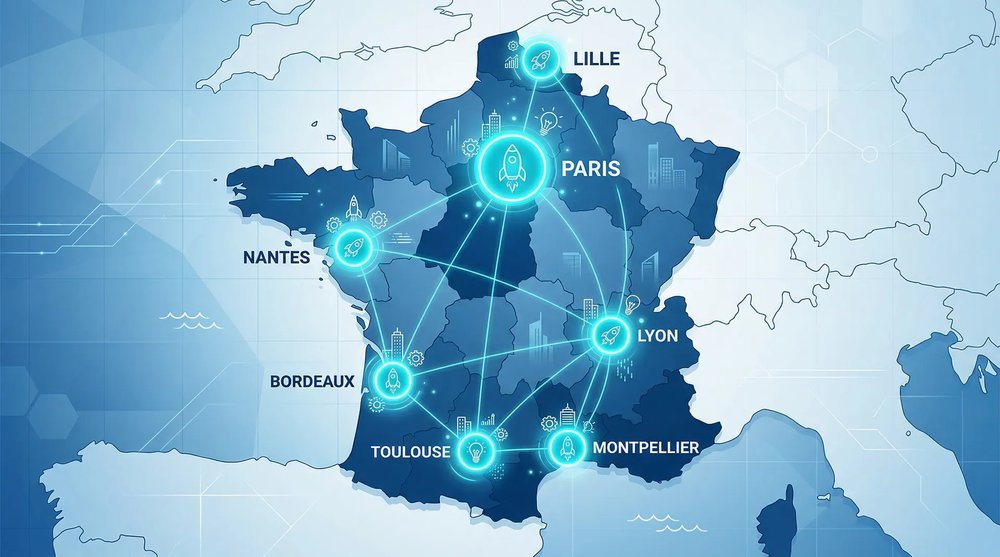
An incubator (Paris&Co, Agoranov, school incubators) supports projects from the idea stage. An accelerator (WILCO, 50 Partners, Founders Future) targets startups with a product and revenue in order to accelerate growth. A startup studio (Hexa) co-builds the company from zero. In Paris, the choice mostly comes down to your stage: idea → incubator, product → accelerator, no idea but a drive to build → startup studio. For a detailed guide to the selection criteria, see our guide to choosing an accelerator. To compare Paris with regional ecosystems, browse our city guides too: Lyon, Bordeaux, Toulouse, Nantes, Marseille, Lille.