How do you get into Station F? The short answer: you never apply to the campus itself. You apply to one of its programs. There's no office request form, no general waitlist, and no single front desk. Instead, there are around forty programs listed on the official programs page, split into three families: programs run by Station F itself, programs run by corporate partners on campus, and school incubators hosted there. Each one has its own eligibility criteria, cost per desk per month, duration and timeline. Picking the right program matters more than polishing your application, because most rejections come from applying to the wrong one. This guide covers the actual criteria, the costs, the timeline, and what to do if the answer is no.
How to get into Station F: the short answer
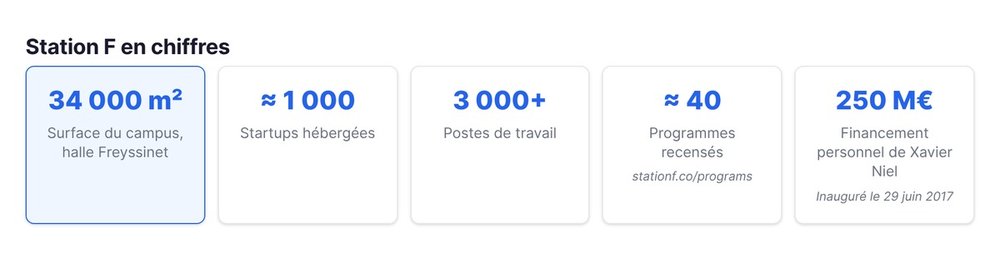
Station F is a 34,000-square-meter campus that opened on June 29, 2017, and it hosts hundreds of startups. At that scale, people picture a building with one front door. In reality, it's a collection of independent programs sharing a roof.
The three ways in
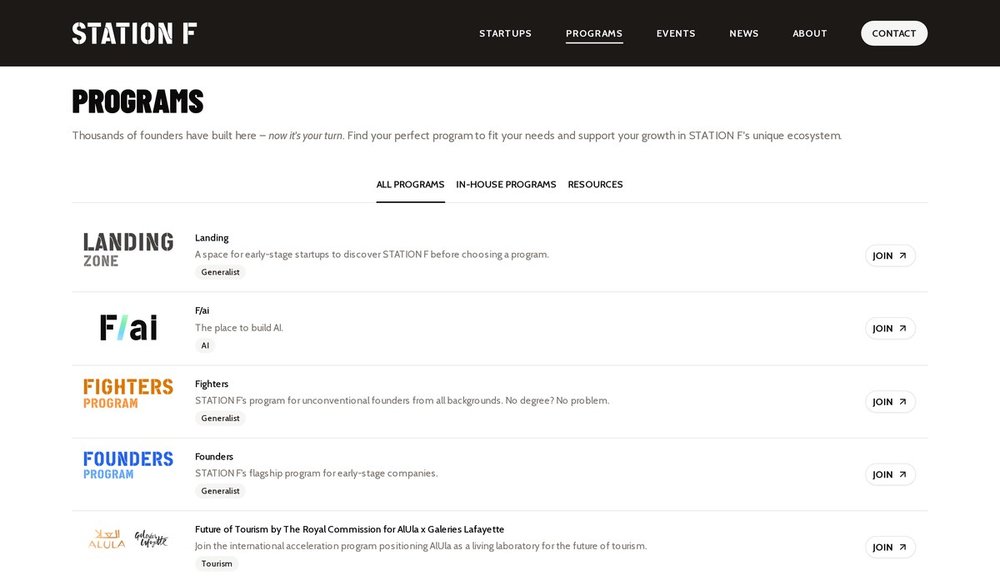
In-house programs. Station F runs these directly. They include the Founders Program, billed as the flagship program for early-stage companies; the Fighters Program, built for founders from underrepresented backgrounds; F/ai, dedicated to artificial intelligence; and Landing, a space for very early-stage startups that want to get to know the campus before choosing a program.
Partner programs. Companies set up their own programs on campus and run their own selection. Microsoft runs a GenAI accelerator there, Meta runs an open-source AI program with Hugging Face, LVMH runs La Maison des Startups, and the list goes on with L'Oréal, Cisco, Sanofi, Thales, BNP Paribas, Huawei, Cegid, PSG and Lab Quantique. Each program sets its own criteria, timeline and pricing.
School incubators. HEC, EDHEC, ESSEC, emlyon, CentraleSupélec, INSEAD, Télécom Paris, Ponts et Chaussées, the 42 incubator and Université Paris 1 Panthéon-Sorbonne all have a presence on campus. Here, eligibility depends on your connection to the school, and Station F plays no role in it.
There's also a fourth, less common route: programs that host foreign delegations, such as India AI, KOSME for South Korea, or UM6P. They're designed for startups already established abroad that want a European beachhead.
What every application has in common
Joining Station F means applying as a team with a defined project. You're applying with what you're building, and the form focuses on exactly that. Looking for a desk on your own won't get you in.
In-house programs require a full-time commitment. A weekend side project won't make the cut.
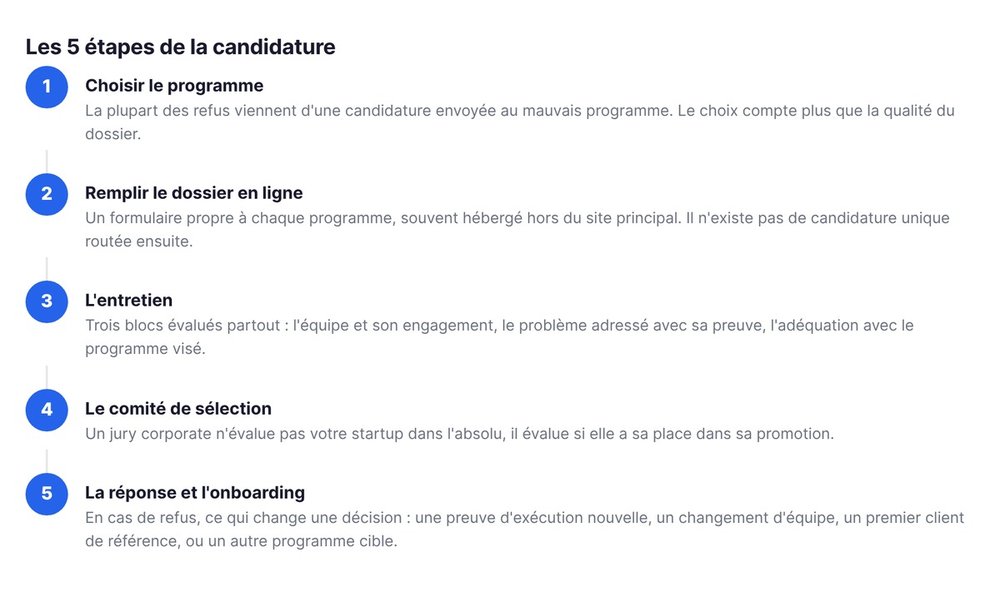
Applications go through an online form specific to each program, often hosted outside the main website. There's no single application that gets routed to the right program afterward: it's up to you to pick the door before you knock.
The annual timeline
In-house programs run in seasons, with application windows announced on the official website several weeks before the deadlines. Partner programs each follow their own rhythm, often tied to the operating company's calendar.
Rather than hunting for a fixed date that doesn't exist, use this method: identify the two or three programs you're genuinely eligible for, open their official pages, and write down the dates as you read them. Any article that quotes a deadline is out of date by the following season.
Station F programs: a decision table
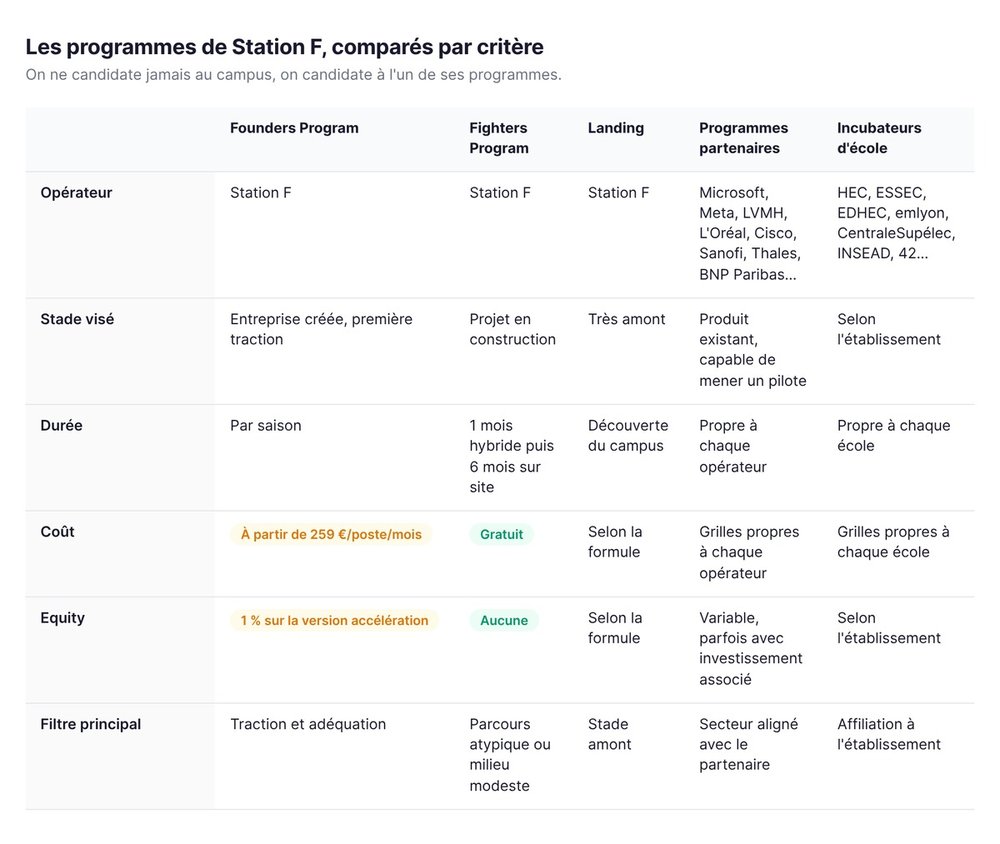
Here are the Station F programs compared by criteria, rather than simply listed.
The Founders Program
The flagship program, built for early-stage companies. It changed in October 2022, when it switched to an acceleration format that comes with a 1% equity stake. Pricing starts at €259 per desk per month.
This is the program to aim for if you have an incorporated company, early traction, a full-time team, and the budget to pay for desks.
Applicants often miss what this shift means. Before, the program took in projects that were still taking shape. Now the bar is growth: you need something to accelerate. A strong idea with no users no longer qualifies.
The 1% stake turns this from a simple cash-flow decision into a line on your cap table, one that will show up in your next rounds. The amount is small, but an investor will ask why it's there.
The Fighters Program
The opposite of the Founders Program, and the most misunderstood program on campus: it's free, takes no equity, and is reserved for founders from low-income or underrepresented backgrounds. The official message is clear: degrees play no part in the criteria.
It runs in two stages. First, a one-month hybrid round focused on the project's fundamentals. Then a six-month round, full-time on campus, to build a usable product.
If you're eligible, it offers the best value on campus for what it costs you. If you aren't, don't apply "just to see": eligibility is based on your background.
Partner-run programs
Dozens of programs are run by companies and institutions, and they follow a different logic: the partner is looking for startups that advance its own agenda.
That changes how you apply. With a corporate partner, an application that explains how your product fits their priorities carries more weight than one that describes a market. Pricing and terms are set by each operator and aren't centralized on the campus website.
The sector breakdown reads like a map. AI has the most programs: Microsoft, Meta with Hugging Face, Cisco, and the in-house F/ai program. Healthcare is covered by Sanofi and by a program that brings together Doctolib, Hôtel-Dieu and Roche. Luxury and beauty by LVMH and L'Oréal. Cybersecurity by Thales. Fintech by BNP Paribas. Climate by Marble. Quantum by Lab Quantique.
If your sector is on the list, go for that program rather than the Founders Program: narrower criteria, less competition, and the partner's commercial interest working in your favor. If it isn't, don't force a fit. It shows.
School incubators on campus
If you're a student or graduate of HEC, EDHEC, ESSEC, emlyon, CentraleSupélec, INSEAD, Télécom Paris, Ponts, 42 or Paris 1, you have a way in that others don't. Your affiliation becomes the main filter, and the school handles selection.
This is the most underused route among people who left school years ago. Check your school's alumni policy before applying anywhere else.
How to choose: eligibility, cost, duration, deadline
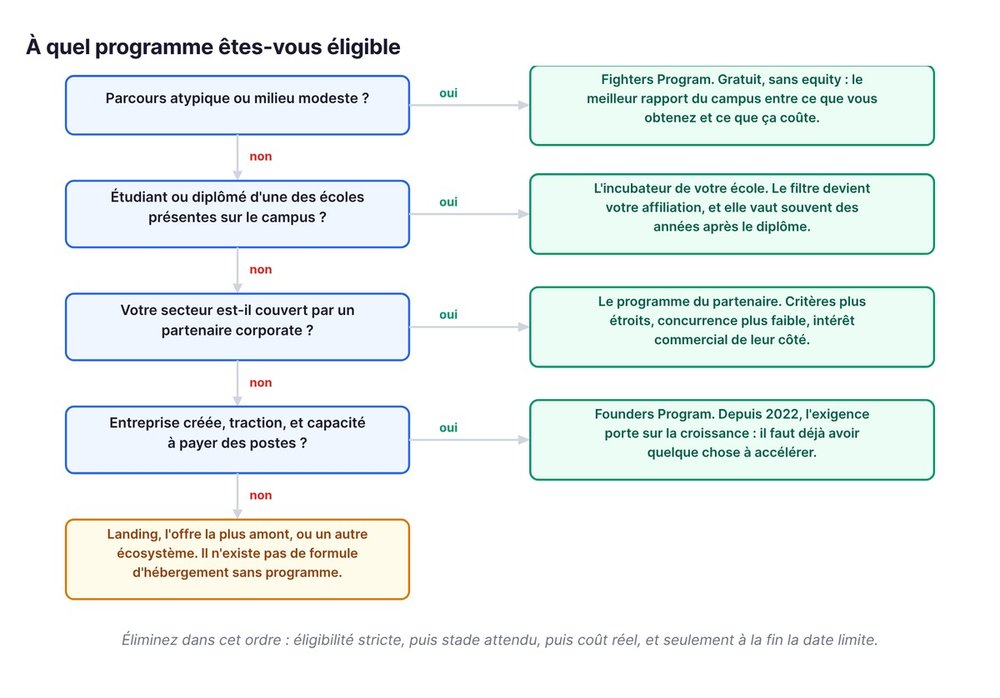
Narrow it down in this order.
Start with strict eligibility: background for Fighters, affiliation for school incubators, sector for corporate programs. Most programs drop out at this stage.
Next, the expected stage. An acceleration program won't take a project without an incorporated company, and an early-stage program has nothing to offer a startup that's already generating revenue.
Then the real cost: desks multiplied by duration, plus equity where applicable.
Only then, the deadline. If you start with the calendar, you'll end up applying to whichever program opens first.
The real selection criteria
That leaves the central question: what gets an application accepted?
The three areas assessed in your application
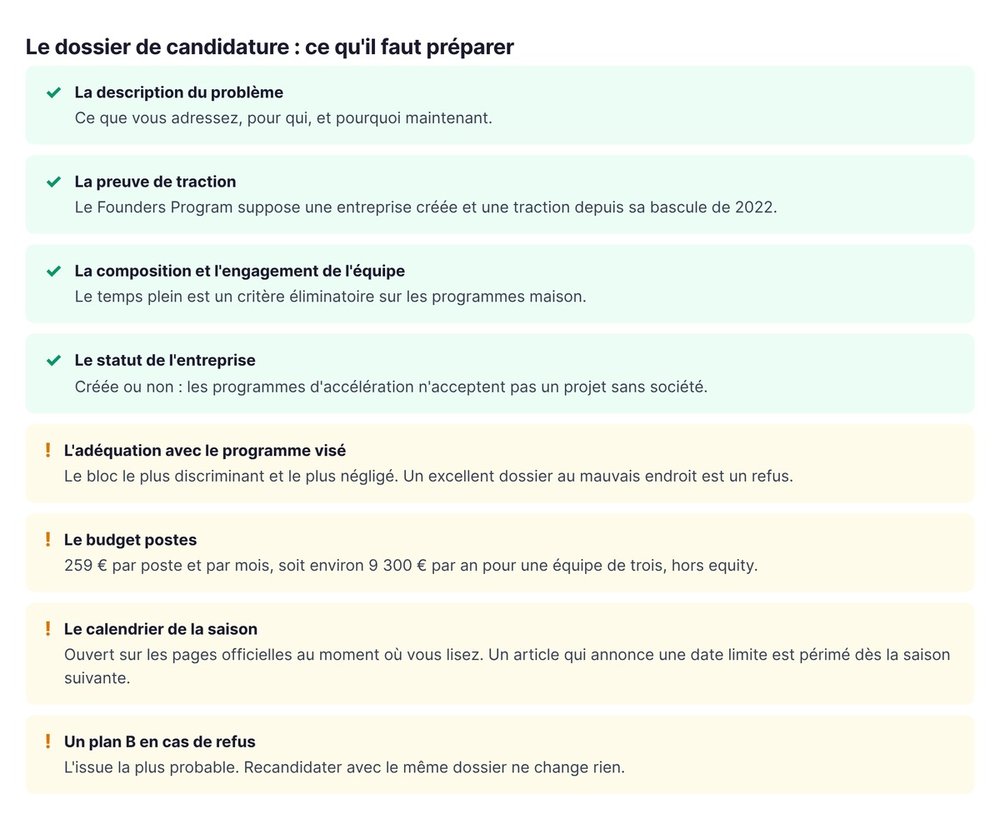
Three areas come up across in-house program forms: the team and its commitment, the problem you're tackling with evidence to back it up, and your fit with the chosen program.
The third is the most decisive and the most neglected. A corporate jury doesn't assess your startup in the abstract; it assesses whether you belong in its cohort. A great application sent to the wrong place gets rejected.
The expected stage by program
Landing welcomes very early-stage projects. Fighters starts with projects under construction, with a fundamentals round before the product round. The Founders Program expects an incorporated company with traction. Corporate programs target startups capable of running a pilot with a large enterprise, which means a product that already exists.
The most common application mistakes
- Applying "to Station F" instead of a specific program: that message has no recipient.
- Sending the same application to five programs: the fit section decides the outcome, and it can't be generic.
- Underestimating the full-time requirement: for in-house programs, it's still a dealbreaker.
- Confusing hosting with funding: a desk at Station F doesn't fund your startup. It costs you money every month.
Desk pricing and what it covers
This is the first question founders ask when comparing Station F with a regular office or a regional accelerator.
Monthly cost per desk
The Founders Program starts at €259 per desk per month. For a team of three, that's about €777 a month, or close to €9,300 over a one-year program, not counting equity.
The Fighters Program is free. Partner programs and school incubators set their own pricing, so check with each operator.
What the monthly fee covers
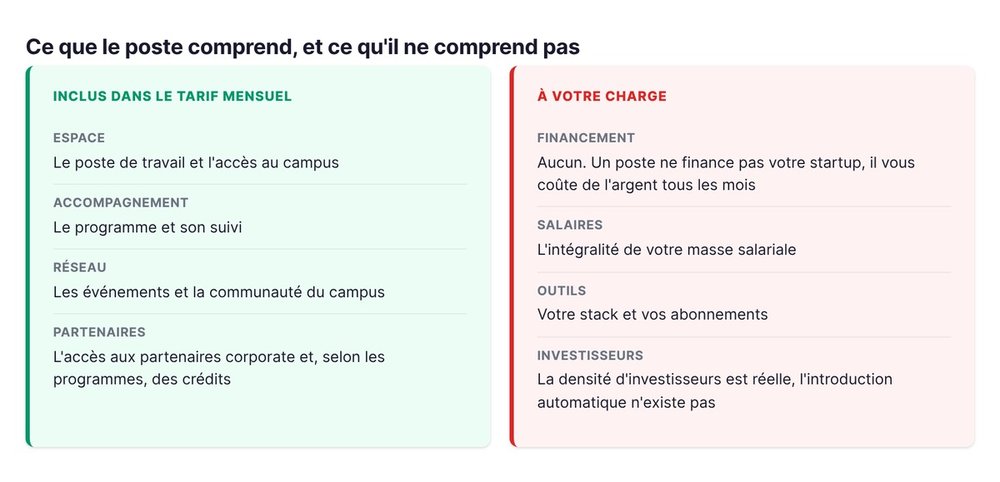
Included: your desk, access to the campus and its services, program support, events and community, and partner credits in some programs.
Not included: your funding, your salaries, your tools, and any privileged access to investors. The density of investors is real, but automatic introductions don't exist.
Equity: what each program takes
The acceleration version of the Founders Program comes with a 1% equity stake, introduced in 2022. The Fighters Program takes no equity. Partner-run programs set their own terms: some take no equity, others come with an associated investment.
Keep the principle in mind: Station F isn't an investor in the traditional sense, and being hosted there doesn't mean giving up equity by default.
Is Station F worth it for your startup?
What the campus actually gives you
Density, first of all: around forty programs on one site, corporate teams looking for pilots, founders at every stage, and a constant stream of events. If your bottleneck is your network, that can save you months.
Then there's the signal: having gone through a recognized program on campus is still a credibility shortcut.
Finally, access to partners. For a B2B startup targeting large enterprises, a corporate program opens a commercial door that's hard to get through any other way. A meeting with the innovation team of a CAC 40 company usually takes months to negotiate. In a program they run, that meeting is built in.
Be clear about the limits of that access, though. An innovation team isn't a procurement team: a pilot only becomes a contract after working its way through the group's internal processes, often another year, with different people. Founders who come away disappointed from a corporate program are almost always the ones who mistook the pilot for the sale.
When Station F doesn't make sense
If your bottleneck is the product rather than your network: six months of events won't replace six months of development.
If your market is regional: a startup whose customers are concentrated in one area loses more by leaving its home turf than it gains in Paris.
If desk costs eat into your runway: €9,000 a year for three desks only makes sense if you know exactly what you're coming for.
A test to help you decide: write down "in six months, thanks to this program, we will have achieved X." If X can't be a measurable result, such as a named customer, a key hire, or a closed round, you're looking for an address rather than a program.
If you're looking for money: a desk at Station F is a monthly expense, never a source of funding. On that point, our map of Xavier Niel's investment funds breaks down what each of the group's vehicles actually funds, campus included.
Incubator or accelerator: where Station F fits
The classic distinction: an incubator supports a project at an early stage, often before the company exists, over the long term and without pressure for immediate growth. An accelerator takes an existing company and tries to compress its growth timeline over a short period, usually in exchange for equity.
Station F fits neither box because it contains both. Landing and some school incubators are incubation. The Founders Program, since its 2022 shift, is acceleration. The accurate way to describe the campus is "an ecosystem that hosts programs," rather than "an incubator."
So the useful question is which of its programs matches your stage, and whether Station F counts as an incubator or an accelerator matters much less. To see where these categories sit in the French landscape, read our guide to accelerators and incubators in France.
Rejected by Station F: alternatives in Paris
Rejection is, after all, the most likely outcome.
Other Paris campuses and incubators
Paris has dozens of organizations beyond the campus: off-site school incubators, public and municipal incubators, sector-specific accelerators, and corporate programs. You'll find the details in our guide to incubators and accelerators in Paris.
A tip on method: if you were rejected because you weren't a fit for a specific corporate program, look for the same kind of program at another large company in the same sector, rather than a generalist incubator.
Reapplying: timing and what needs to change
Reapplying with the same application is pointless: a jury that said no will say no again three months later.
What changes a decision: proof of execution that didn't exist before, a change in team composition, a first reference customer, or a switch to a different target program. If you can't check any of those four boxes, wait until you can.
And if you're targeting international programs in parallel, our guide on how to get into Y Combinator as a French founder walks through a comparable application process with more explicit criteria.
FAQ
How does a project get accepted at Station F?
A project is accepted by a program, not by the campus. Each program applies its own eligibility criteria and has its own jury. The three areas assessed across the board are the team and its full-time commitment, the problem being tackled with evidence to back it up, and fit with the chosen program. That last one is the most decisive.
Who funded Station F?
Xavier Niel funded Station F entirely from his personal fortune, to the tune of €250 million. The campus, located in the Halle Freyssinet in Paris, opened on June 29, 2017.
Does Station F take equity?
It depends on the program. The acceleration version of the Founders Program has come with a 1% equity stake since 2022. The Fighters Program is free and takes no equity. Partner-run programs set their own terms.
Can you join Station F without being in a program?
No, at least not in the sense of simply renting an office. Access to the campus requires admission to one of its programs, including Landing, the earliest-stage option. There's no hosting option without a program.