Antler France refers to how French founders access the Antler pre-seed fund. It has nothing to do with the British luggage brand of the same name. One thing to know before anything else: Antler no longer runs a residency in France. The official locations page has no French entry, and French founders apply to the Continental Europe residency, run from Berlin with outposts in Amsterdam and Munich. The model itself is unchanged. Antler invests before the idea and often before the team is formed, commits up to €500,000 at inception, and keeps backing founders all the way to Series C. This article covers what the day zero model means in practice, the check size and equity, the residency calendar, and what your application needs to demonstrate.
Antler in France: what you need to know
First, a quick clarification, since it muddies this search: Antler is also a British suitcase brand, which explains some of the French search suggestions. This guide is about the investment fund.
A two-stage model: residency, then investment
Antler doesn't select existing startups. The process runs in two stages.
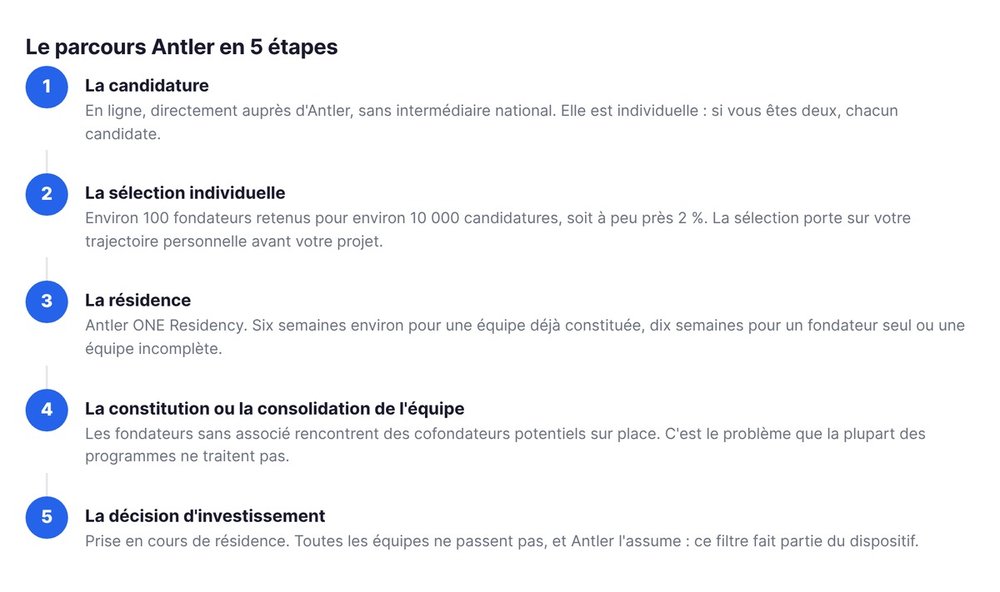
First comes a residency, which the fund calls the Antler ONE Residency. Individually selected founders come together in one location, work on their projects in an intense environment and, for those without a partner, meet potential cofounders.
Then comes an investment decision, made during the residency, for the teams that make a convincing case. Not everyone gets through, and Antler is open about it: that filter is part of the design.
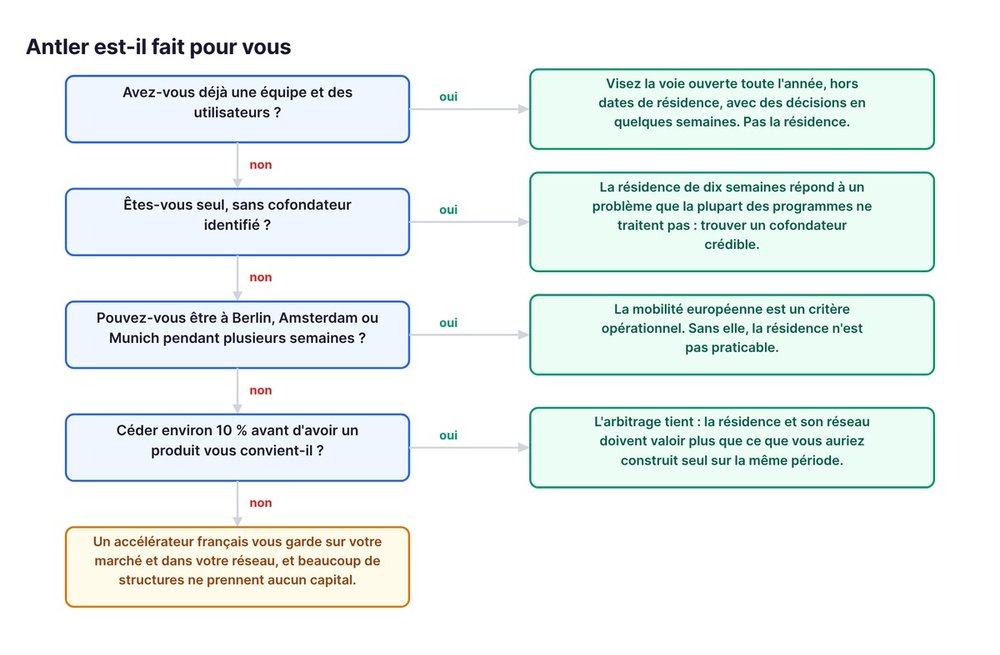
There is also a parallel track for teams that already have early users or revenue. Antler takes these year-round, outside residency dates, and says it reaches decisions within a few weeks. If you already have a team and users, aim for this door rather than the residency.
The French presence: since when, and where
On this point, every existing French-language page is out of date, 2023 press coverage included.
On Antler's official locations page, the European entries are Continental Europe (run from Berlin), plus Denmark, Finland, Norway, Sweden and the United Kingdom. There is no France entry. In fact, the URL for France redirects to the Continental Europe page.
This has three consequences for a French founder. You apply to the Continental Europe residency, since there is no national program. You need to plan on relocating to Berlin, Amsterdam or Munich during the residency. And you won't have a dedicated French point of contact.
It also explains why search results for this query are dominated by company registry pages: with no active French program, search engines read the query as a company lookup first.
"Day zero investing" explained
The phrase, used by Antler and its founders, has no common French equivalent.
Investing before the idea and before the team
Day zero means the moment before everything else: before the company, before the product, sometimes before the cofounders have even met. That is exactly where Antler positions itself. In its own words, it's an inception-stage investor that backs founders, often before they've found their cofounder or developed their idea.
When there's no product and no numbers, all that's left is the person. Antler says it looks for four qualities. Drive: an unusual level of urgency and ownership. Grit: the persistence that keeps going after it has stopped being fun. Spike: visible excellence in one specific dimension, whether technical, commercial, storytelling or people. And full commitment: no side project, no safety net.
How it differs from a traditional accelerator
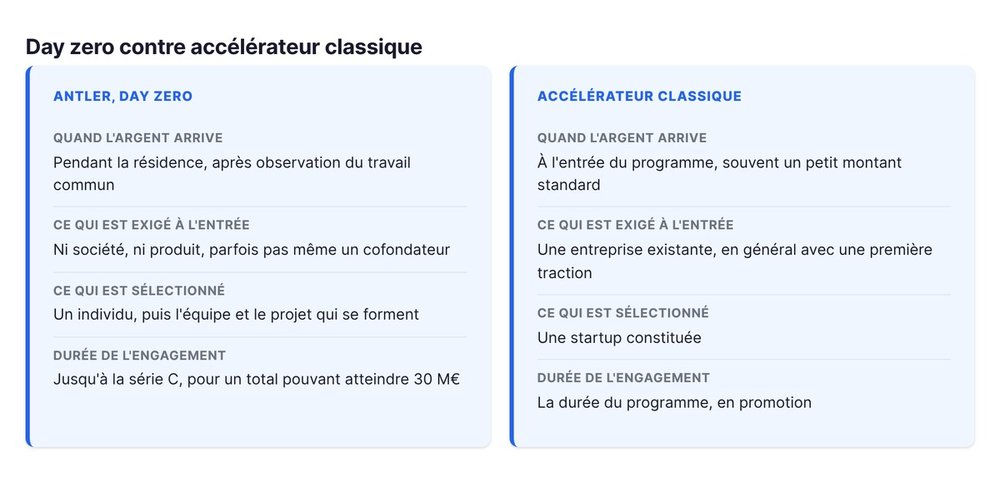
What gets selected. An accelerator selects a startup. Antler selects an individual, then watches which team and which project take shape.
When the check arrives. An accelerator invests when you join the program, usually a small, standard amount. Antler makes its investment decision during the residency, and not everyone gets one.
How long the commitment lasts. Antler says it supports its founders through Series C, with up to €30 million in total over time. The program is presented as just the start of the relationship.
Accelerator, incubator or fund: where Antler fits
The official answer rejects both labels. Antler calls itself neither an accelerator nor an incubator, but an inception-stage investor.
There's substance behind that. An incubator supports founders without necessarily investing. An accelerator works with an existing company, in cohorts, in exchange for a standard stake. Antler invests a significant amount, selects people before companies, and stays involved well beyond the program.
For a French founder comparing options, the most accurate description is a pre-seed fund with a team-formation program attached.
The investment thesis
Stage, check size and terms
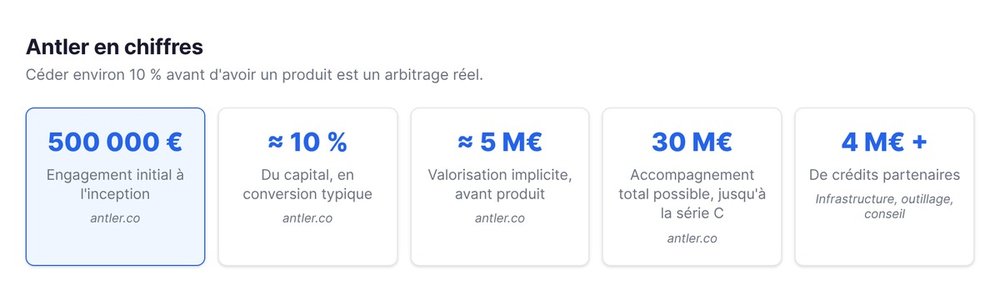
Antler publishes its investment terms on the regional page. The initial commitment is €500,000 at inception. It typically converts into about 10% of the company, at a valuation of around €5 million. The decision is made as you work together, usually within a few weeks.
That implied €5 million valuation before any product is the number to look at first. The useful benchmark is the real alternative at day zero: bootstrapping, business angels, or nothing at all. A classic seed round, where you'd show up with early users or revenue, is the wrong comparison. The real question is whether the residency and its network are worth more than what you would have built on your own over the same period.
Beyond the first check, Antler cites support of up to €30 million through Series C, plus more than €4 million in partner credits for infrastructure, tooling and advisory services.
The takeaway: a large check for such an early stage, paired with equally significant dilution. Giving up around 10% before you have a product is a real trade-off.
Sectors and founder profiles
There's no stated sector thesis. The filter is on people, and the founder pool is described as broad: many have more than ten years of experience or have led teams at scale, some are repeat founders, and others are earlier in their careers but stand out for how fast they execute.
The stated selectivity is the most useful number here: roughly 100 founders accepted out of about 10,000 applications.
What this rate really means is that your application has to make what sets you apart obvious within a few minutes. You don't need to be exceptional in the absolute sense. A strong profile presented generically looks exactly like nine thousand other strong profiles presented generically. A specific, verifiable fact (a number, a hire, a sale) is what sets you apart.
How to apply to Antler France
The process, step by step
You apply online, directly with Antler, with no national intermediary. Applications are individual: if there are two of you, each person applies, and the consistency between the two applications matters. Selection focuses on your personal track record before your project, which throws founders used to accelerator applications, where the project takes up most of the form.
Antler runs open sessions with its partners so you can understand how it works before applying. It's the cheapest way to check you're in the right place.
The residency calendar
There are two residencies a year, starting in March and September.
The length depends on your situation. Teams that are already formed join the residency for about six weeks, focused on building and speeding up execution. Solo founders and incomplete teams stay about ten weeks, with the first phase dedicated to setting direction and working out team dynamics.
These timelines are indicative, and Antler notes that it can invest earlier when it makes sense.
The four things your application must show
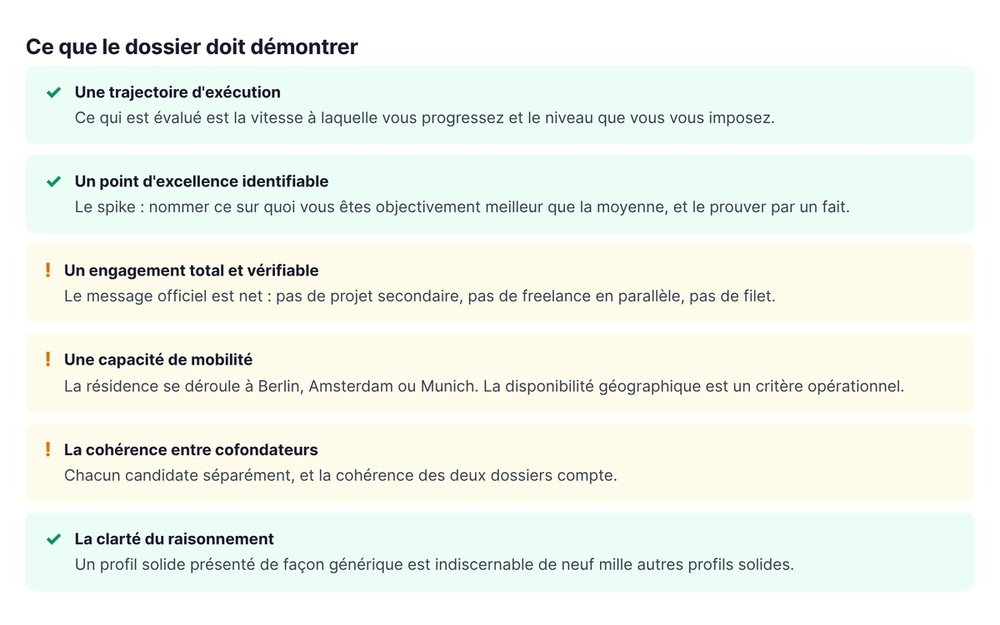
Your application needs to show four things, in this order.
A track record of execution. What's being assessed is how fast you move and the standard you hold yourself to.
A clear area of excellence. You should be able to name what you're objectively better than average at, and back it up with a fact.
Full, verifiable commitment. The official message is clear: no side project, no freelance work on the side, no safety net.
Ability to relocate. Since the residency takes place in Berlin, Amsterdam or Munich, your geographic availability is an operational requirement.
Antler's French portfolio
French startups Antler has funded
Antler has a portfolio on its own site that you can filter by country, France included. It's the only up-to-date source on this, and the page to check instead of a list copied into an article.
What you'll see there confirms the rest of this article: the companies featured on the Continental Europe page are mostly German, Dutch or Spanish. France sits outside the center of gravity of this region, which fits with the absence of a French program.
For a French founder, the practical conclusion is simple: don't count on a national community effect inside the program. What you're really getting is access to a European network. The French ecosystem is easier to find at home.
Antler or another program: how to choose
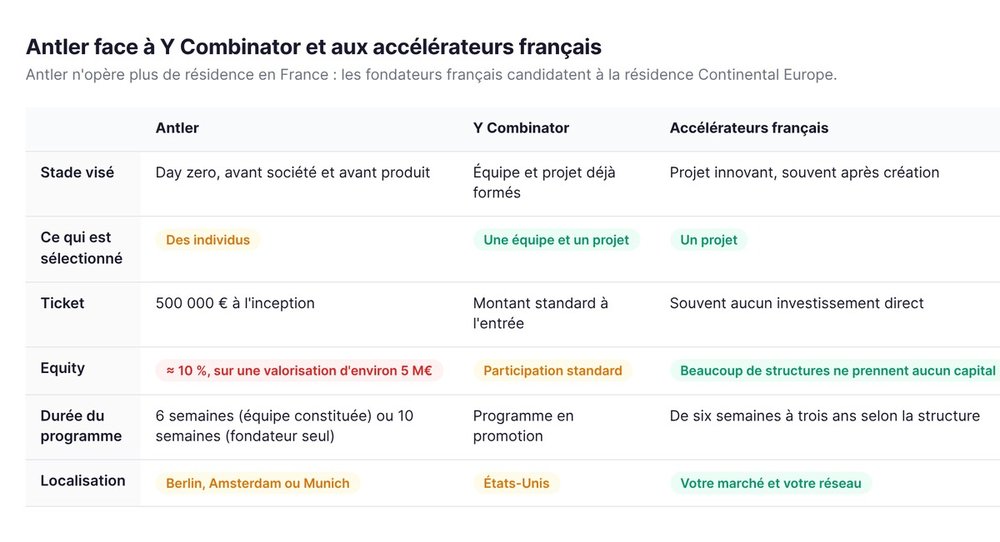
Compared with Y Combinator
Both recruit internationally and invest early, but they select for different things. Y Combinator picks a team and a project that already exist. Antler picks individuals, even if that means the team forms on site.
So the deciding factor is your starting point. If you already have a cofounder and an early product, you fit the Y Combinator format, and our guide on how to get into Y Combinator as a French founder walks through that process. If you're solo and determined, Antler solves a problem most programs leave untouched: finding a credible cofounder.
Compared with French accelerators
The amount. An initial commitment of €500,000 is far above what most French programs offer at this stage.
The dilution. Around 10% before product is also above the French norm, where many support organizations take no equity at all.
The location. A French accelerator keeps you in your market and your network. Antler moves you elsewhere in Europe for several weeks.
For the full landscape of French programs, see our guide to accelerators and incubators in France, and for investors who can take over after a first round, check our overview of French venture capital funds.
FAQ
Is Antler an accelerator or an incubator?
Neither, by its own definition. Antler describes itself as an inception-stage investor that backs founders, often before they've found their cofounder or developed their idea. The difference from an accelerator is structural: selection is based on individuals, the investment is decided during the program and not at entry, and the commitment continues through Series C.
Do you need a team to apply?
No. Antler offers two tracks: one for formed teams, lasting about six weeks, and one for solo founders or incomplete teams, lasting about ten weeks and including meeting potential cofounders. A separate track, open year-round, is for teams that already have early users or revenue.
Does Antler take equity, and how much?
Yes. The initial €500,000 commitment typically converts into about 10% of the company, at a valuation of around €5 million. Antler says it can invest up to €30 million in total through Series C. These terms are published by the fund and should be checked when you apply.