A fundraising bridge is often a critical necessity for startups facing urgent cash flow needs. With interest rates rarely below 15%, this type of interim financing becomes especially strategic between two conventional fundraising rounds.
The BSA Air (Bon de Souscription d'Actions par Accord d'Investissement Rapide) has established itself as a particularly effective bridge finance solution since its launch in 2013. This bridge financing mechanism lets startups access funds in as little as 72 hours, while offering investors an attractive discount of 5 to 30% on their next round.
This practical guide breaks down the essentials of the BSA Air, from the ideal conditions for setting one up to negotiation strategies with investors, so you can secure your bridge financing on the best possible terms.
When to consider a bridge with BSA Air
For fast-growing startups, spotting the right moment for bridge financing can shape their future success. The BSA Air (Bon de Souscription d'Actions par Accord d'Investissement Rapide) has stood out as a particularly well-suited mechanism since its introduction in 2013.
The signs you need bridge financing
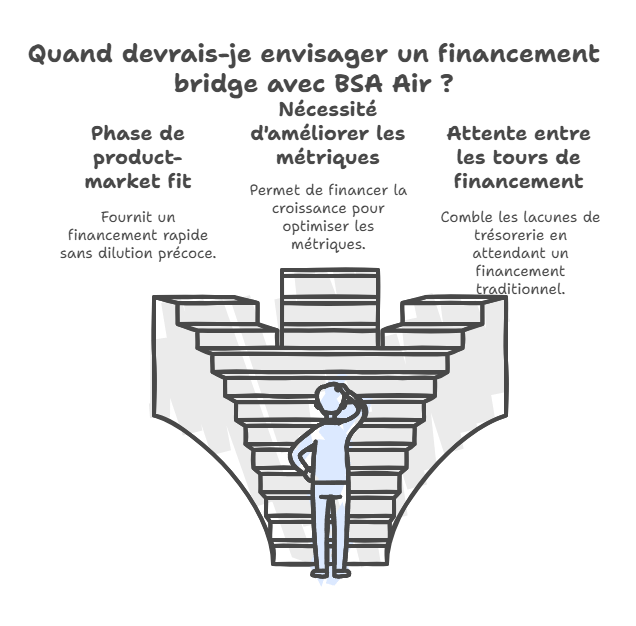
Several situations clearly signal that a bridge with BSA Air could be the ideal solution:
- Product-market fit phase: Startups still pinning down their fit with the market can benefit from fast financing without early dilution.
- Need to improve your metrics: A bridge lets you fund your growth so you can strengthen your indicators before your next conventional round.
- Gap between two funding rounds: When your cash risks running out before a traditional round closes, which can take between 6 and 9 months.
- Uncertain economic climate: In an environment where investors are becoming more selective, securing funds quickly becomes a priority.
The strategic advantages of the BSA Air in uncertain times
In times of economic uncertainty, the BSA Air offers considerable advantages. First, it delivers accelerated financing, with the money paid straight into the startup's bank account. This is especially valuable when traditional funding cycles stretch out.
It also cleverly lets you postpone valuation negotiations, which are so often the systematic sticking point in capital increases. Founders can thereby avoid locking in a potentially risky valuation in a shifting environment.
The BSA Air also acts as leverage to strengthen your overall funding capacity. Setting one up can make it easier to secure a complementary bank loan, multiplying the resources available to you.
Finally, unlike conventional loans or convertible bonds, no interest is paid on the amounts invested. This major advantage lets entrepreneurs channel every euro raised into growing their business rather than servicing debt.
In return for this flexibility and speed of execution, investors generally benefit from a discount ranging between 15 and 30% on the later conversion into shares, rewarding the risk they take on.
Comparing the BSA Air with other bridge financing options
Within the bridge financing ecosystem, several mechanisms exist for startups seeking interim funding. Each has distinct characteristics worth weighing before you decide.
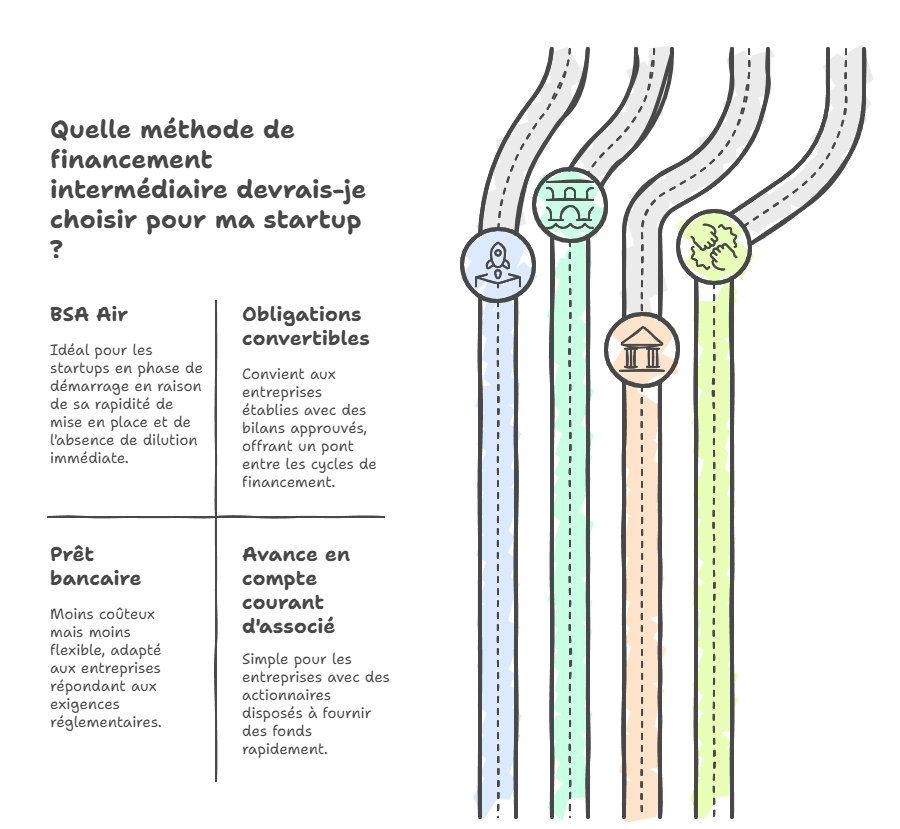
BSA Air vs. convertible bonds
Though often compared, these two instruments differ significantly. First, unlike convertible bonds, BSA Airs do not constitute debt securities. As a result, Article L.228-39 of the French Commercial Code, which requires a review of assets and liabilities for companies that have not yet approved two sets of accounts, does not apply to BSA Airs.
In addition, issuing convertible bonds requires the involvement of a statutory auditor, generating extra costs for young companies. The BSA Air, by contrast, offers great flexibility, since its only exercise condition is an event agreed in advance between the entrepreneur and the investor.
In the venture market, convertible bonds are generally favored by more mature companies looking for bridges between two rounds.
BSA Air vs. bank loan
A bank loan remains cheaper capital, but rarely offers the flexibility of the BSA Air. Banks assess applications according to their regulatory requirements and internal parameters, which makes them more rigid in their lending criteria.
Bridge-type lenders, on the other hand, are not bound by the same regulatory constraints and can be more flexible and creative when evaluating a project.
BSA Air vs. shareholder current account advance
The current account advance is a very popular corporate financing tool among shareholders, thanks to its ease of implementation and its neutrality regarding control of the company. The PACTE law has even relaxed the conditions by removing the requirement for shareholders to hold at least 5% of the share capital.
Even so, this option requires existing shareholders willing to advance funds, unlike the BSA Air, which can attract new investors.
Choosing the method that fits your situation
The choice depends largely on your company's stage of development:
- For early-stage startups: The BSA Air is particularly well suited thanks to its speed of setup and the absence of immediate dilution.
- For established companies: Convertible bonds may be preferable, especially if they already have two approved sets of accounts.
- With a solid shareholder base: The current account advance offers a simple solution if your existing shareholders can inject funds quickly.
Defining the optimal parameters for your equity bridge
Structuring the BSA Air's parameters is the decisive step for a successful equity bridge. These technical variables directly affect future dilution and how attractive your offer looks to investors.
Setting the valuation tunnel (Cap and Floor)
The valuation tunnel frames the future conversion of BSA Airs into shares. It has two essential components:
- The Cap valuation is the maximum conversion ceiling. If your valuation at the next round exceeds this figure, the BSA Airs will convert on this basis. For seed-stage startups, the Cap generally ranges between 1 and 3 million euros.
- The Floor valuation sets the minimum floor for conversion, protecting founders from excessive dilution. It often reflects a realistic valuation of the company in the absence of a new funding round.
To define these parameters precisely, base them on tangible aspects of your business such as your stage of maturity, your commercial traction, and your product/market fit.
Setting a balanced discount rate
The discount rate rewards BSA Air investors for taking on risk. According to an analysis of thousands of transactions, it generally ranges between 15% and 30%. Two-thirds of founders agree on a discount between 10% and 20%.
This discount is directly correlated to your stage of development: the further you move toward Series A or B, the higher the discount tends to be. Startups setting discounts of 10-20% generally plan for caps between 2 and 3 million euros.
Establishing the right trigger events
Trigger events determine when the BSA Airs will convert into shares. Among the most common:
- A qualifying fundraising round
- An IPO
- An acquisition or sale of the company
- The dissolution or liquidation of the business
At the same time, it is crucial to set a deadline for automatic exercise of the BSA Airs, generally between 6 and 24 months after issuance. In the current context, favor longer timeframes that reflect the extended funding cycles.
To prevent minor capital increases from triggering conversion prematurely, set a minimum total subscription amount as the activation threshold.
Don't forget to rely on calculation formulas based on indisputable accounting aggregates, thereby avoiding potential conflicts between investors and executives.
Negotiation strategies with investors for a successful bridge
Pulling off an equity bridge takes more than the right financial instrument. It also calls for a strategic approach during negotiations with investors. This phase often determines the quality of the terms you secure for your bridge finance.
Presenting your bridge as an investment opportunity
The key to a successful negotiation lies first in presenting the BSA Air as a mechanism that creates a natural alliance of interests between founders and investors. Because investors receive warrants that later convert into shares, their success stays directly tied to the startup's future performance. This alignment encourages closer collaboration and ongoing support from investors, who have a direct stake in seeing the startup thrive.
It's also worth highlighting the secure and potentially lucrative framework the BSA Air offers. By deferring the conversion of warrants into shares, investors can benefit from a discount generally ranging between 15% and 30% on the share price at conversion, boosting their potential return on investment.
Techniques for securing favorable terms
In the current economic climate, startups can negotiate longer conversion timeframes that reflect the extended funding cycles. It's also wise to clearly define the amount of the qualifying fundraising round as the trigger event.
On the discount side, startups can offer tiered rates based on when the trigger events occur, or adjust them according to the amount invested. This flexibility helps attract investors while protecting the company's interests.
Managing the expectations of existing and new investors
Support from experienced legal and financial advisors is essential to ensure the terms of the agreement are clear and favorable over the long term. Likewise, transparent communication with investors throughout the process helps align expectations and avoid misunderstandings.
Finally, it's important to anticipate that the terms of the BSA Air and the articles of the Commercial Code relating to the protection of holders of securities granting access to capital require the investor's position to be taken into account in all subsequent capital operations, on a fully diluted basis.
Conclusion
The BSA Air stands out as a particularly effective bridge financing tool for French startups. This solution allows you to secure funds quickly while pushing valuation discussions to a more opportune moment.
What's more, the flexibility of the BSA Air, compared with convertible bonds or conventional bank loans, gives entrepreneurs valuable freedom in structuring their financing. Adjustable parameters such as the valuation tunnel, the discount, and the trigger events let you tailor the instrument to each startup's specific needs.
That said, a successful bridge financing requires careful preparation and a well-defined negotiation strategy. Founders must pay close attention to the balance between appeal to investors and protection of their company's interests.
Ultimately, the BSA Air is a pragmatic solution for startups looking to secure funds quickly between two rounds. It's important to note that this article provides general information only and does not constitute legal advice. Entrepreneurs are strongly encouraged to consult their lawyer or a qualified legal professional before setting up this type of financing.
FAQs
Q1. What are the main advantages of the BSA Air for a startup? The BSA Air lets you secure fast financing without immediate dilution, postpone valuation negotiations, and avoid paying interest. It also offers greater flexibility than traditional financing methods.
Q2. How do you know when to consider a bridge with BSA Air? A bridge with BSA Air is particularly well suited during the product-market fit phase, when you need to improve your metrics before a conventional round, or during periods of economic uncertainty when investors become more selective.
Q3. What are the key parameters to define for a BSA Air? The essential parameters include the valuation tunnel (Cap and Floor), the discount rate, and the trigger events for conversion. It's crucial to balance these elements well in order to protect the startup's interests while staying attractive to investors.
Q4. How do you negotiate effectively with investors for a successful bridge? Present the BSA Air as an investment opportunity that aligns the interests of founders and investors. Negotiate flexible terms, such as conversion timeframes suited to the economic context. Transparent communication and support from experienced advisors are equally essential.
Q5. What are the main differences between the BSA Air and convertible bonds? Unlike convertible bonds, BSA Airs are not debt securities, which simplifies their setup. They don't require the involvement of a statutory auditor and offer more flexibility in how they're exercised. BSA Airs are generally better suited to early-stage startups, while convertible bonds are a better fit for more mature companies.