Daphni: Portrait of the Community VC Fund That Became a Deep Tech Champion
Paris, 2015. Marie Ekeland leaves Elaia Partners, the fund where she spotted Criteo before anyone else. Her goal: build a radically different model of venture capital. Not a classic fund with General Partners behind closed doors, but an open platform connected to a community of 300 entrepreneurs, executives, academics and artists. Daphni launches with 150 million euros raised by the first woman in Europe to reach that amount. Ten years later, the fund manages over one billion euros, has invested in Back Market and Swile (two French unicorns), and has just pivoted toward scientific deep tech with a Blue fund of 260 million euros. Daphni is proof that you can reinvent VC while keeping the results.
 Screenshot of the daphni.com homepage (March 2026)
The story of Daphni
Daphni was born of a break. Marie Ekeland, one of the most respected figures in French VC, walks away from a fund that works to build something new. The story of Daphni is that of a fund that has mutated several times without losing its identity.
The founding: "VC as a Platform" (2015)
In 2015, Marie Ekeland co-founded Daphni with Willy Braun, Mathieu Daix (co-founder of France Digitale, the French startup lobby), Pierre-Eric Leibovici and Pierre-Yves Meerschman. The first fund raised 150 million euros. It was an event: Marie Ekeland became the first woman in Europe to raise a fund of this size.
Daphni's innovation was not in the amount. It was in the model. Daphni invented the concept of "VC as a Platform": a community of 300+ active members (the "daphnipolitains") who take part in sourcing, evaluating and supporting startups. Entrepreneurs, senior executives, academics, artists. A proprietary digital platform enables transparency and connections.
The initial thesis: European usage, global ambition
The first fund invests in European startups with strong local DNA and international ambitions. Three focus areas: collective/inclusion, quality of life/leisure, technological inventiveness. It is deliberately broad. The idea is to invest in companies that reflect European values while targeting global markets.
Back Market, Swile, Shine: the founding successes (2017-2020)
The early years produced spectacular results. Back Market (a marketplace for refurbished products, now a unicorn) is the flagship investment. Swile (formerly Lunchr, employee benefits, now a unicorn) confirmed Daphni's ability to identify disruptive models in traditional markets. Shine (a neobank for freelancers) was sold to Société Générale.
The departure of Marie Ekeland (2020)
In 2020, Marie Ekeland left Daphni to co-found 2050, a fund focused on impact and climate. This departure marked a turning point. The historic founder left, but the fund carried on. Marc Simoncini (founder of Meetic, Jaïna Capital) grew closer to Daphni. The remaining team pursued the strategy with a gradual shift toward deep tech.
The deep tech pivot: the Blue fund (2025-2026)
The most striking change came with the Blue fund. Launched in 2025, the fund reached a final close of 260 million euros in January 2026, above its initial target of 200 million. Blue marks a strategic shift: Daphni is moving from a generalist "European usage" VC to a deep tech, science-driven player. The fund targets spin-outs from France's major research institutions (INRIA, Institut Curie, INSERM, Institut Langevin). The intersection: science + AI + the physical world. Nine companies born out of research labs are already in the Blue portfolio.
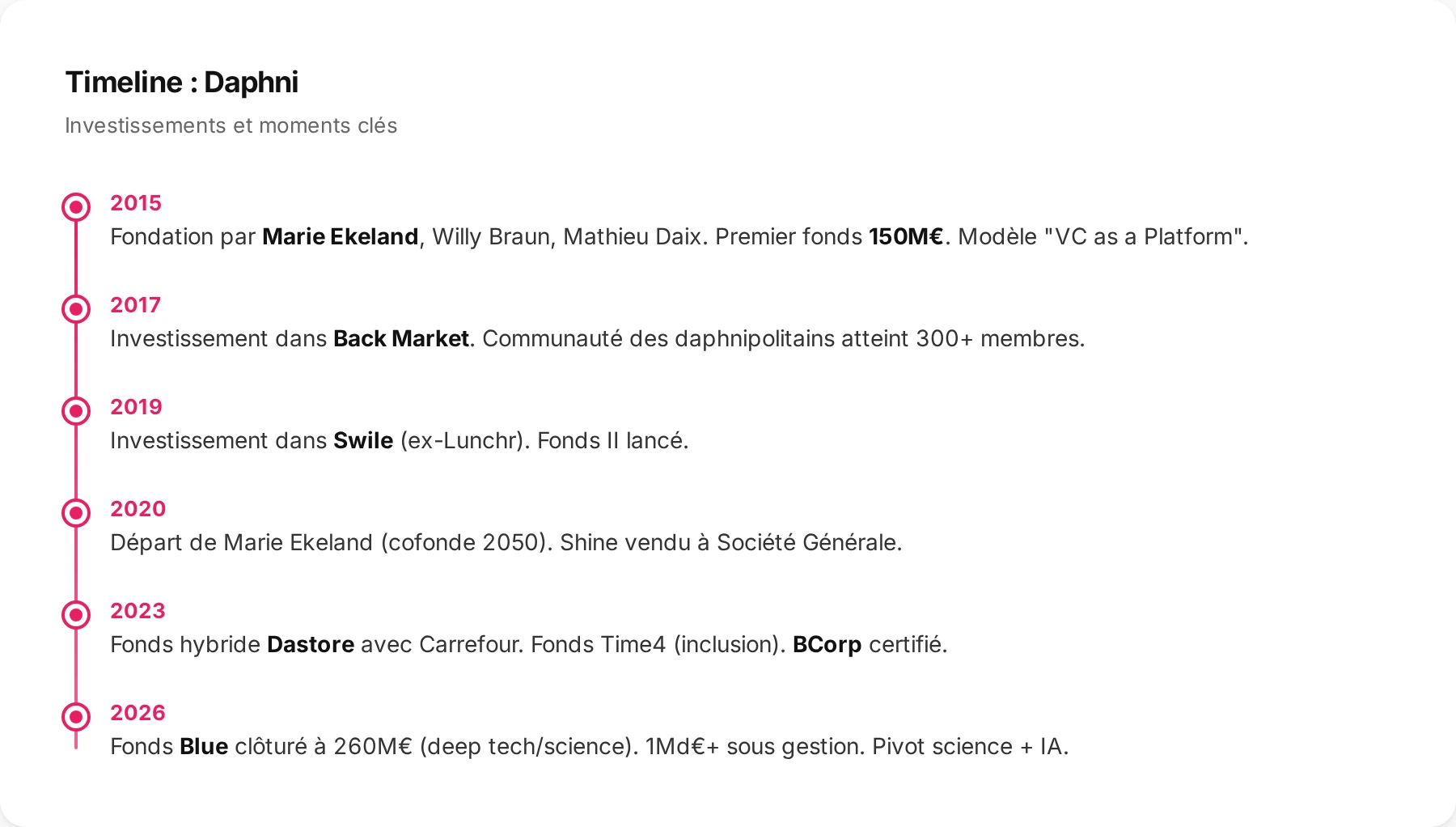 Timeline of Daphni's investments and key moments
The founders and the team
Marie Ekeland: the pioneer (left in 2020)
Marie Ekeland remains a central figure in Daphni's story, even though she is no longer there. Formerly of Elaia Partners, where she identified Criteo, she is the first woman in Europe to raise a 150-million-euro VC fund. Chevalier of the Légion d'honneur. Her time at Daphni laid the foundations of the community model. Today she runs 2050, an impact/climate fund.
Willy Braun: continuity
Co-founder Willy Braun ensures continuity after Marie Ekeland's departure. He is the architect of the current investment strategy and of the pivot toward deep tech.
Mathieu Daix: the connector
Co-founder of France Digitale (the main French startup association), Mathieu Daix brings Daphni an institutional network without equal in the French ecosystem. When Daphni needs access to political decision-makers, large corporations or research institutions, Daix is the bridge.
Pierre-Eric Leibovici and Pierre-Yves Meerschman
Pierre-Eric Leibovici and Pierre-Yves Meerschman (formerly of Orkos Capital) complete the founding team, bringing financial expertise and investment experience respectively.
Marc Simoncini: the strategic ally
Founder of Meetic and Jaïna Capital, Marc Simoncini has grown closer to Daphni. His reputation in the French tech ecosystem and his experience as a founder who has exited bring a complementary network.
The full team numbers between 11 and 50 people, based mainly in Paris, with connections across Europe's leading hubs (London, Berlin, Copenhagen, Stockholm, Amsterdam, Helsinki).
Daphni's investment thesis
Daphni's thesis has evolved over ten years, but two constants remain: the community model and the ambition to find non-obvious models.
The "VC as a Platform" model
The "daphnipolitains" are 300+ people (entrepreneurs, executives, academics, artists) connected through a proprietary digital platform. This network is not decorative. The daphnipolitains take part in deal sourcing (who better than an active founder to spot the next gem?), in evaluation (real-time market feedback), and in support (customer introductions, recruitment, operational advice).
For a founder, being in the Daphni portfolio means access to 300 people who have a stake in your success. It is a network effect that classic funds (where the network is limited to partners and a few LPs) cannot offer.
The scientific deep tech pivot (Blue fund)
The Blue fund represents a new era for Daphni. Gone are the consumer and marketplace startups. In come the lab spin-outs: quantum computing (Pasqal), generative AI (H), micro-robotics, drug discovery, photonics. The Blue fund's carried interest is partly indexed to ESG criteria, a first in French VC.
The Blue fund's thesis rests on one conviction: the next global tech champions will come from European fundamental research, not from Silicon Valley incubators. France has world-class research institutions (INRIA, CNRS, CEA, Institut Curie). The problem is not scientific talent, it is the move from lab to market. Daphni Blue wants to be that bridge.
Stages, tickets and geography
The fund invests mainly at pre-Series A and Series A. Tickets range from 2 to 15 million euros, with a target of 12 to 25% ownership. Geographically it covers Europe, with a focus on Paris and the main innovation hubs (London, Berlin, Copenhagen, Stockholm, Amsterdam, Helsinki).
Specialized and hybrid funds
Daphni is not limited to classic vehicles:
- Dastore: a hybrid fund with Carrefour, dedicated to retail tech. A corporate VC that combines Daphni's expertise with Carrefour's on-the-ground reach.
- Time4: a fund dedicated to founders from underrepresented areas (rural regions, disadvantaged backgrounds). An inclusion initiative that is rare in VC.
The notable portfolio
More than 80 companies, over one billion euros under management. Here are the standout investments:
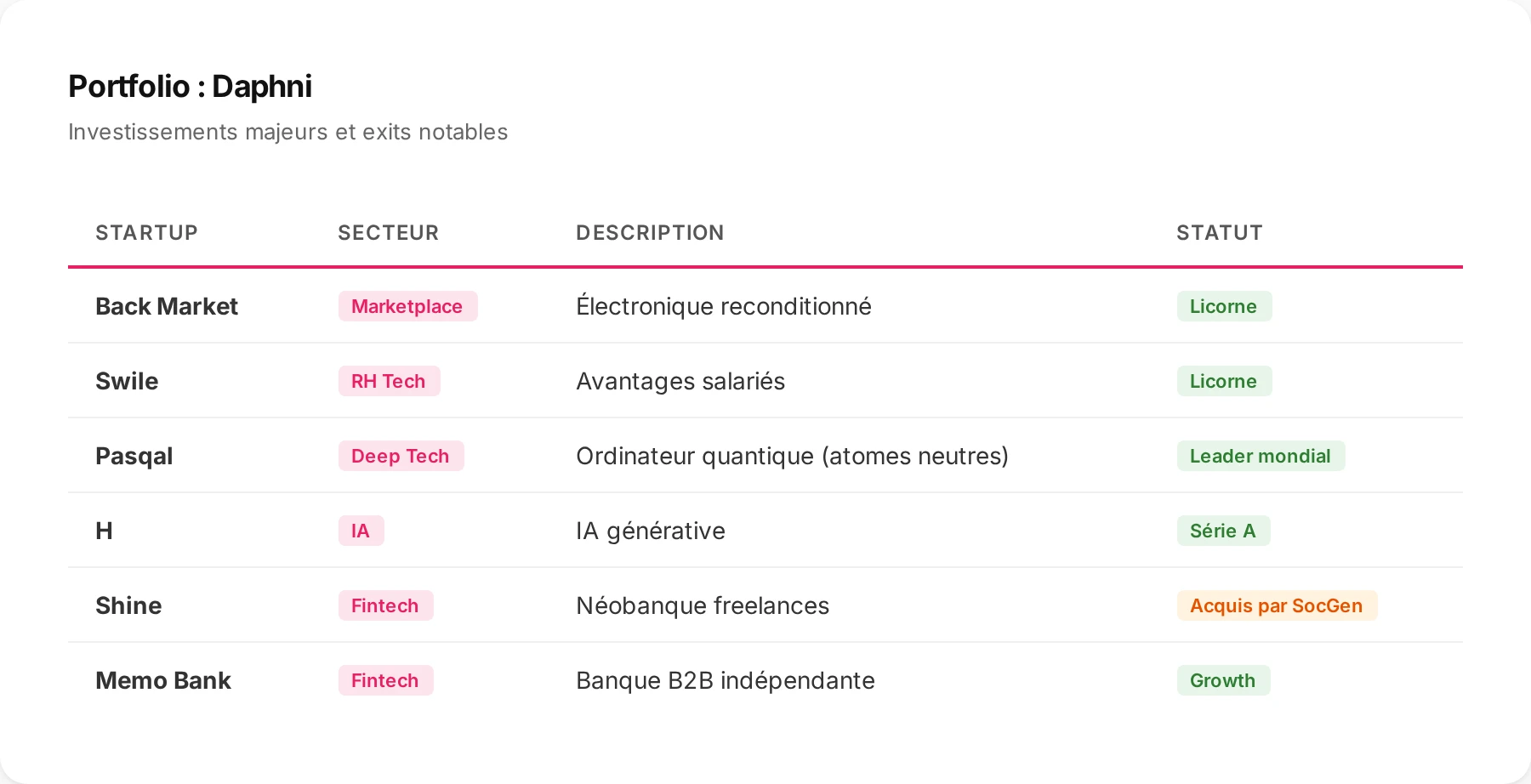 Daphni's main investments and notable exits
Back Market: a marketplace for refurbished electronics. A French unicorn, invested in 2017. Back Market changed how refurbished products are perceived in France and Europe. One of Daphni's greatest successes.
Swile: (formerly Lunchr) an employee benefits platform. A French unicorn. It disrupted the long-established meal-voucher market by offering a single card for all employee benefits.
Pasqal: a quantum computing startup based on neutral atoms. One of the world leaders in quantum computing, spun out of the research lab of Alain Aspect (2022 Nobel Prize in physics).
H: a generative AI startup. An investment in the wave of AI innovation that is reshaping the software industry.
Shine: a neobank for freelancers. Sold to Société Générale. A clean exit that validates the model.
Memo Bank: an independent B2B bank. One of the few banks built from scratch in France in decades.
Key figures
- Founded: 2015
- Headquarters: Paris
- AUM (assets under management): over one billion euros
- Number of companies invested in: 80+
- Unicorns: 2 (Back Market, Swile)
- Fund I: 150 million euros (2015-2016)
- Fund II: around 150 million euros
- Blue fund: 260 million euros (final close January 2026)
- Tickets: 2 to 15 million euros
- Target ownership: 12-25%
- Stages: Pre-Series A, Series A
- Team size: 11-50 people
- Community: 300+ daphnipolitains
- Certification: BCorp (the first certified VC in France)
- Geography: Europe (Paris, London, Berlin, Copenhagen, Stockholm, Amsterdam, Helsinki)
- Hybrid funds: Dastore (with Carrefour), Time4 (inclusion)
FAQ
What is Daphni's Blue fund?
The Blue fund is Daphni's latest vehicle, closed at 260 million euros in January 2026. It targets deep tech and science-driven startups spun out of France's major research institutions (INRIA, Institut Curie, INSERM). The focus is at the intersection of science, AI and the physical world.
Is Marie Ekeland still at Daphni?
No. Marie Ekeland, Daphni's historic founder, left the fund in 2020 to co-found 2050, a fund focused on impact and climate. The current team, led by Willy Braun and Mathieu Daix, is pursuing the strategy with a marked pivot toward deep tech.
What is the daphnipolitains community?
The daphnipolitains are a community of 300+ active members (entrepreneurs, senior executives, academics, artists) connected through a proprietary digital platform. They take part in sourcing, evaluating and supporting the startups in Daphni's portfolio. It is the heart of the "VC as a Platform" model.
Does Daphni invest in startups spun out of labs?
Yes. The Blue fund is specifically designed for spin-outs from French research labs. Nine companies in the Blue portfolio come from laboratories.