Your first business angel asks: "Do we sign a SAFE or a BSA Air?". You hesitate for three days, you post the question on Slack, and you get five conflicting opinions back. Short answer: if your startup is a French SAS and your angel is French, go with a BSA Air. It's the default instrument in 2026: a well-understood legal framework, 18% IR-PME tax relief at conversion under certain conditions, and French VCs and angels who are comfortable with the structure. The SAFE comes into play when your entity is offshore (typically a Delaware C-corp) or when a US/UK investor refuses the BSA Air. A common hybrid case: a SAFE for your American angel and a BSA Air for your French angel in the same round, with mirrored economic terms. This guide gives you the decision tree by scenario, the 8-criteria comparison, the tax nuance that steers French angels away from the SAFE, and the cases where neither instrument is the right answer. We're not lawyers: before you sign, go see a startup attorney.
The quick pitch: what each one is
SAFE (Simple Agreement for Future Equity) in 3 sentences
A convertible investment contract created in 2013 by Y Combinator (drafted by John Bautista, a partner at Orrick Silicon Valley). The investor puts in funds today in exchange for the promise of shares at the next qualified round, at a favorable price (cap, discount, or both). No debt, no interest, no maturity: a promise of equity, full stop.
BSA Air (Bon de Souscription d'Actions, Accord d'Investissement Rapide) in 3 sentences
The French adaptation of the SAFE, launched the same year, 2013, by The Family and SB Avocats. Legally, it's a security in the sense of the French Commercial Code: a share subscription warrant that grants the right to shares at the next round. Same economic logic as the SAFE, French legal wrapper.
For the mechanics of the BSA Air in detail
The complete how-to (issuance, EGM, subscription form, conversion) is in the complete BSA Air guide. Here we're comparing.
The quick comparison table
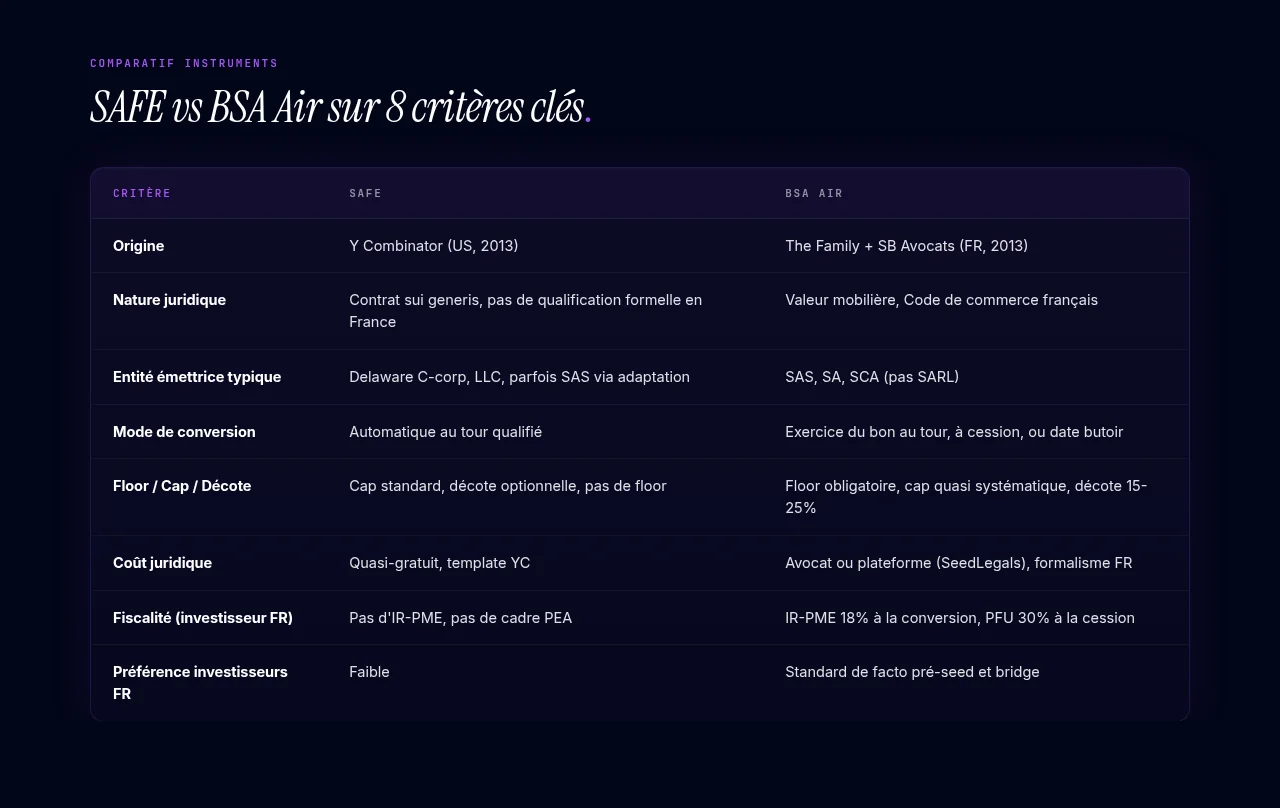
| Criterion | SAFE | BSA Air |
|---|---|---|
| Origin | Y Combinator (US, 2013) | The Family + SB Avocats (FR, 2013) |
| Legal nature | Sui generis contract, no formal qualification in France | Security, French Commercial Code |
| Typical issuing entity | Delaware C-corp, LLC, sometimes SAS via adaptation | SAS, SA, SCA (not SARL) |
| Conversion mechanism | Automatic at the qualified round | Exercise of the warrant at the qualified round, at a sale, or at a deadline |
| Floor / Cap / Discount | Standard cap, optional discount, no classic floor | Mandatory floor (Commercial Code), optional but almost systematic cap, 15-25% discount |
| Legal cost | Nearly free, YC template | Attorney or platform (SeedLegals), French formalities to observe |
| Taxation (FR investor) | No IR-PME, no PEA framework | 18% IR-PME at conversion under SME conditions, 30% flat tax at sale |
| FR investor preference | Low | De facto standard for pre-seed and bridge |
For a French startup, which one to choose?
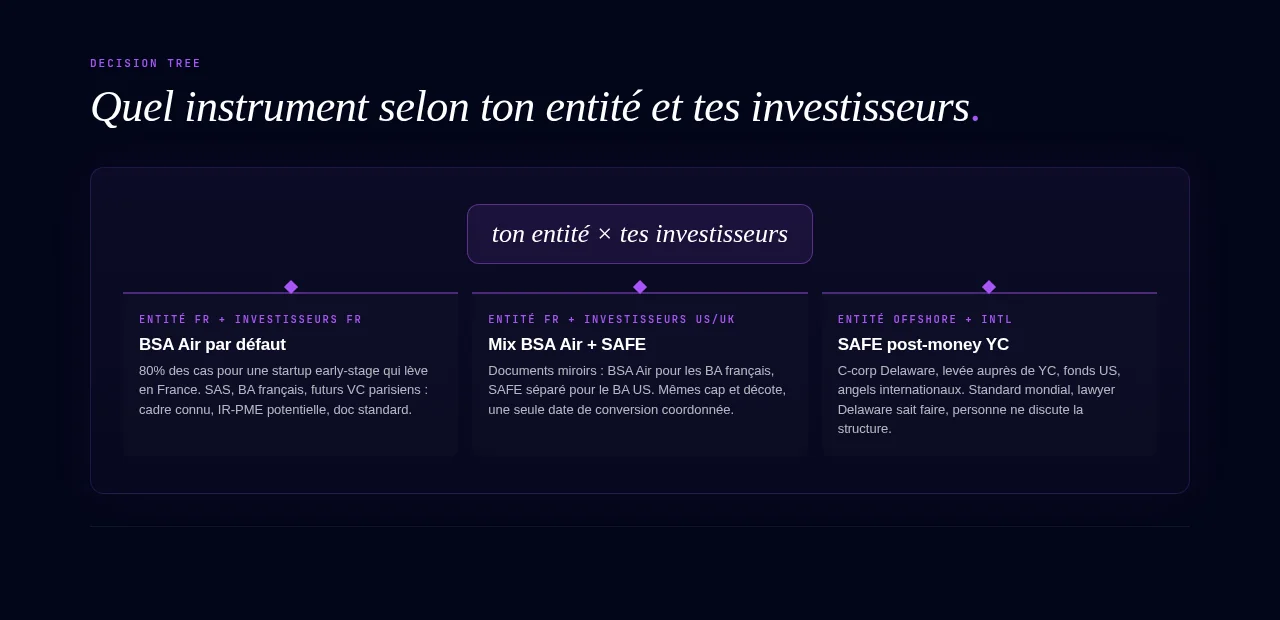
A three-branch decision tree. Two questions, in order:
Q1: Is your entity French (SAS, SA, SCA) or offshore (Delaware, Singapore, UK Ltd)? Q2: Are your investors mostly French, international, or a mix?
If FR entity + FR investors: BSA Air by default
This covers 80% of cases for an early-stage startup raising in France. A SAS, French angels or a French family office, future Paris-based VCs. Go with a BSA Air, no debate. It's what your attorney will recommend, what SeedLegals will generate by default, and what your future Series A VC knows.
If FR entity + US/UK investors: a mix is possible
You have a SAS but an American angel joins the round, or a UK fund wants in. Three options. You offer them a BSA Air and explain it (15 minutes of teaching, their lawyer translates). You do a separate SAFE for them, two contracts with aligned economic terms. You decline their check if you don't want the complexity. The clean practice: mirror documents, same cap and discount, a single coordinated conversion date.
If offshore entity + international investors: standard SAFE
A Delaware C-corp (by flip or by original choice), raising from YC, US funds, and international angels. Go with a post-money YC SAFE, full stop. It's the global standard, your Delaware lawyer knows it by heart, and nobody questions the structure. The BSA Air makes no sense here.
Edge cases: FR team + US holding, planned Delaware flip
A French team but a US holding: you're a US company that pays salaries in France through a subsidiary. Your instrument follows your legal issuing entity, not the location of your team. Same thing if you plan a Delaware flip within 12 months: wait for the flip and raise on a SAFE directly, rather than setting up a BSA Air you'll have to restructure.
Taxation: the practical IR-PME difference
This is where it gets decided for a French angel.
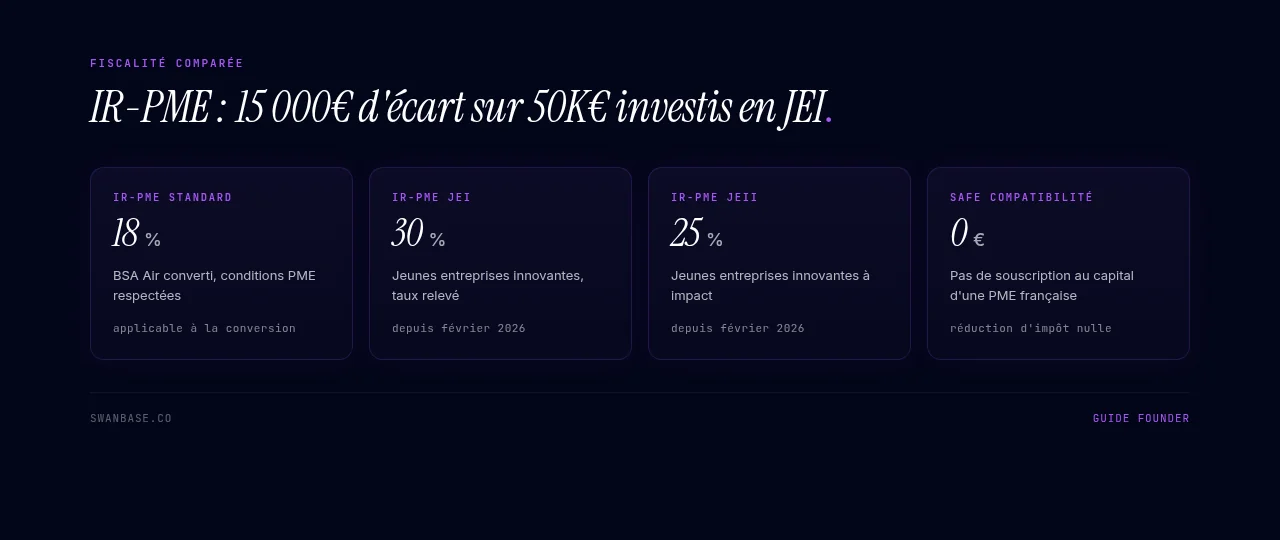
18% IR-PME: compatible with the BSA Air at conversion
The IR-PME gives a French subscriber an income tax reduction of 18% of the amounts paid in cash subscriptions to the capital of an SME (Service Public, 2026). Since February 2026, the rate rises to 30% for JEIs (young innovative companies) and 25% for JEIIs (young innovative impact companies). For the BSA Air, the rule is subtle: subscribing to the warrant does not open the right to IR-PME (it isn't a subscription to capital), but exercising the warrant at conversion does open the right to the reduction if the SME conditions are met at the time of exercise. A 2024 Senate amendment confirmed this eligibility, specifying that the amount taken into account includes both the nominal value and the issue premium.
The SAFE is typically not IR-PME eligible
An American SAFE imported as-is poses two problems for IR-PME. It isn't a subscription to the capital of a French SME (a contractual promise, not a French security). And if the issuing entity is offshore, even at conversion the French investor isn't subscribing to the capital of an SME in the French sense. The result: no IR-PME possible. For an angel investing €50,000, that's €9,000 to €15,000 less in tax relief depending on JEI/non-JEI status. Not trivial.
The upshot: a French angel often steers away from the SAFE
On €50,000 invested in a French JEI:
- BSA Air converted into shares: potential reduction of €15,000 (30%).
- Equivalent US SAFE: zero.
Ask any French angel used to the IR-PME scope: at equal economic terms, they prefer the BSA Air. Not out of patriotism. Out of tax arithmetic.
Safeguard: consult a tax advisor
The IR-PME has strict conditions on the company side (size, age, eligible activity, holding shares for 5 years) and on the investor side (tax residency, annual cap). Never promise IR-PME in a term sheet without validation from a tax advisor. The rule evolves (February 2026 changes on JEI/JEII), and the holding conditions can trap the investor at exit.
Investor preference: who prefers what in 2026?
French VCs: BSA Air
Eurazeo, Partech, Daphni, Elaia, Kima, Breega: all of them structure their pre-seed and bridge checks as BSA Air. A known legal framework, clear taxation for French LPs, standardized docs. A French VC offering you a SAFE in 2026 on a French SAS is an odd signal: either a special case (co-investing with a US fund), or a lack of practice.
French business angels: BSA Air (often for the IR-PME)
For an angel investing in their own name, the IR-PME is what makes taking the risk acceptable. So, BSA Air. Angels investing through a wealth-holding vehicle (SC, SARL holding) are less sensitive to IR-PME but stay attached to the French framework.
US angels / VCs: SAFE
YC, Sequoia, a16z, and most American angels have worked with SAFEs since 2013. The default template, a lawyer who knows it, a 5-page doc. Offering them a BSA Air means a structuring effort on their end. Possible, but friction. If your US angel is the anchor, offer them a SAFE.
International family offices: variable
European family offices (Swiss, Luxembourgish, German) are comfortable with both. They follow the lead of the round. A French lead VC: everyone signs a BSA Air. A US lead fund: everyone signs a SAFE.
Is the conversion into shares different?
Similar mechanics, different formalities.
SAFE: automatic conversion at the qualified raise
At the closing of your qualified round (typically Seed or Series A above a defined threshold), the SAFE converts automatically into preferred shares (or common shares, depending on the version). The calculation: amount invested divided by the conversion price (round price minus discount, or price at the cap, whichever is more favorable to the investor). No shareholder meeting, no subscription form, the contract simply executes.
BSA Air: exercise of the warrant, French formalities
At the trigger (qualified raise, sale, or deadline), the investor exercises their BSA Air. They pay the exercise price (often symbolic, €1), receive the shares, and get recorded in the securities transfer register. On the company side, it's more formal: a decision by the president (under EGM delegation) noting the exercise, an amendment to the articles if needed, and an update to the Kbis. The economic calculation is identical: you get more shares than the new entrants for the same cash invested.
Practical differences for the founder
At equal economic terms, both produce a similar dilution effect. But the cumulative effect of stacked post-money SAFEs is more of a trap than that of BSA Air: YC has published the warning since 2018, and several American founders have paid the price at Series A. For the mechanics of the cap table impact, go see BSA Air and the cap table: how to model the impact. For the parameters to negotiate (discount, cap, floor), look at how to negotiate discount, cap, and valuation on a BSA Air.
When to use neither
These instruments aren't universal.
If you're raising more than €2M: go straight to an equity round
Above a €2M check, the convertible instrument loses its appeal. You set a valuation, you negotiate preferred shares, you sign a full shareholders' agreement. The market signal is better: a priced round says you're ready for the structure. For the clauses to negotiate, see the VC France term sheet guide.
If you have 1-2 angels and a simple check: an equity SPA may be enough
Two French angels, €30,000 each, a clear valuation set in advance: a simple SPA (share purchase agreement) with a capital increase is enough. No more complex than a BSA Air, and your angels become shareholders immediately (direct IR-PME at subscription). The BSA Air makes sense when you don't want to set the valuation now. If you can set it, do it.
FAQ
Can you sign a SAFE with a French SAS?
Technically yes, the SAFE is just a contract. But without a formal legal qualification under French law, it floats in a void. In practice, if your attorney wants to secure the SAFE in France, they effectively restructure it into a BSA Air. You might as well sign a BSA Air directly.
Can a BSA Air convert across multiple rounds?
No, the conversion is one-time. At the triggering qualified raise, all BSA Air in the same tranche convert together according to the agreed parameters. If you have several tranches issued at different times with different parameters, each converts according to its own rules.
What's the legal cost for each instrument?
A SAFE costs almost nothing (YC template, signature). A BSA Air often costs a few thousand euros with a startup attorney, or far less through a platform like SeedLegals. For a €200K round, the BSA Air typically represents 1 to 2% of the round. In exchange, it offers a secure French framework that the SAFE lacks.
Which instrument is fastest to sign in 2026?
Both can be signed in 1 to 2 weeks. The SAFE wins on contractual formalities (5 pages, no EGM). The BSA Air wins on familiarity for French investors (no teaching required). With a French angel in a hurry, a BSA Air via SeedLegals gets signed in 5 days.
Your instrument is chosen by reading your entity and your investors, not by following the trend. The SAFE isn't more modern, the BSA Air isn't more restrictive: two tools, same need, two distinct legal frameworks. Choose the one that fits yours.