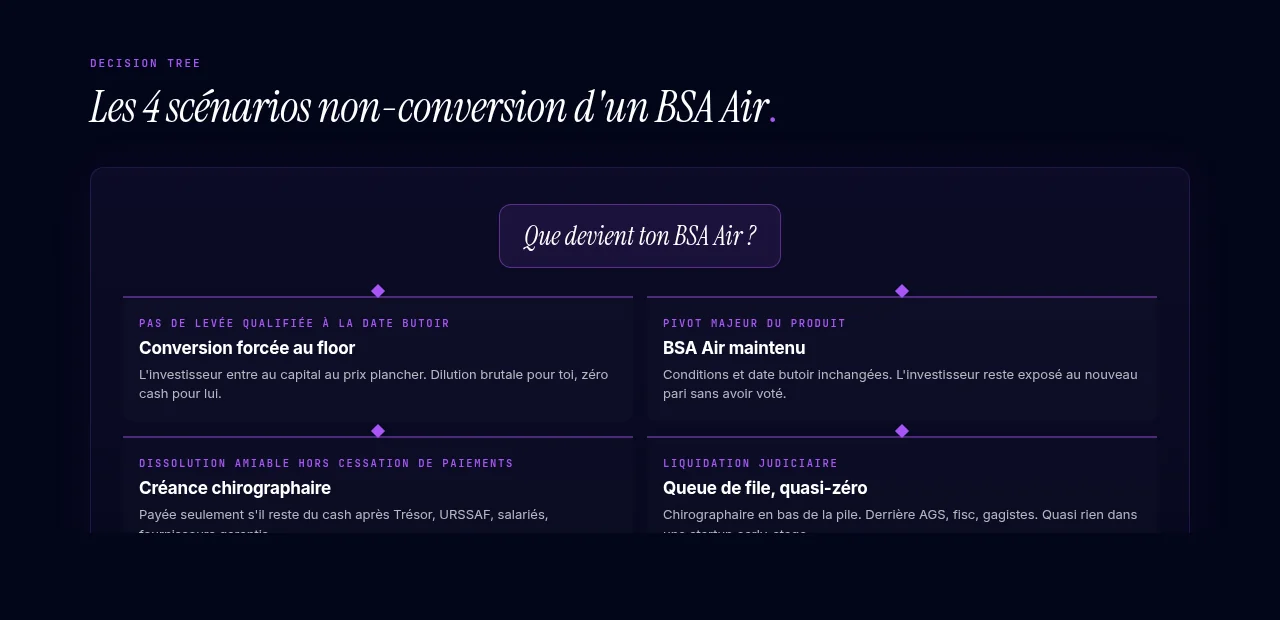
Your startup is struggling, the runway is melting away, and you realize that two or three BSA Air agreements signed 18 months ago are sitting untouched in a Drive. What happens to that money if the company shuts down? Four scenarios. 1) Deadline reached with no qualified round: forced conversion at the floor price, the investor enters the cap table at a bad valuation, you get diluted. 2) Major pivot: the BSA Air stays alive, terms unchanged. 3) Voluntary dissolution: an unsecured claim, paid only if cash remains after priority debts. 4) Court-ordered liquidation: last in line behind wages, URSSAF, the tax authority, and secured suppliers. In most cases, the investor recovers nothing.1 Safeguard: the moment you see one of these scenarios coming, call a startup lawyer. This article tells you when and why.
Quick recap: what exactly is BSA Air conversion
The BSA Air is a share subscription warrant: the investor puts in cash now and gets the right to receive shares later, at a discounted price. Conversion is triggered by a qualified round, an acquisition, or the deadline (typically 18 to 36 months). The BSA Air is not debt. No interest, no cash repayment, no shareholder status before conversion.2 The complete BSA Air guide covers the mechanism. This article deals only with the adverse scenario: your startup won't convert as planned.
The 4 "non-conversion" scenarios for a BSA Air
Most articles about the BSA Air describe the happy case: you raise your Series A, the warrant converts, everyone smiles. The unhappy case gets two lines. Yet when the market turns, that's exactly what matters. Four possible situations, each with its own rules and traps.
Scenario 1: No qualified round by the valuation date
You signed a BSA Air in March 2024, with a 36-month deadline, so March 2027. It's early 2027, no Series A in sight, and the clause kicks in. Two cases, depending on the contract. Case A, automatic conversion at the floor: the investor enters the cap table at the original minimum valuation. If your floor was €3M pre-money and the company is worth €1.5M, they get a lot of shares and your dilution is brutal. Case B, pure expiry: the BSA Air lapses and the investor recovers nothing. Rare in France, more standard on the post-money SAFE side. Without an explicit expiry clause, the default is forced conversion.
Scenario 2: Major pivot
You change your product, sometimes your market. Pivoting is not a trigger event: the warrant stays alive, terms and deadline unchanged. Your investor stays exposed to the new bet without having voted for it. Some contracts include a "material change of business" clause that allows a review. Check it line by line.
Scenario 3: Voluntary dissolution
You decide at an extraordinary general meeting to close the company before insolvency. A voluntary liquidator realizes the assets, pays the debts, and redistributes the balance to the shareholders. The BSA Air becomes an unsecured claim (no collateral, no priority): the investor lines up behind the tax authority, URSSAF, employees, and secured suppliers. Creditors have 30 days after publication in the Bodacc to object.3 Thin residual cash? The BSA Air gets nothing.
Scenario 4: Court-ordered liquidation
Insolvency, commercial court, liquidator. Assets sold and distributed in strict legal order: super-priority claims (AGS for wages) → legal costs → priority creditors (tax authority, URSSAF, secured lenders) → unsecured creditors.4 The BSA Air is right at the bottom. In the liquidation of an early-stage startup that has burned through its cash, there is almost never anything left for unsecured creditors. And the BSA Air has no liquidation preference right, unlike the preferred shares from a classic round.1 It's the most brutal scenario, and also the most frequent.
What the investor recovers in each scenario
For the investor, the asymmetry is harsh: they paid cash upfront and most often walk away empty-handed if the company fails.
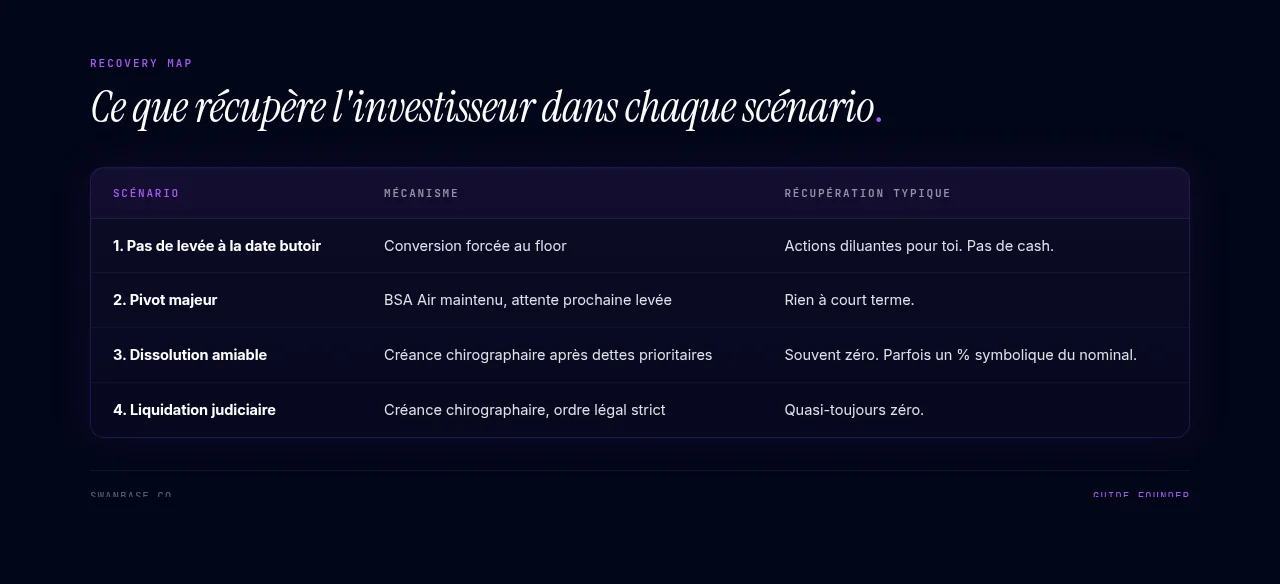
| Scenario | Mechanism | Typical recovery |
|---|---|---|
| 1. No round by the deadline | Forced conversion at the floor | Dilutive shares for you. No cash. |
| 2. Major pivot | BSA Air maintained, waiting for the next round | Nothing in the short term. |
| 3. Voluntary dissolution | Unsecured claim after priority debts | Often zero. Sometimes a symbolic % of the nominal. |
| 4. Court-ordered liquidation | Unsecured claim, strict legal order | Almost always zero. |
Scenario 1: forced conversion OR expiry
The investor enters the cap table at the floor. No cash; they become a shareholder in a struggling company. If the clause provides for expiry without conversion (rare in France), they lose everything.
Scenario 2: no automatic recovery
The BSA Air lives on and the investor waits for the next round. No liquidity, no exit, unless there's a specific buyback clause (very rare in French BSA Air).
Scenario 3: unsecured claim in voluntary dissolution
If €50K remains after wages, taxes, and suppliers, and they had put in €100K, they get a fraction. Otherwise zero.
Scenario 4: near-total loss in court-ordered liquidation
The unsecured creditor comes after everyone else. In the vast majority of early-stage startup liquidations, the BSA Air is lost.
Safeguard
These scenarios describe the standard legal framework. Every BSA Air has its own clauses: a firm may have slipped in a repayment clause, an early buyback, or a founder's personal guarantee (extremely rare, but it happens). You won't know without rereading the contract with a lawyer.
Valuation date expired: what really happens
The deadline is the tipping point. You know it (or you should). It's there in black and white in the contract. And yet many founders discover it six weeks before it hits.
Standard clauses at the deadline
Three mechanics. Conversion at the floor price: the French market default. Extension by agreement of the parties: an amendment to push the deadline back 6 to 12 months. Conversion at a valuation negotiated on the date: less common, requires an independent appraisal or an agreed figure.
Renegotiating with your business angels to extend the date
Talk to your investors three to six months before, not three weeks before. Propose an amendment. Be transparent about the reasons (market, traction, next round planned for T+9 months). Most business angels prefer to push the date back rather than force you to convert into a company they no longer believe can raise. They also know the floor is worthless if the company dies two months later.
Voluntary dissolution vs court-ordered liquidation: the practical difference
Both procedures are often called "liquidation" in everyday language. Legally, they're night and day.
Voluntary dissolution: a shareholder decision
Decided at an extraordinary general meeting, outside of insolvency. You choose to close. A voluntary liquidator (often a director or an accountant) realizes the assets, pays the debts in legal order, and redistributes the balance to the shareholders. Cost €1,500 to €4,000, duration 3 to 12 months. Assets > liabilities: you return money to the shareholders. Otherwise, it shifts to court-ordered liquidation.
Court-ordered liquidation: the commercial court
You're insolvent (payable liabilities > available assets). File for bankruptcy within 45 days. The court appoints a liquidator who takes over. Assets are sold, creditors paid according to the legal order. You no longer have the power to favor an investor, and trying to do so exposes you to criminal liability (fraudulent bankruptcy, personal liability for the shortfall).
Where the BSA Air stands in each case
Voluntary dissolution: unsecured, behind priority debts, ahead of the shareholders (but often nothing to collect). Court-ordered liquidation: unsecured, at the bottom of the pile, behind AGS, taxes, URSSAF, and secured lenders. In both cases, no priority. Not a convertible bond, not secured debt, not a preferred share with a 1x liquidation preference.1
Are there repayment clauses in some BSA Air?
The standard view is no: no cash repayment, by design.2 But contracts negotiated at the margins can contain what no template provides for.
Early buyback clauses (rare in France)
Some bespoke BSA Air give the company the option to buy back the warrant for a set amount (nominal + premium). This assumes available cash, so it saves no one in insolvency. Useful in the case of a pivot or a post-signing misalignment.
"Minimum return" clauses
Inspired by the American post-money SAFE, some variants provide for a minimum amount owed to the investor in the event of an exit. Almost nonexistent in French BSA Air. Not to be confused with the liquidation preference of preferred shares, which applies to shares, not to unconverted warrants.
How to check whether your BSA Air has one
Three places to reread. Conversion terms: the words "buyback", "expiry", "lapse", "termination". Company undertakings: sometimes a conditional buyback promise. Financial appendix: the warrant's nominal, the subscription premium, and any repayment formula. If you see nothing, there's probably nothing. Confirm with your lawyer.
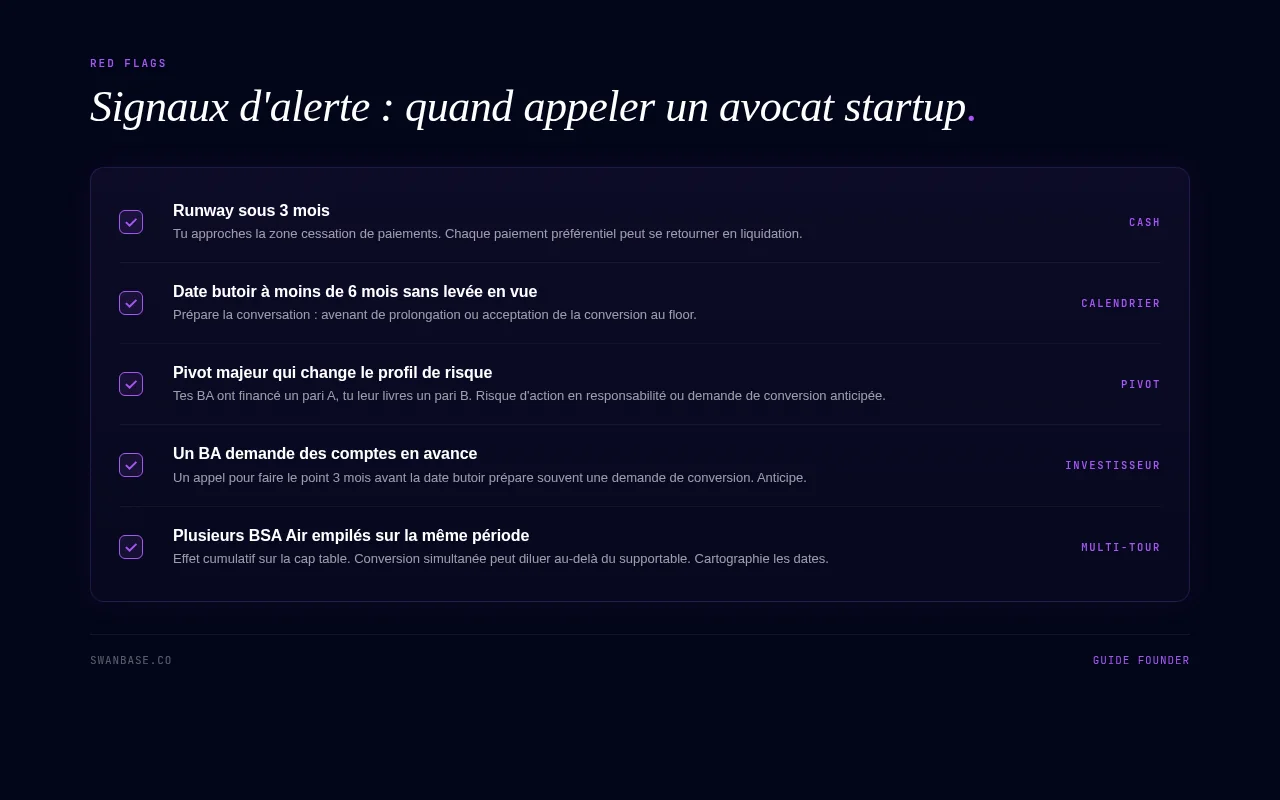
When to consult a lawyer (founder warning signs)
The subject is legally sensitive. The line between soundly handling a difficulty and mismanagement (liable for the shortfall) is thin. Here are the signals that call for an immediate meeting, not one in two months.
Runway < 3 months
Under three months of cash, you're approaching the insolvency zone. Every decision (a preferential payment, a new commitment, a salary increase) can be held against you in liquidation. A startup lawyer, ideally an ad hoc administrator, keeps you safe.
Valuation date < 6 months with no round in sight
Prepare the conversation with your investors: an extension amendment or accepting conversion at the floor. The lawyer drafts the documents (amendment, minutes of the general meeting, subscription form).
A major pivot that changes the risk profile
Your investors financed bet A, and you're delivering bet B. Risk: a liability claim (rare but possible) or a request for early conversion.
A BSA Air investor asks for an update early
A business angel who calls to "touch base" three months before the deadline: that's a signal. They're often preparing a conversion request or a claim. Get ahead of it with counsel.
Finding a startup-friendly lawyer
Several Paris firms cover the topic: SB Avocats (the inventors of the BSA Air), OMADA, Squair, Alkeom, Hashtag, and Kickston on the financial advisory side. Platforms like SeedLegals cover simple cases (amendment, conversion at the deadline). For the adverse scenario, go to a firm, not a platform.
Communicating with your BSA Air investor in tough times
Handled badly, this conversation turns a disappointed investor into a litigious one. Handled well, it keeps you an ally for your next company (because there will be a next one).
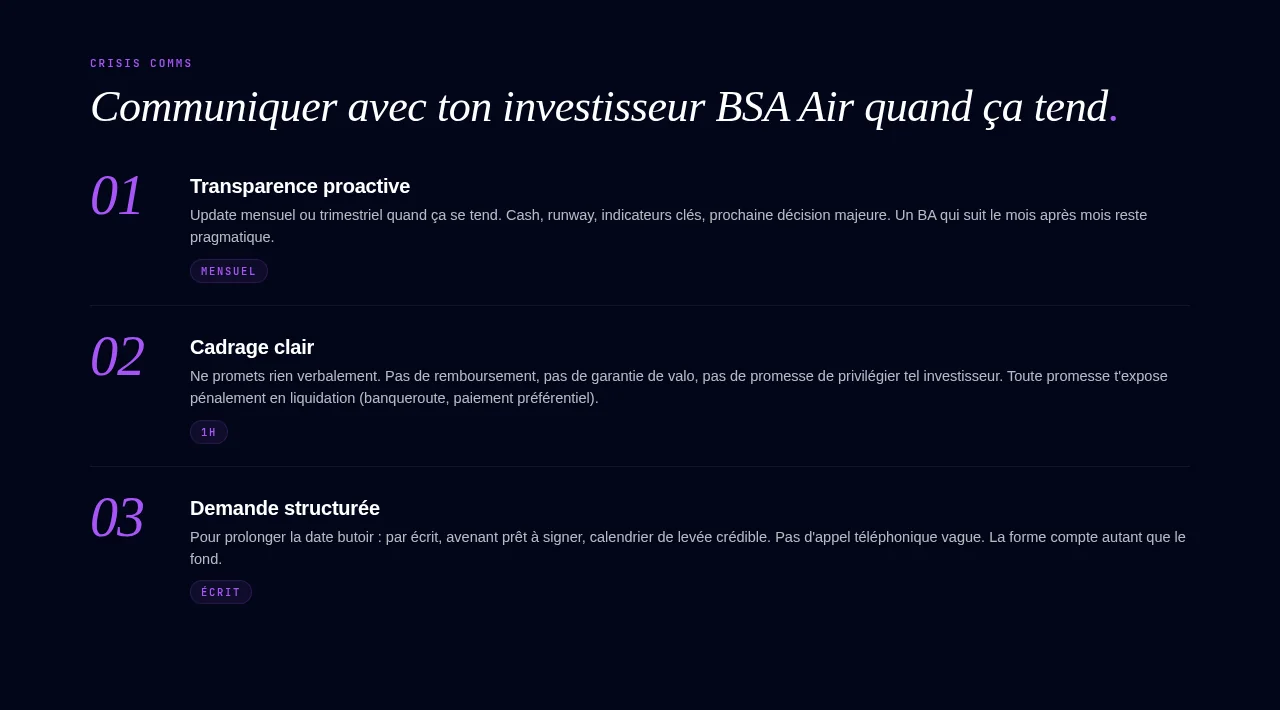
Proactive transparency
Monthly or quarterly when things tighten. A short update: cash, runway, key metrics, next major decision. A business angel who discovers the dissolution from a liquidator's email goes into litigation mode. A business angel who watches the situation deteriorate month after month stays pragmatic.
Clear framing
What you must not do: verbally promise a repayment, guarantee a conversion at valuation X, commit to favoring a given investor. All of this exposes you to criminal liability in liquidation (fraudulent bankruptcy, preferential payment). Say what you know, say what you don't know, and promise nothing.
A structured request
If you're asking for a deadline extension: in writing, with an amendment ready to sign and a credible fundraising timeline. Not a vague phone call. Form matters as much as substance.
Founder mistakes to avoid in tough times
Three classic traps when the BSA Air becomes a hot topic.
Ignoring the approaching valuation date
You know it's coming. You do nothing. On D-day, the investor triggers conversion at the floor, and you end up diluted without having negotiated anything. Set a reminder 9 months ahead.
Verbally promising your business angels a repayment
Under pressure, you blurt out "don't worry, we'll give you your money back". If the company closes, that sentence can cost you dearly. The BSA Air does not allow repayment.2 Any promise to the contrary exposes you personally.
Not getting a pivot approved when the clause requires it
Some contracts include an information obligation or even oversight rights over major pivots. Skip it and you invite a request for early conversion or a liability claim. Reread the contract before you pivot.
FAQ
Can a BSA Air block a voluntary dissolution?
No, not directly. Dissolution is decided by the shareholders at an extraordinary general meeting. The BSA Air investor, as an unsecured creditor, can file an objection within 30 days of publication in the Bodacc.3 The objection delays the dissolution but doesn't block it for long: the court decides.
Do you have to repay business angels if the startup fails?
No, unless there's a specific contractual clause. The BSA Air is a subscription warrant, not debt: no cash repayment is provided by default.2 The investor takes an equity risk and accepts it at signing. Any verbal promise contrary to the contract can bind you personally.
Do business angels have oversight rights during the life of the BSA Air?
Limited by default. The BSA Air does not grant shareholder status before conversion: no vote, no general meeting, no dividends. Some contracts provide for periodic reporting or oversight rights over major pivots. Check the contract.
How much does a lawyer consultation cost when in difficulty?
The first meeting is free at most startup firms. A simple amendment or review: €800 to €2,000 excl. VAT. A financial difficulty case (ad hoc mandate, negotiation, dissolution preparation): €3,000 to €10,000 excl. VAT depending on complexity. Platforms like SeedLegals: flat-rate packages starting at €500 for simple documents.
The BSA Air is a defensive bridge tool when the market is doing well. When it turns, it's a midnight clause that strikes at 18 or 36 months without warning. First protection: read the contract before signing (floor, deadline, trigger events, oversight rights). Second: the lawyer called six months before the red zone, not six weeks after. To go deeper: complete BSA Air guide, discount, cap and floor, cap table impact, BSA Air vs SAFE, BSA Air bridge.
Footnotes
-
https://www.maddyness.com/2024/03/12/le-bsa-air-reste-t-il-toujours-loutil-indispensable-de-lamorcage/ ↩ ↩2 ↩3
-
https://eldorado.co/blog/2021/12/09/le-bsa-air-en-theorie-et-en-pratique ↩ ↩2 ↩3 ↩4
-
https://entreprendre.service-public.gouv.fr/vosdroits/F23744 ↩ ↩2
-
https://dissolution.comptable-en-ligne.fr/r/creanciers-privilegies-et-creanciers-chirographaires ↩