Welcome to Physical AI. Physical artificial intelligence refers to systems that can perceive their environment and then act in the real world. Generative AI produces content. Physical AI also has to deal with matter, time, failing sensors, and the consequences of movement.
For you as a founder, the product depends on a complete loop. That loop starts at the sensors, runs through the model, and comes back from the field as data. Your opportunity sits in the layer where your team can learn faster on a task narrow enough to actually deploy.
Physical AI: the definition that matters
🧭 A working definition. The Office québécois de la langue française describes a branch of AI that embeds learning and perception into hardware systems. Those systems then interact autonomously with the physical world. The OQLF settles on "intelligence artificielle physique" and "IA physique" as the French terms.
If you searched for "physical AI definition," hold on to this anchor. Physical AI turns an observation into a physical action, then uses the result to improve the next decision.
A chatbot can get things wrong without shutting down a factory. A robotic arm can stop a line or put someone at risk. Quality therefore depends on both the model and the recovery procedure.
Physical AI is not a model. Its loop has to survive the real world.
From digital intelligence to physical action
Digital intelligence manipulates representations. It classifies an image or predicts a word. Physical intelligence closes the loop: it observes, acts, measures the result, and adjusts its behavior.
Take a sorting robot. The camera spots the object, then the system estimates its position. The arm executes the movement. Force feedback checks the grip and triggers a correction if the object slips.
You are no longer validating a model offline. You are measuring the task and the recovery.
Robotics alone is not enough
Robotics provides the body and part of the control. Physical AI adds learning and generalization. The OQLF cites optical sorting, autonomous vehicles, and rescue drones. A humanoid is only one possible form factor.
Pairing "physical AI" with "robotics" tells an incomplete story. A camera can understand a scene and orchestrate a machine. A vehicle adapts its trajectory. A sorting system learns new objects. The unit of analysis is not the robot's shape, it is the loop between perception and action.
How does Physical AI work?
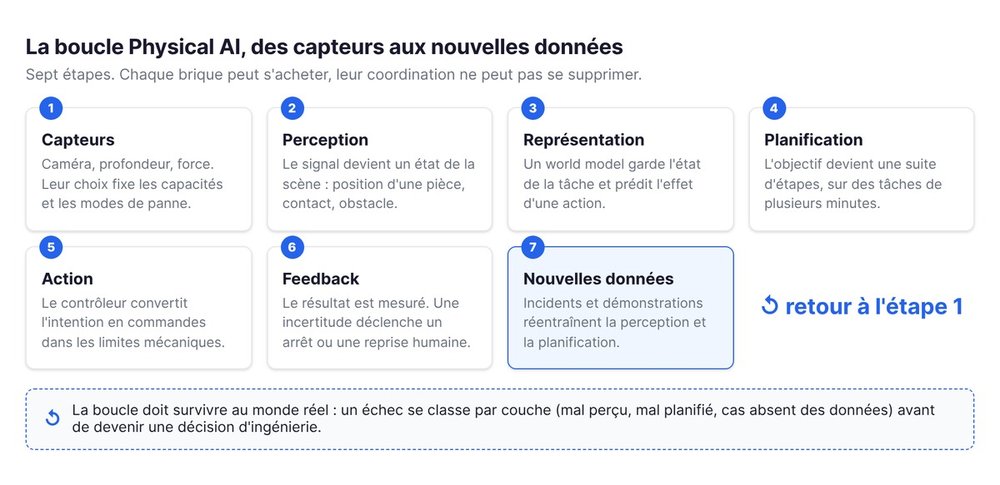
⚙️ The minimum chain. Physical AI coordinates perception with an internal state. It then links an action policy to control, and control to feedback. You can buy several of these building blocks. You cannot remove the need to coordinate them.
Perceiving through sensors
Sensors turn the world into images, depth, or force. Your choice of sensors sets both what the product can do and how it fails.
A camera depends on light. A force sensor only detects contact at the point where it is fitted. The system then has to flag an inconsistent reading.
For your MVP, ask which observation actually supports a decision and which failure remains acceptable. The best sensor reduces uncertainty without blocking deployment.
Building a representation and planning
The system converts signals into a state of the task. A world model predicts how the environment might evolve after an action.
The search term "world models robotics" becomes concrete here: the model keeps track of a part's position or a collision risk, not every detail of the world.
Planning turns a goal into steps. Google DeepMind describes this separation in Gemini Robotics 2: one model tracks the task, while a vision-language-action model converts observations and the instruction into motor control.
Google DeepMind reports that its reasoning model plans tasks lasting several minutes. Its on-device model also adapts to a new two-armed robot with a few hours of data, generally under two hundred examples according to the team. These results come from the vendor, running on its own systems. They do not predict how your product will perform.
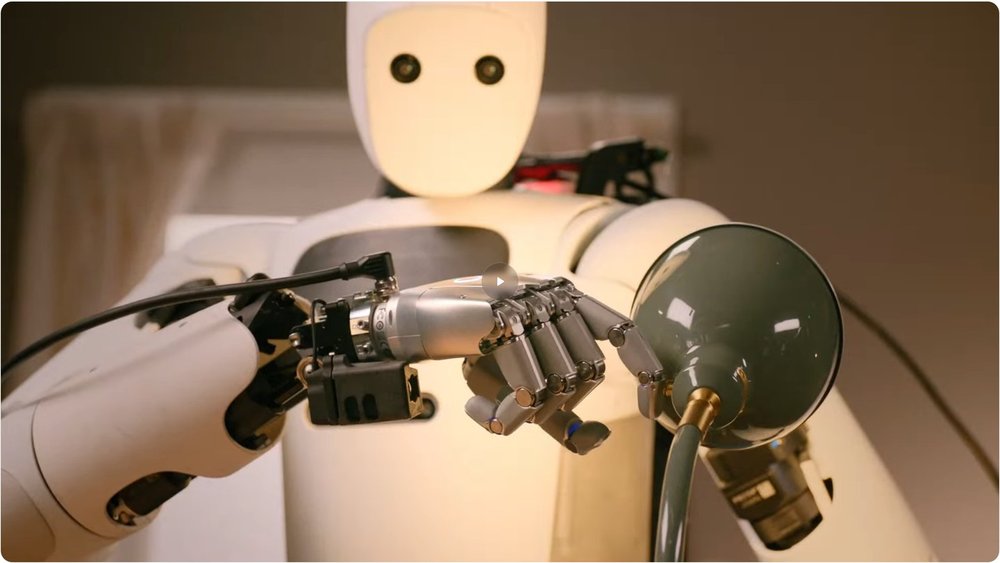
Source: Google DeepMind, Gemini Robotics 2, captured September 4, 2026.
Acting and correcting through feedback
The controller turns intent into commands that respect the mechanical limits. This layer blocks a decision that is physically impossible.
Feedback closes the loop. An uncertain situation has to trigger a stop or a human intervention. That recovery path belongs to the product from the very first pilot.
Sort your failures by layer. Did the system perceive badly, plan badly, or hit a case missing from the data? That attribution turns an incident video into an engineering decision.
Physical AI vs. generative AI and embodied AI
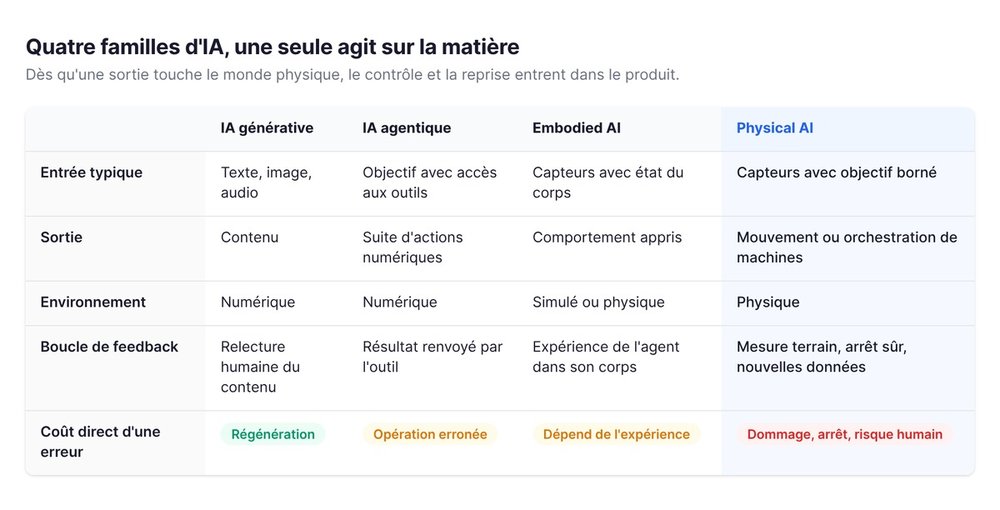
🔎 The dividing line. Generative AI produces content. Agentic AI acts inside digital tools. Physical AI executes an action in the physical world.
The output changes with the system
| Category | Typical input | Output | Environment | Direct cost of an error |
|---|---|---|---|---|
| Generative AI | text / image / audio | content | digital | correction or regeneration |
| Agentic AI | goal with tool access | sequence of actions | digital | wrong operation |
| Embodied AI | sensors with body state | learned behavior | simulated or physical | depends on the setup |
| Physical AI | sensors with a bounded goal | movement or orchestration | physical | damage, downtime, or human risk |
The terms overlap. As soon as an output acts on matter, evaluate control and recovery.
For the purely digital layer, see also the AI tools worth using in a startup. Physical AI starts when the product has to close the loop in the real world.
Physical AI and embodied AI, two neighboring scopes
The query "Physical AI vs embodied AI" sets two close cousins against each other. Embodied AI emphasizes intelligence that learns through a body. Physical AI covers the deployed machine more directly, along with its stack and its operating constraints.
Use embodied AI for the scientific question: how does an agent develop situated understanding? Use Physical AI for the product question: how does that understanding become a reliable, sellable action?
Data is the bottleneck
🧪 A collection rule. Clean demonstrations teach the intended motion. Imperfect trajectories show the recoveries. Field incidents reveal the situations your simulation never contained.
Real demonstrations and synthetic data
Real data carries the reflections, the damaged objects, and the human gestures. Collecting it takes a machine, an operator, and an annotation method.
Simulation multiplies scenes without tying up the site. You can vary positions and lighting, then generate rare failures. NVIDIA's Physical AI glossary describes that role: physics simulation and world foundation models create synthetic data, then help annotate it.
This data expands a distribution you chose. If the simulation leaves out a friction effect or a human behavior, the model will learn an incomplete world.
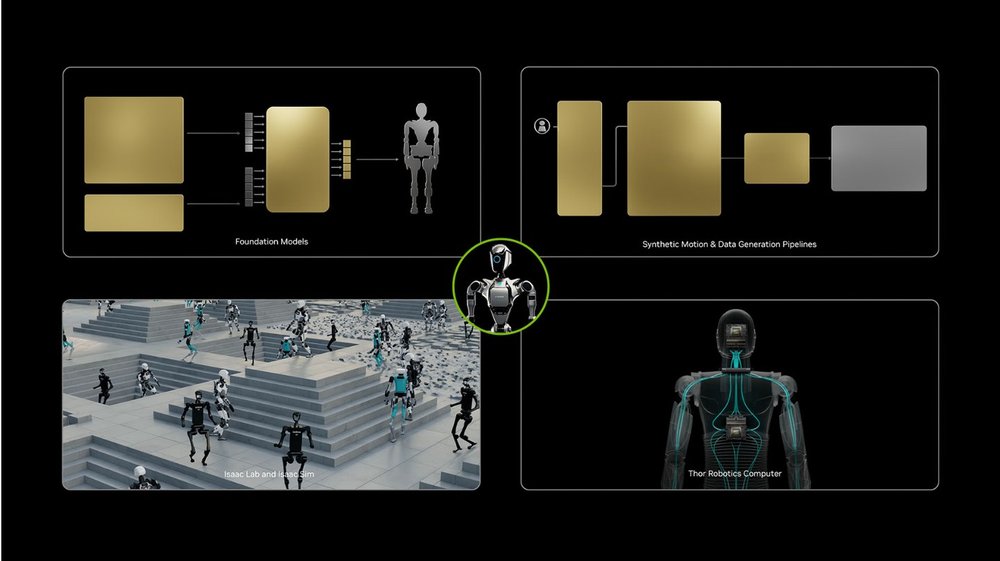
Source: NVIDIA, Isaac GR00T, captured September 4, 2026.
Getting from simulation to the field
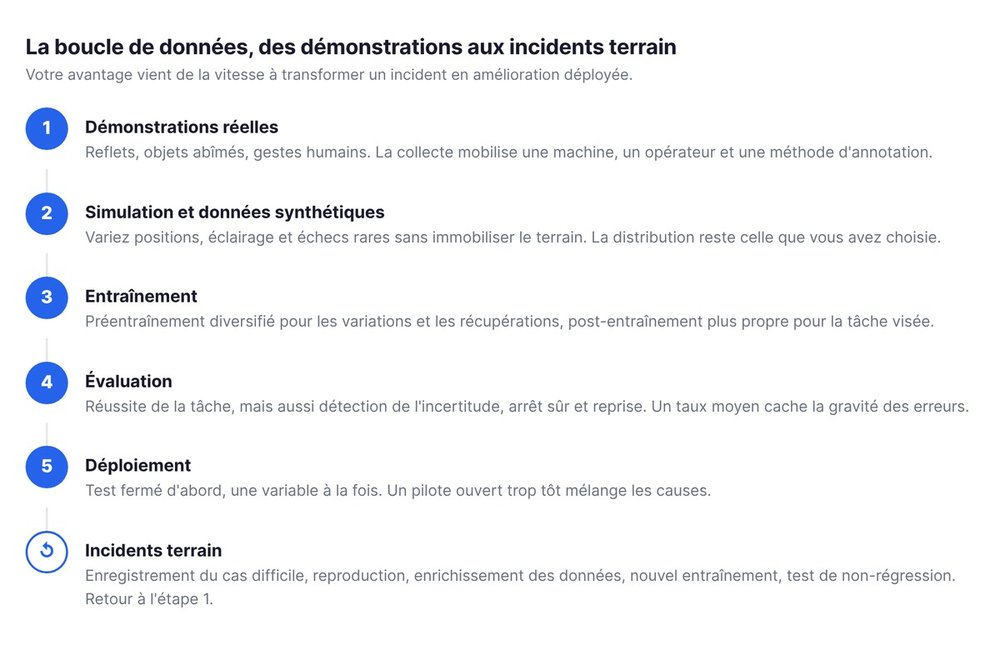
Sim-to-real refers to the gap between simulation and machine. Vary the virtual environment, then feed real incidents back into your tests.
Start with a closed test and add one variable at a time. An open pilot launched too early mixes causes together.
The useful loop runs in six steps: deploy; record the hard case; reproduce it; enrich the data; retrain; run a regression test. Your advantage comes from how fast you turn an incident into an improvement.
Measuring recovery, not just success
An average success rate hides how severe the errors are. Also measure uncertainty detection, safe stopping, and recovery.
Physical Intelligence's π0 paper distinguishes diverse pre-training, useful for variation and recovery, from cleaner post-training. Its proprietary corpus covers roughly ten thousand hours of demonstrations across seven robot configurations and sixty-eight tasks.
Those volumes show that generality consumes data. They do not set the entry ticket for your startup. Your wedge shrinks that need by bounding the task or the environment.
A clean benchmark is no substitute for messy field feedback.
The Physical AI stack for a founder
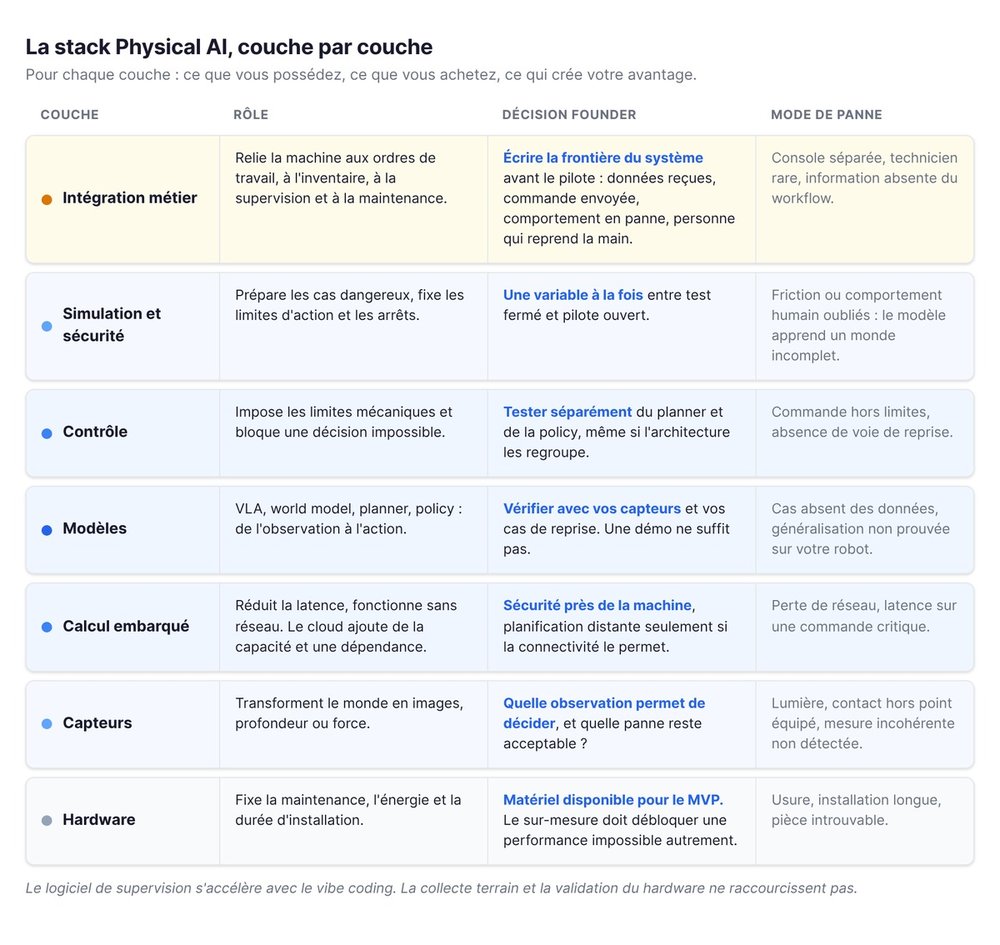
🧱 A decision map. Every layer carries a cost and a failure mode. You need to know which one you own, which one you buy, and which one creates your advantage.
Sensors and on-device compute
Hardware sets your maintenance load, your power draw, and how long installation takes. On-device compute cuts latency and works without a network. The cloud brings more capacity, but adds an external dependency. The five criteria for choosing between them are laid out in our article on edge AI.
Safety commands stay close to the machine. Planning can run on remote compute if connectivity allows.
For an MVP, favor hardware you can actually get. Custom builds should only unlock performance you cannot reach any other way.
Vibe coding speeds up your supervision software. It does not shorten field data collection or hardware validation.
Models and control
A VLA model links vision to language, then to action. π0 adds an action expert based on flow matching to a vision-language backbone. The team reports frequencies of up to fifty hertz for some dexterous manipulation.
A world model predicts how the environment will evolve. A planner picks a sequence. A policy turns state into action. The controller enforces the physical limits. Even when a single architecture bundles these functions, test them separately.
Check the model against your sensors and your recovery cases. A demo does not settle it.
Simulation and workflow integration
Simulation prepares the dangerous cases. Safety sets action limits and stops. Integration connects the machine to the customer's workflow: work orders; inventory; supervision; maintenance.
This layer is often what decides adoption. A high-performing robot that forces a separate console and a hard-to-find technician can lose to a less general machine that is built into the workstation. The customer is buying an outcome inside their own flow.
Before the pilot, write down the system's boundary. Specify the data it receives, the command it sends, how it behaves on failure, and who is authorized to take over. That interface keeps you from discovering on site that your autonomy depends on information the workflow never produces.
Where a startup can build a moat
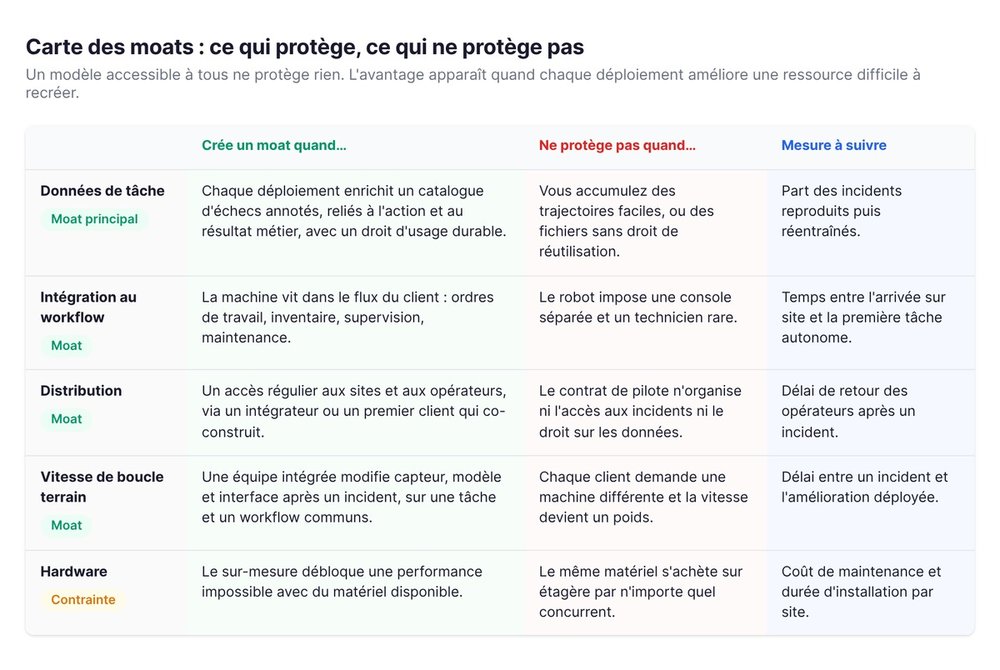
🏰 The defensible point. A model everyone can access protects nothing. Your advantage shows up when each deployment improves a resource that is hard to recreate.
Proprietary data on a narrow task
The best data links a hard situation to an action and to its business result. A well-annotated catalog of failures can be worth more than a mountain of easy trajectories.
Pick a task where the workflow itself produces the feedback. If every label requires you to be there, collection will not scale.
An installed fleet or deep integration builds a lead. Files without durable usage rights build no moat at all.
Vertical integration and the deployment loop
An integrated team can change the sensor, the model, and the interface after an incident. That speed helps when the layers interact. It becomes a burden if every customer asks for a different machine.
Keep one shared task and one shared workflow. Customer-specific adaptations stay in parameters or connectors.
Measure the time between arriving on site and the first autonomous task. If it drops with every installation, you are building an operational asset.
Distribution and access to the real environment
Physical AI is sold in the field. Regular access to sites and operators shortens the learning loop. That channel can come from an integrator or from a first customer willing to build alongside you.
The pilot contract also has to organize the learning. Define access to incidents, the right to reuse the data, and how quickly operators send feedback. Without those operational clauses, you deploy a machine without building the loop that is supposed to improve it.
A technical problem does not become a market if nobody carries the budget and the risk. Identify the buyer and the user before you widen the sale.
AI on its own creates no moat. The field can.
Deciding whether your market is ready
✅ The first decision. Pick a task where autonomy creates enough value to pay for the data, the hardware, and the errors that remain.
Choosing a bounded task and environment
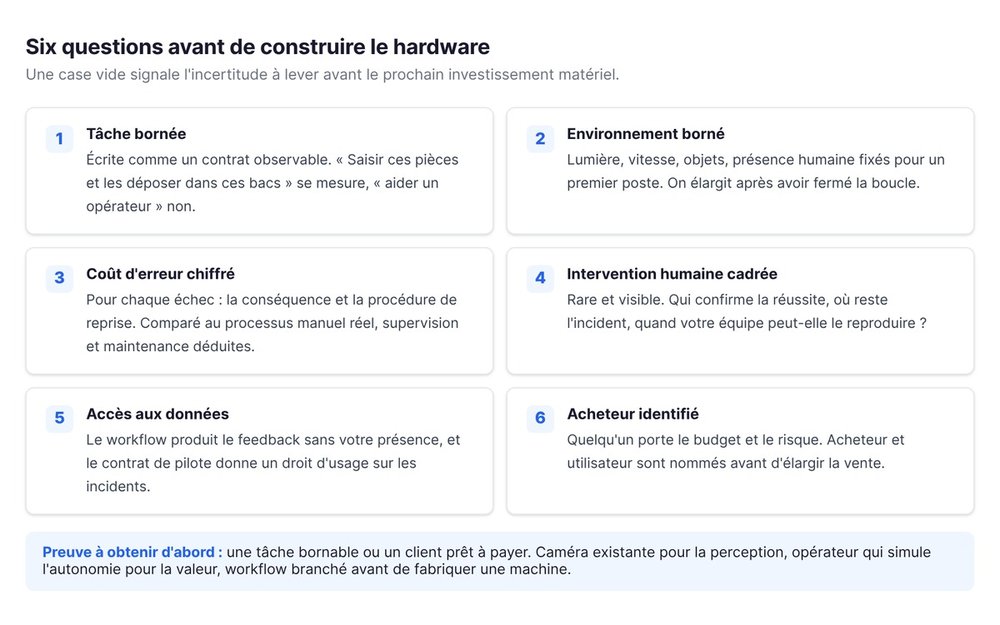
Write the task as an observable contract. "Assist an operator" stays vague. "Pick these parts and drop them in these bins" can be measured.
Bound the environment: light; speed; objects; human presence. Widen it after you have closed the loop on a first workstation.
The best wedge combines a frequent pain with manageable variability. That wedge automates a verifiable outcome.
Putting numbers on errors and human intervention
For every failure, note the consequence and the recovery procedure. Human intervention stays acceptable as long as it is rare and visible.
Then compare autonomy against the real manual process. Count the operator time saved, then subtract supervision and maintenance time. That baseline stops you from selling technical performance that produces no savings for the customer.
Document the feedback: who confirms success, where the incident stays, and when your team can reproduce it.
Set a threshold before moving into production. Track task success, safety, and human workload.
Defining the proof you need before building hardware
Test the most expensive hypothesis first. For perception, collect scenes with a camera you already have. For value, simulate autonomy with an operator. Wire up the workflow before you build a machine.
Your proof has to confirm either a task you can bound or a customer ready to pay. That proof is not just there to produce a demo. It also tells you which uncertainty to remove before your next hardware investment.
If you are building a startup on this stack, apply to swanbase. We will work with you on the wedge, the field proof, and the deployment loop.
Physical AI FAQ
💬 Short answers. Use them to align your team before you get into architecture.
What is the difference between Physical AI and robotics?
Robotics designs machines that can sense and act. Physical AI adds learning models that adapt the action to the situation. A robot can run on fixed rules. Physical AI learns or generalizes from data.
Does Physical AI require a humanoid robot?
No. An autonomous vehicle, a drone, a sorting system, or an industrial arm can all run Physical AI. The form follows the task and the environment. Our map of French humanoid robots shows where the human form actually earns its place.
Why is synthetic data useful?
Synthetic data lets you vary scenes and generate rare cases without tying up the site. It lowers collection costs, but it does not replace real data. The system has to check the gap between simulation and deployment.
What is the difference between Physical AI and embodied AI?
Embodied AI mostly refers to intelligence that learns through a body situated in an environment. Physical AI emphasizes the complete autonomous system and how it executes in the real world. The two scopes overlap.
The next step is yours: pick a task, bound its environment, and get a first round of field feedback before you widen the promise.