A world model is an AI model that learns to predict how the world evolves, based on observations (video, sensors, actions), where an LLM learns to predict the next word in a text. Yann LeCun, 2018 Turing Award winner and former Chief AI Scientist at Meta, left Meta in late 2025 to found AMI Labs in Paris and build these world models, because he believes text prediction, however large you scale it, will never produce a machine that understands the consequences of an action.
For a founder, the useful question fits on one line: what does this let you build right now, with which models, and at what entry cost. The researchers' debate can settle itself later.
What is a world model?
🧭 Definition. A world model is an internal representation of the environment that an AI system uses to anticipate the effect of its actions before executing them. Wikipédia en français describes it by analogy with a human's mental model: a map of the world's dynamics, not a copy of the world.
Predicting the world instead of predicting the next word
An LLM has read billions of sentences describing gravity. It knows how to write that a dropped glass falls. A world model has watched hours of video of objects falling, and it has learned to predict the trajectory. The first one describes, the second one anticipates.
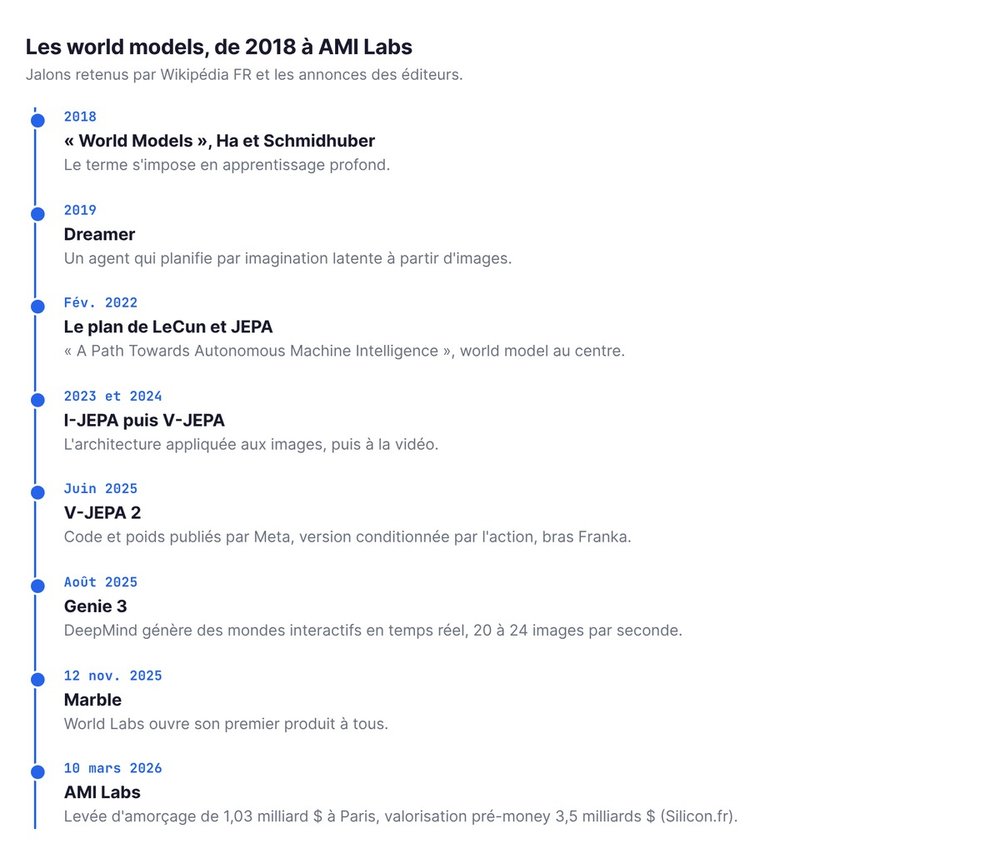
The term took hold in deep learning with the 2018 paper "World Models" by David Ha and Jürgen Schmidhuber, but the idea goes back to reinforcement learning in the 1980s: an agent that has a model of its environment can simulate several futures, compare them, then act. Predictive video models like Dreamer (2019) and Meta's JEPA architectures (2022) are the recent milestones Wikipedia singles out.
The chess player's mental map, LeCun's image
A chess player does not simulate every photon on the board. They hold an abstract map of the position and think three moves ahead. That is the image LeCun uses for his approach: a useful world model does not need to reproduce the world in pixels, it needs to grasp its logic and predict in an abstract representation space.
That distinction, abstraction versus realistic simulation, is what separates the teams building world models.
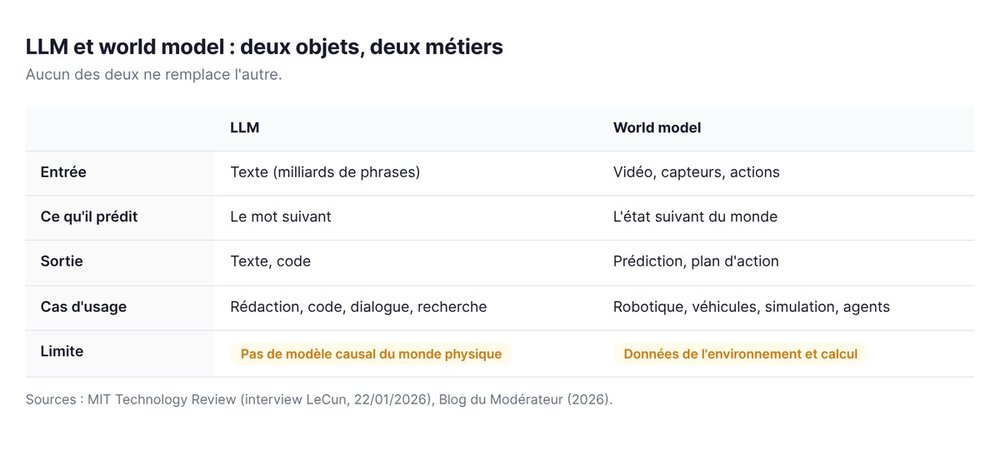
World model vs LLM: the difference that matters
⚖️ Two objects, two jobs. The LLM manipulates language. The world model manipulates world states and how they evolve. Neither replaces the other.
An LLM and gravity
In his January 2026 interview with MIT Technology Review, LeCun sums up his critique: LLMs "manipulate language very well," but the idea that simply making them bigger gets you to human-level intelligence is "just wrong." The hard part, he says, is understanding the real world. He cites Moravec's paradox, formulated in 1988: what is easy for us (perceiving, moving around) is hard for machines, and vice versa.
An LLM knows the glass falls; it has no idea what happens if the glass sits on the edge of a vibrating table, because no text describes that scene. A world model, trained on the scene and its variants, produces a prediction.
Two uses, no substitution
LLMs answer universal needs: summarizing, writing, conversing, coding. World models are built to anticipate and act: robotics, autonomous vehicles, simulation, agents making decisions inside an environment. In its 2026 feature, Le Blog du Modérateur quotes the Head of Data Science at the Hellowork group: world models will be "hidden," like pre-ChatGPT AI, powering tools rather than consumer interfaces.
LeCun says as much to MIT Technology Review: LLMs will become "the orchestrator" of systems where the world model does the prediction work.
Why Yann LeCun is betting on world models
📍 The context in three facts. 2018 Turing Award with Hinton and Bengio. Founder of Facebook's FAIR lab in 2013, Chief AI Scientist at Meta until his departure was announced in November 2025. Founder of AMI Labs, Advanced Machine Intelligence, headquartered in Paris.
The 2022 plan and JEPA
In February 2022, LeCun published "A Path Towards Autonomous Machine Intelligence," a position paper describing a complete architecture for an autonomous agent. At its center: a world model that predicts how the world evolves, including the consequences of the agent's own actions. The architecture he proposes to implement it is called JEPA, Joint Embedding Predictive Architecture.
JEPA does not predict pixels. It encodes two related observations (two images, two moments in a video) into an abstract space, then trains a predictor to recover one representation from the other. Unpredictable details (the texture of a surface, the grain of the light) are ignored; the structure (shapes, trajectories, spatial relationships) is kept. That is LeCun's argument against generative video models: "the world is unpredictable; if you try to predict every detail of the future, you will fail."
I-JEPA in 2023 applied the idea to images, V-JEPA in 2024 to video. V-JEPA 2, released by Meta in June 2025 with code and weights, adds an action-conditioned version trained on a small volume of robot data, and Meta shows the model driving a Franka arm through pick-and-place tasks in unfamiliar environments.
AMI Labs in Paris
On March 10, 2026, AMI Labs announced a $1.03 billion seed round, roughly €890 million, at a $3.5 billion pre-money valuation, according to Silicon.fr. The company is headquartered in Paris, Alexandre Lebrun, co-founder of Nabla, takes the CEO role, and LeCun keeps the scientific one. World models have left the lab.
To MIT Technology Review, LeCun describes applications that look nothing like a chatbot: a holistic model of an aircraft engine or a steel mill learned from thousands of sensors, or glasses that understand what they see. His systems will be trained "on video, audio and sensor data of all kinds," from the position of a robot arm to lidar.
How you build a world model
🔧 The principle. You show the model a lot of video or a lot of situations, you ask it to anticipate what comes next without any hand annotation, and it learns the consequences of actions.
Watch video, predict in latent space
The JEPA recipe has three blocks: an encoder turns the observation into a compact representation; a predictor learns the dynamics in that space, from the current representation and the action; a regularization term stops the model from cheating by producing empty representations. LeWorldModel, published in 2026 by researchers from Mila, NYU and Brown with LeCun among the authors, shows that such a model can be trained end to end from pixels with only two loss terms, at a lower compute cost than previous methods.
Prediction happens in an abstract space, not in the image: cheaper than video generation, and far less spectacular to watch.
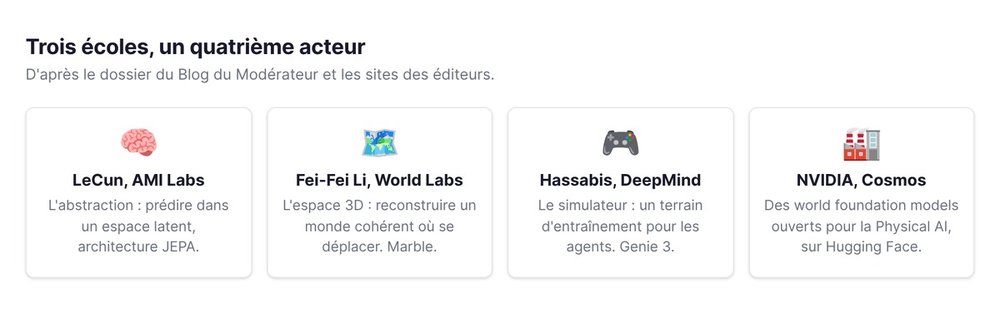
The three schools: LeCun, Fei-Fei Li, Hassabis
Le Blog du Modérateur's feature sums up three competing approaches:
- Yann LeCun, AMI Labs. Abstraction. The world model grasps the logic of the world, not its appearance. JEPA.
- Fei-Fei Li, World Labs. Spatial perception. The world model reconstructs a coherent three-dimensional space you can move through. Marble, their first product, generates persistent 3D worlds from text, images or video, and has been open to the public since November 12, 2025.
- Demis Hassabis, Google DeepMind. The training ground. The world model is a simulator an agent practices in. Genie 3, introduced in August 2025, generates real-time interactive environments at 20 to 24 frames per second in 720p; Google is gradually opening it through Project Genie to AI Ultra subscribers, starting in the United States.
NVIDIA takes a fourth spot with Cosmos, a family of "world foundation models" for Physical AI, downloadable on Hugging Face, designed as both a physics simulator and a post-training base for robots.
The world models you can access today
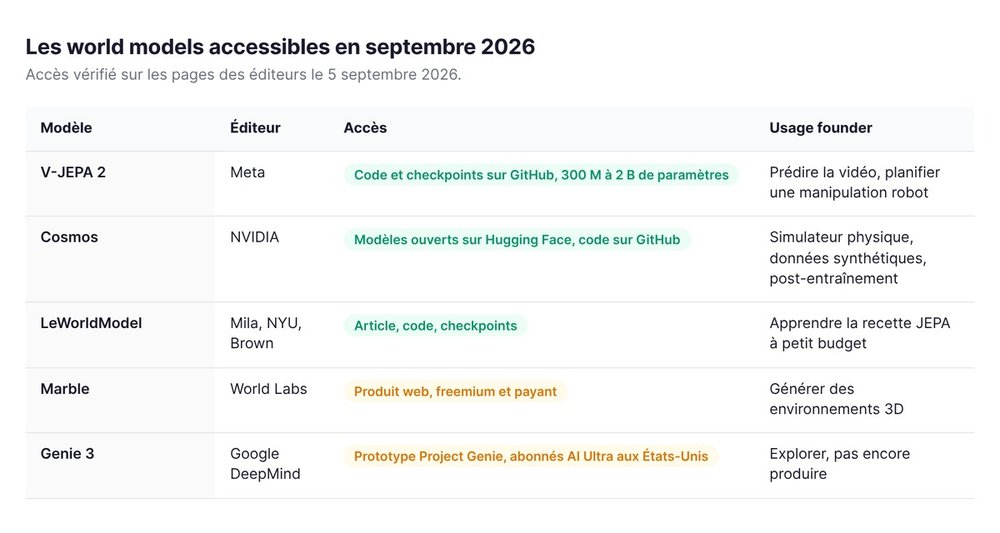
🗂️ Four entry points. Two are open with code and weights, one is a consumer product, one is a research prototype behind a subscription.
V-JEPA 2, Cosmos, Genie, LeWorldModel: who gives access to what
| Model | Publisher | Access | Founder use |
|---|---|---|---|
| V-JEPA 2 | Meta | code and checkpoints on GitHub (encoders from 300 million to 2 billion parameters) | understand and predict video, plan a robot manipulation from an image goal |
| Cosmos | NVIDIA | open models on Hugging Face, code on GitHub | physics simulator, synthetic data, post-training on your cameras and your robot |
| LeWorldModel | Mila, NYU, Brown | code and checkpoints released with the paper | learn the end-to-end JEPA recipe on a small compute budget |
| Marble | World Labs | web product, freemium and paid | generate 3D environments for a game, a walkthrough, a simulation |
| Genie 3 | Google DeepMind | Project Genie prototype, AI Ultra subscribers in the United States | explore interactive worlds, not yet a production building block |
What a first attempt costs
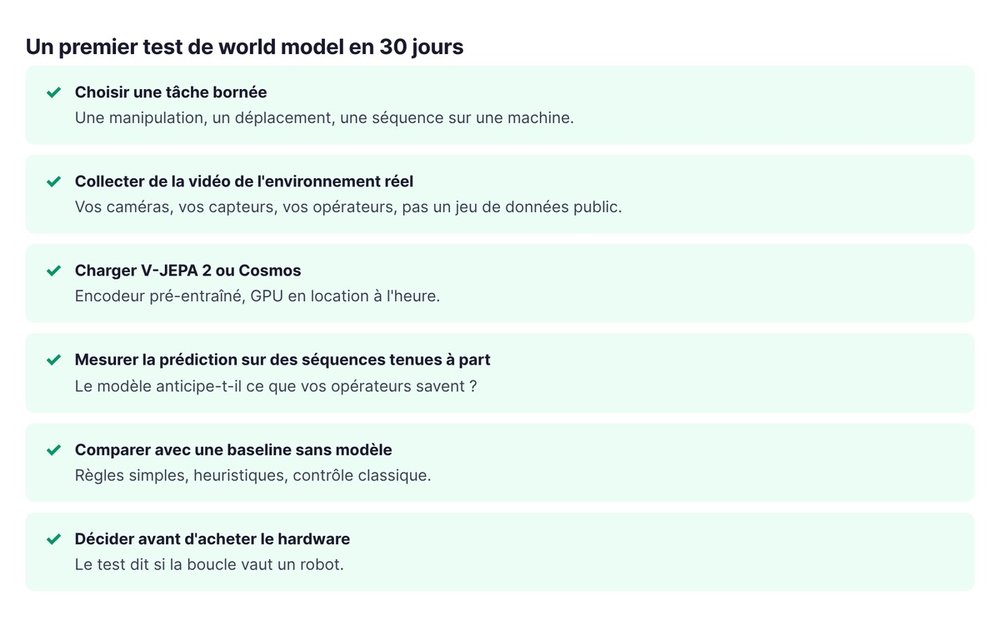
For V-JEPA 2 and LeWorldModel, the entry cost is a rented GPU and an engineer who reads a GitHub repo. You load a pre-trained encoder, you plug it into your videos, you measure what it predicts. For Cosmos, the cost is the time it takes to learn NVIDIA's tooling. For Marble, a subscription.
The expensive part is not the model. It is the data from your environment: the hours of video of your warehouse, your operating room, your production line. The swanbase pillar on Physical AI and its stack explains why data is the bottleneck.
What a founder can actually do with this
🏗️ Three cases where a world model changes a product decision. Plus a reminder of what it does not change.
Simulate before you build
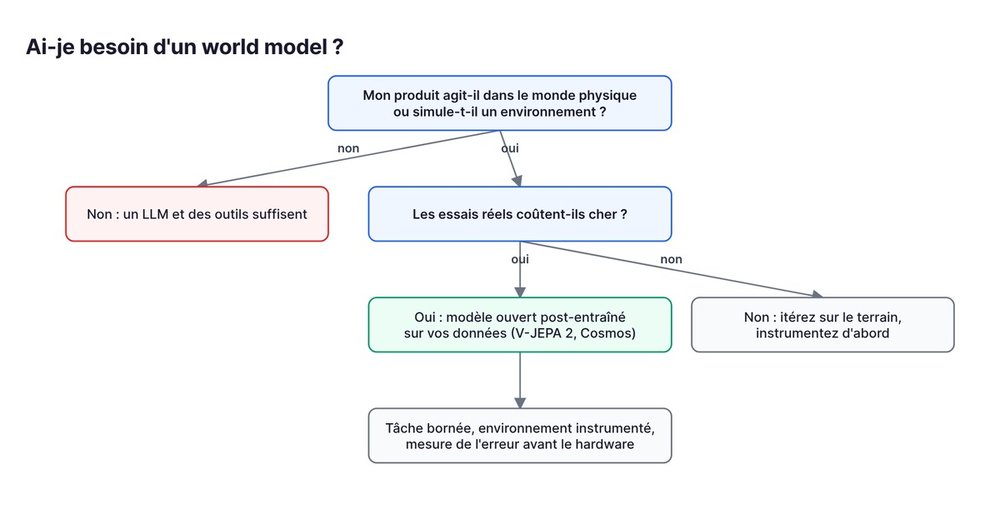
If your product acts in the physical world, question number one is the cost of real-world trials. A world model trained on your videos, or a simulator like Cosmos, lets you test a control policy hundreds of times before you break a part. Meta's V-JEPA 2 demo on a Franka arm, in an environment it had never seen, is exactly that scenario: planning from an image goal, without retraining on site.
For a founder, that translates into one decision: order the hardware later, and prove the loop in simulation first.
Agents that can plan
Agents built on an LLM chain tool calls together without knowing what happens if an action half fails. An agent with a world model can ask the question LeCun cites as his example, "if I do this, what happens next?", and choose accordingly. Le Blog du Modérateur's feature places the tipping point right there: agents with "far more autonomy, far more responsibility," and therefore an impact on every industry that runs processes.
The industrial case LeCun describes, a holistic model of a factory built from thousands of sensors, is a viable product for a vertical startup that has access to a sector's sensor data.
Out of reach in 2026
Three things stay out of reach for a three-person team: training a foundation world model (that is the job of AMI Labs, Meta and NVIDIA), getting robust generalization when the environment changes (LeCun himself says "absolutely nobody" knows how to make a humanoid robot smart enough to be useful), and deploying without a human in the loop on a task where an error is expensive. Le Blog du Modérateur points at the weak spot: when a world model decides and acts, the human interface that used to proofread an LLM's output disappears.
The right scope in 2026: a bounded task, an instrumented environment, an open model post-trained on your data, and a way to measure error. That is the advice in the Physical AI pillar, because the world model is the "build a representation and plan" layer of that stack, sitting just above the on-device compute described in our article on edge AI, and beneath the French humanoid robots that are its most visible application.
If you are building on this stack, you can apply to swanbase.
FAQ on world models
Will world models replace LLMs?
No. LLMs handle language and code; world models handle anticipating and acting. LeCun describes a future where the LLM orchestrates systems that include perception and a world model. The two coexist, and NVIDIA already combines both in Cosmos.
Do world models lead to AGI?
That is the thesis held by LeCun and DeepMind, who both present their world models as a step toward general intelligence. LeCun tells MIT Technology Review that "major conceptual breakthroughs" are still needed and that it "is not going to happen next year." None of which affects what a founder can build today.
Can you test a world model without a GPU?
For exploring, yes: Marble is a web app and Project Genie runs in the browser for eligible subscribers. To post-train V-JEPA 2 or Cosmos on your own data, you need a GPU, and renting one by the hour is enough for a first attempt.