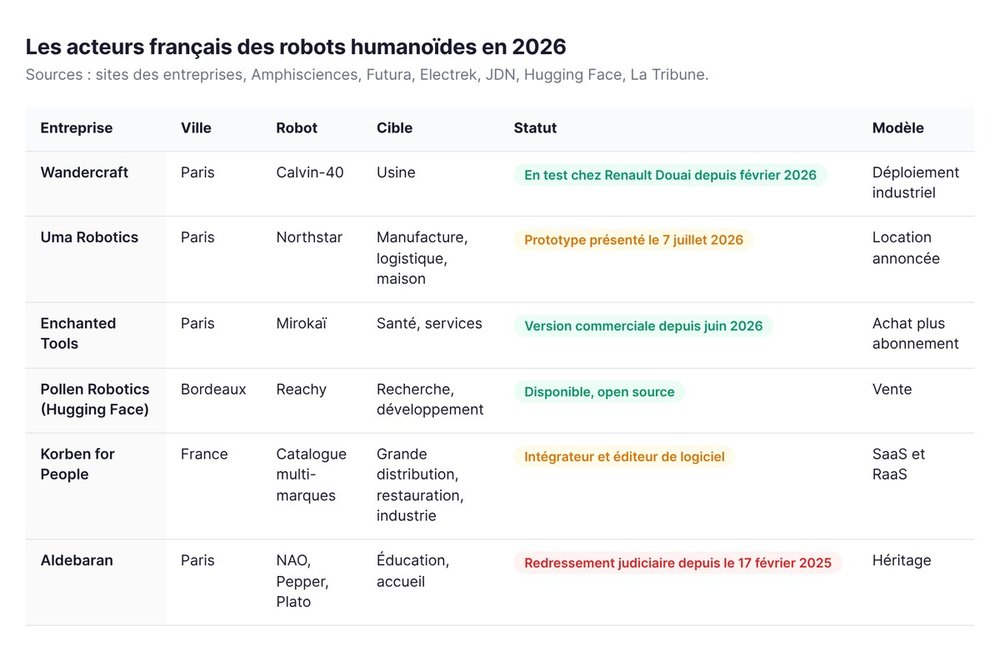
As of 2026, four French companies have either built a humanoid robot or unveiled one: Wandercraft (Calvin, in testing at Renault's Douai plant since February), Uma Robotics (Northstar, a prototype shown in July), Enchanted Tools (Mirokaï, commercial version launched in June) and Pollen Robotics (Reachy, open source, acquired by Hugging Face in 2025). None of them sell to consumers. Public prices run from an entry-level Chinese robot advertised from $13,500 to a French service robot priced around 50,000 euros to buy, subscription on top.
You want the map before deciding where to build: the players, what their robots actually do, the prices, and the slots still open in the value chain for a startup that will never manufacture a humanoid. Here it is.
French humanoid robots in 2026: the map of players
🗺️ Four manufacturers, one integrator, one legacy. Each comes from a different trade: medical exoskeletons, self-driving AI, the old Aldebaran team, developmental robotics research.
Wandercraft: from the Atalante exoskeleton to Calvin at Renault
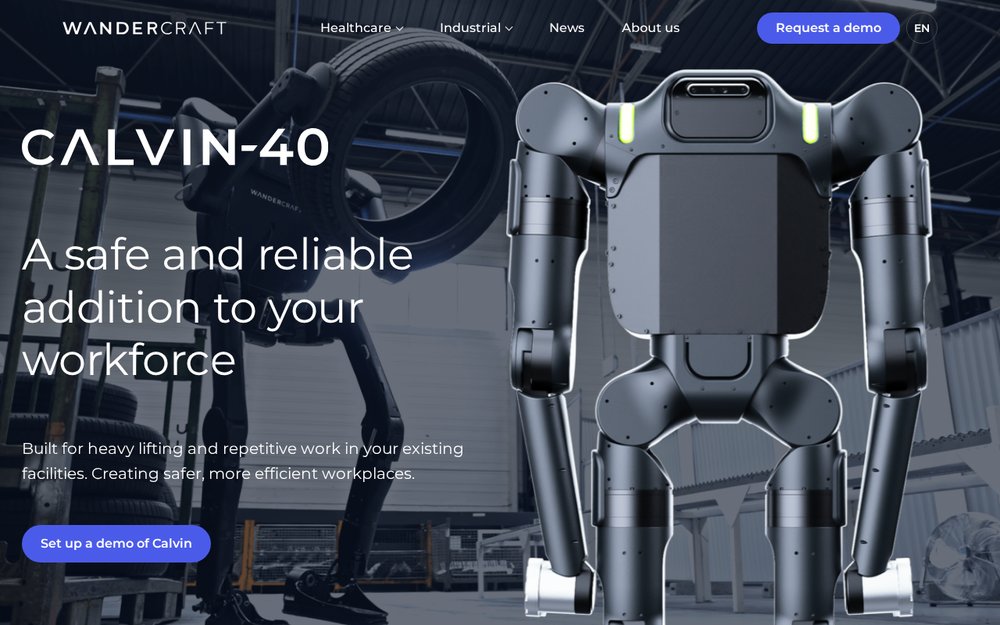
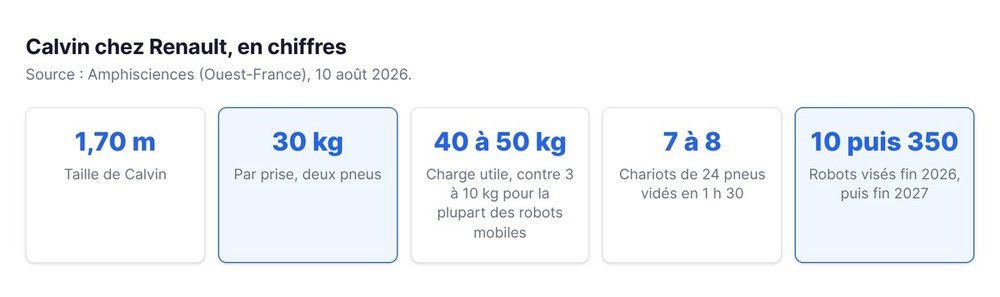
Wandercraft, a Paris scale-up, has spent more than ten years building self-balancing exoskeletons for rehabilitation (Atalante) and daily life (Eve). Its industrial humanoid is called Calvin-40. According to an investigation by Amphisciences, the science magazine of Ouest-France published in August 2026, Calvin stands 1.70 m tall and has been working since February 2026 in the wheel shop of Renault's Douai plant, where it picks up tyres two at a time, roughly thirty kilos per grab, with a payload of 40 to 50 kg where most mobile robots top out between 3 and 10 kg.
The story starts at a Cap Digital conference on 1 October 2024, where a Renault robotics expert heard the words "humanoid robots." The announced roadmap: around ten robots in French and Spanish plants by the end of 2026, then 350 units by the end of 2027. Wandercraft presents Calvin with a target failure rate below 1 in 1,000, backed by its medical device manufacturing standards.
Uma Robotics: Northstar, a prototype in nine months
Uma, short for Universal Mechanical Assistant, came out of stealth in December 2025 in Paris. Its cofounder and CEO, Rémi Cadène, spent about three years at Tesla in the Autopilot group, working on the vehicle's AI systems and on Optimus, then led LeRobot at Hugging Face, the open source robotics library. On 7 July 2026, at the Machina show in Paris, he presented Northstar, a bipedal prototype built in nine months, according to Futura and Electrek.
The prototype, still hanging from a safety cable, stays upright when pushed. Uma is announcing a rental model rather than outright sales, targeting manufacturing, logistics and the home, with "50 potential customers" in discussions according to Electrek. No product has shipped so far.
Enchanted Tools: Mirokaï, the service robot with a face
Founded in 2021 by Jérôme Monceaux and Samuel Benveniste, both Aldebaran alumni, Enchanted Tools builds the Mirokaï, service robots with expressive heads and articulated ears, designed as characters rather than machines. On 16 June 2026, the company launched the commercial version of its robots at its urban factory in the 11th arrondissement of Paris, a 300 m² pilot line opened in late 2024.
The use cases, as described by Jérôme Monceaux to the Journal du Net in March 2026: assistance, monitoring and emotional support in healthcare, with deployments in paediatric radiotherapy at the Institut du Cancer de Montpellier and in AP-HP nursing homes. The company was producing "by the dozens" and aims for hundreds this year, then a thousand.
Pollen Robotics: Reachy, the open source humanoid from Bordeaux
Pollen Robotics, founded in 2016 in Bordeaux by two former researchers from Inria's Flowers team, builds Reachy, an open source humanoid launched at CES 2020 and used in around a hundred units across some twenty countries. On 14 April 2025, Hugging Face announced its acquisition of Pollen Robotics, its fifth acquisition, to sell open source robots and connect them to LeRobot.
Reachy is a research and development platform, teleoperable in virtual reality, that labs and product teams buy to build on top of.
Korben for People and the rest
Korben for People is a French company founded by Lucas Goumarre, a pharmacist by training, that publishes fleet management software for multi-brand service robots, priced at around 150 euros excluding VAT per robot per month according to Robot Magazine, and that resells and rents cleaning, reception and logistics robots to retail and hospitality. A TF1 report in January 2026 showed a humanoid from its catalogue, valued at 150,000 euros, destined for a nuclear site. Korben is an integrator and a software vendor; the robot comes from another manufacturer.
Other names come up: the "Nio" robot from a French company, not a humanoid, mentioned on Reddit; public labs such as LORIA in Nancy and LAAS-CNRS in Toulouse, which run Unitree G1 and H1 units for locomotion research.
NAO, Pepper, Aldebaran: the legacy
France was a pioneer. NAO, designed by Aldebaran in Paris, remains the best-known humanoid robot, present in schools and labs since 2006. Then Pepper, then Plato. Aldebaran, which passed under Japanese and later German control, entered receivership on 17 February 2025, cut 80 of its 167 jobs, and received two takeover offers in the spring of 2025, according to La Tribune. Part of the French humanoid ecosystem descends from that team: the founders of Enchanted Tools came out of it.
What a humanoid robot actually does in 2026
🏭 Two arenas, one limit. The factory and the service floor. Plus a list of things no humanoid does reliably yet.
In the factory: tyres, two at a time
Renault runs 11,000 six-axis robots across 23 plants, each bolted to one station and one task. Calvin moves around, reads the scene with a depth camera and force sensors under its feet, and empties seven to eight carts of 24 tyres in an hour and a half. Repeated heavy handling is one of the leading causes of musculoskeletal disorders in the auto industry; that is the task it gets first.
The Amphisciences piece also describes the weekly work: every week, the Renault and Wandercraft teams adjust the camera height, the leg length, the software. Deploying a humanoid is a weekly integration job that starts on delivery day.
In services: reception, light logistics, monitoring
Enchanted Tools' Mirokaï rest on three building blocks, according to their founder: social interaction, social navigation, and manipulation in human environments. They keep a child company alone in a radiotherapy room, guide residents in nursing homes, carry small objects. At Korben, service robots clean hypermarkets and greet guests in restaurants: most of them run on wheels, and the humanoid is the exception.
The limits in 2026
Yann LeCun, interviewed by MIT Technology Review in January 2026, is blunt: demos of dancing robots are "planned in advance," and "absolutely nobody" knows how to make these robots smart enough to be generally useful, because every task demands a mass of teleoperation data and generalisation to a slightly different environment remains weak. The scientific reviews cited by Amphisciences flag the same blockers: energy autonomy, robustness, safety around humans.
A humanoid sold in 2026 performs one bounded task, in a prepared environment, with a team tuning it.
What a humanoid robot costs
💶 Three price tiers, plus a fourth you never see. The research robot, the service robot, the industrial robot, then integration.
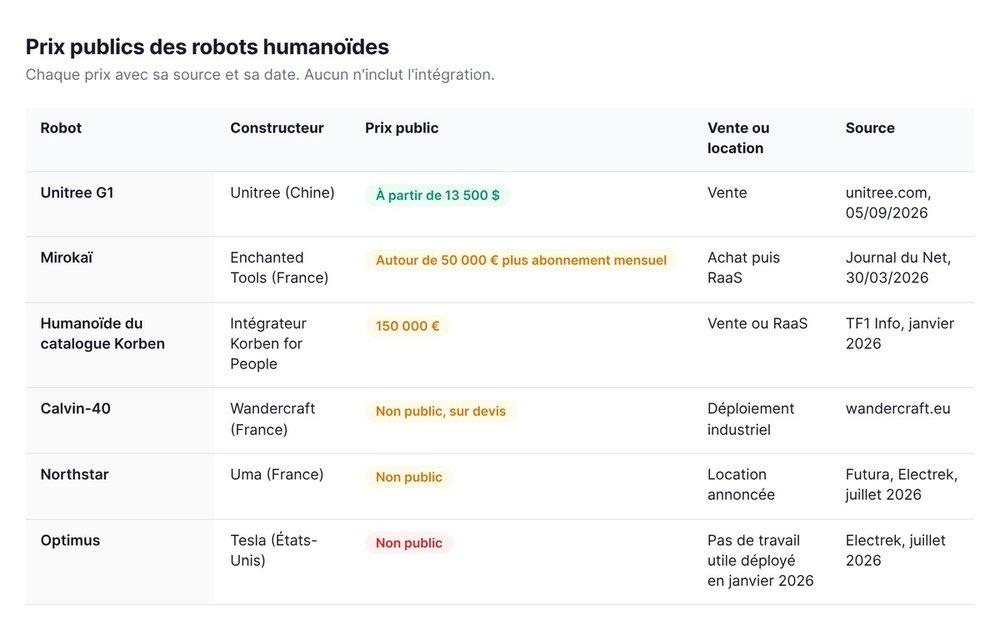
Public prices: from Unitree to Optimus
| Robot | Manufacturer | Public price | Source, date |
|---|---|---|---|
| Unitree G1 | Unitree (China) | "from $13,500" | unitree.com, accessed 05/09/2026 |
| Mirokaï | Enchanted Tools (France) | "around 50,000 euros to buy," plus a monthly subscription of several hundred euros | Journal du Net, 30 March 2026 |
| Humanoid from the Korben catalogue | integrator Korben for People | "valued at 150,000 euros" | TF1 Info, January 2026 |
| Calvin-40 | Wandercraft (France) | not public, industrial deployment quoted case by case | wandercraft.eu |
| Northstar | Uma (France) | not public, rental announced | Futura, Electrek, July 2026 |
| Optimus | Tesla (United States) | not public; Electrek reported in January 2026 that no Optimus is yet doing "useful work" | Electrek, July 2026 |
The Unitree G1 sets the entry price for the global market. LORIA picked it, according to Génération Robots, for its performance-to-budget ratio, code access and user community. At the other end, Figure runs its robots on shifts at BMW in Spartanburg, but publishes no prices.
Sale, rental, robot-as-a-service
Enchanted Tools is aiming for robot-as-a-service but getting there gradually, because building a robot costs a lot up front and subscriptions spread revenue over time. Uma is announcing rental from day one. Korben bills its fleet software as a subscription and offers RaaS on the hardware. The question "what does the robot cost" turns into "what does an hour of robot cost."
The hidden cost: integration and operation
A Mirokaï contains roughly 1,500 parts, a complexity comparable to a compact car, according to its founder; a shortage of one minor component halts production. On the customer side, the real cost hides in site integration, training, maintenance and the weekly tuning seen at Renault, line items absent from every public price.
Humanoid or not: choosing the right form factor
🤔 The question Reddit asks and manufacturers dodge. "The humanoid form factor promises more than it delivers," reads the title of one French-language thread.
Why the human shape
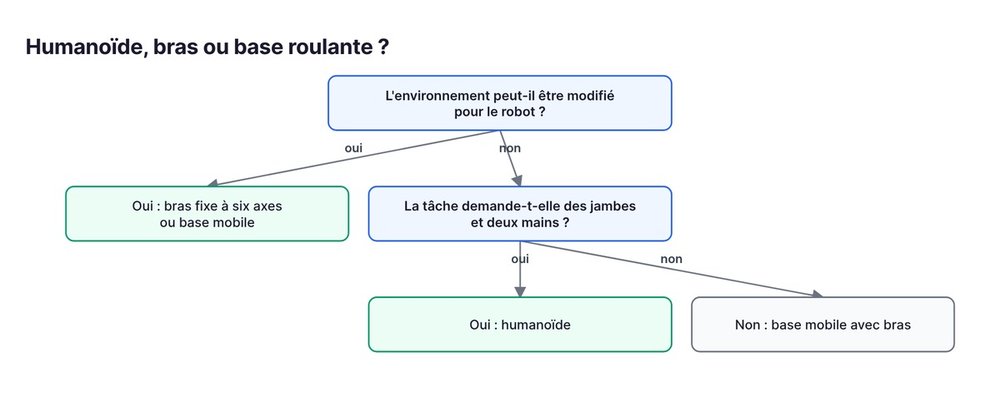
The manufacturers' argument is the one Lucas Goumarre made on TF1: "tasks are designed for human beings." A site built for arms, hands and legs takes a humanoid without renovation work. That is the case for Calvin in an existing plant, and Uma's case for manufacturing.
When an arm or a wheeled base is enough
If the task is fixed, a six-axis arm costs less and breaks down less. If the floor is flat and the load rolls, a mobile base does the job: that is what Korben and most retail service robots deploy. The swanbase pillar on Physical AI answers the same question in its FAQ: the human shape is justified only when the environment cannot be changed.
Where a startup fits without building the robot
🧩 Six layers, two openings. Building the humanoid is the business of Wandercraft, Uma, Unitree, Figure and Tesla; the rest of the chain is open.
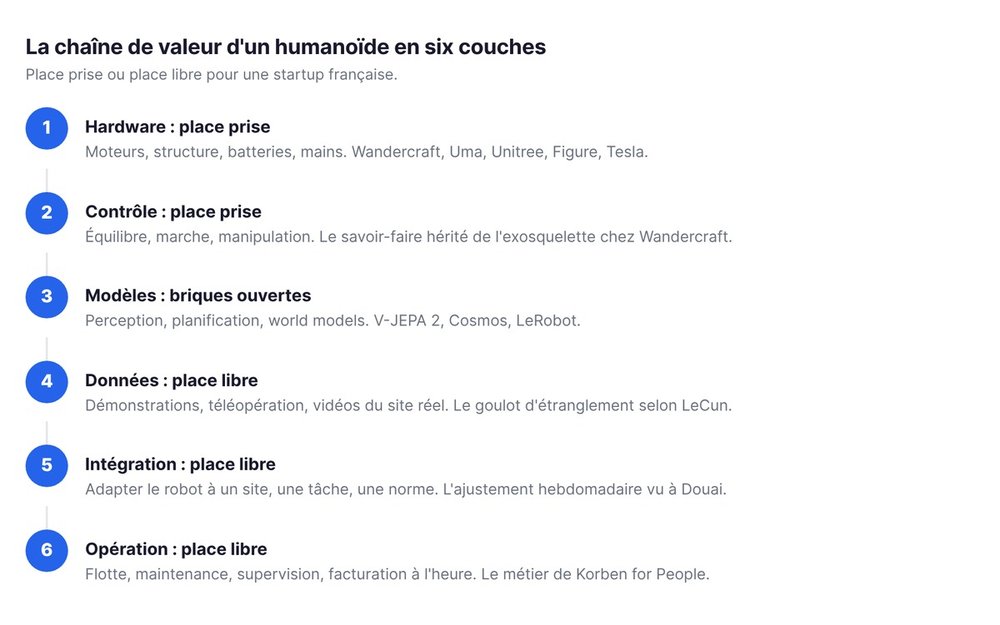
The value chain in six layers
- Hardware: motors, structure, batteries, hands. Capital heavy, long cycles.
- Control: balance, walking, manipulation. The know-how Wandercraft inherited from exoskeletons.
- Models: perception, planning, world models. The turf of AMI Labs, NVIDIA Cosmos, LeRobot.
- Data: demonstrations, teleoperation, video from the actual site. The bottleneck, according to LeCun.
- Integration: adapting the robot to a site, a task, a safety standard. The weekly work seen in Douai.
- Operation: fleet, maintenance, supervision, hourly billing. Korben's business.
The taken slots, the open ones
Layers 1 and 2 are held by funded players. Layer 3 belongs to labs and giants, but its building blocks are open (V-JEPA 2, Cosmos, LeRobot), and our article on world models spells out what a founder can do with them. Layers 4, 5 and 6 are where a vertical startup wins: the data of one specific sector (hospital pharmacy, cold chain logistics, nuclear maintenance), integration for one type of site, running a multi-brand fleet. Korben built exactly that, with software and robots from other brands.
Starting from a Unitree G1 like a lab
LORIA and LAAS-CNRS, according to the Génération Robots blog, got their Unitree units walking almost immediately under teleoperation and deployed walking policies trained in simulation. That is the path for a layer 4 or layer 5 startup: buy an entry-level robot, instrument a task, collect the data, sell the integration. The robot becomes a tool serving your product. Onboard perception and balance fall under edge AI; planning falls under world models. If your startup targets one of layers 4 to 6, apply to swanbase with the task and the site you have in mind.
FAQ on French humanoid robots
What is the best-known humanoid robot?
NAO, designed by Aldebaran in Paris, has been the reference in education and research since 2006, alongside Pepper for reception duties. Its manufacturer has been in receivership since February 2025, with takeover offers filed in the spring.
Is there a domestic humanoid robot in France?
No French manufacturer sells a humanoid to consumers in 2026. Uma lists the home among its future targets, and Lucas Goumarre of Korben talks about consumer sales "within 10 years."
What does an entry-level humanoid robot cost?
The Unitree G1 is advertised "from $13,500" on the manufacturer's site, options and integration excluded. The French labs using it add weeks of engineering before it does anything beyond walking.