Naval Ravikant: 5 Early-Stage Founder Lessons (the Francophone Filter, 2026)
Naval Ravikant offers five principles that change how an early-stage founder in France decides. Leverage (code and media scale without permission, capital and labor don't). Specific knowledge (the expertise no school can teach you). Build wealth, not status (assets that earn while you sleep versus the zero-sum game). Positive-sum games with long-term, trusted partners. And scarcity: doing what only you can do. This article does the sorting: we keep these five principles and bin the cargo cult "Joe Rogan = school" and the "rich in 10 years" promises. For each principle: a sourced quote, a concrete founder application, a practical decision for the week. At the end, the bridge to the interactive Naval Ravikant widget to explore more than 80 quotes sorted by theme.
Who is Naval Ravikant, in 200 words
Investor, AngelList, podcaster, philosopher
Naval Ravikant was born on November 5, 1974, in New Delhi. At 9, he landed in New York. Stuyvesant High School, then Dartmouth College (computer science + economics, 1995), a brief stint at Boston Consulting Group, then off to Silicon Valley.1
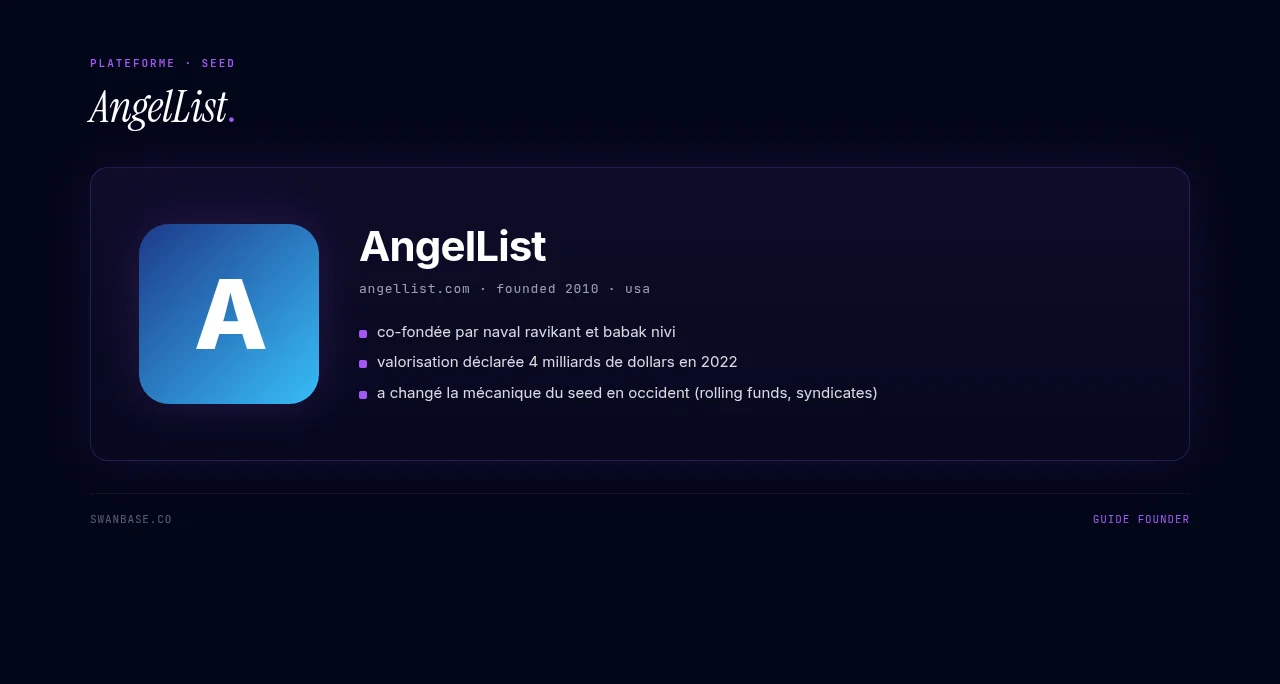
In 1999, he co-founded Epinions (raising 45 million from Benchmark and August Capital). In 2007, The Hit Forge, a 20-million early-stage fund that invested in Twitter, Uber, and Stack Overflow. In 2010, with Babak Nivi, he co-founded AngelList, which reshaped seed mechanics in the West. In 2022, AngelList Venture raised at a reported valuation of 4 billion dollars.2
Alongside the investor there's the podcaster (Nav.al) and the Twitter philosopher whose threads were compiled in 2020 into The Almanack of Naval Ravikant by Eric Jorgenson (French edition by Valor Editions).3 In 2023, he co-founded Airchat, a voice-based social network. He has never stopped building.
Why early-stage founders listen to him in 2026
He sold in 2003, invested before Twitter, built AngelList before seed funding got industrialized, and keeps publishing with no middle platform. His thinking has been tested by eighteen years of investor decisions. Not by eighteen management books.
Why another article about Naval Ravikant in French
The almanac-summary trap (already done 1,000 times)
Type "Naval Ravikant français" into Google. A PDF of the almanac from Valor Editions, an Audible page, a YouTube summary, two bookseller listings. No long-form French-language article that takes a position. Eighty quotes lined up like trinkets on a shelf.
You leave with the same vague impression you arrived with: Naval has "some interesting things to say about wealth."
The cut: 5 founder principles, not 80 quotes
Naval has published hundreds of tweets since 2015. Aphorisms to some, tools to others. This article doesn't list them, it sorts them.
Five principles, five sections, five concrete founder applications. The rest gets binned.
How we selected (criteria: actionable early-stage, verifiable, still valid in 2026)
Three criteria to make the cut:
- Actionable early-stage. Usable this week by someone just starting out, not by a post-Series-B founder.
- Verifiable. A source quote you can find on navalmanack.com or nav.al. No "Naval supposedly said that."
- Still valid in 2026. Some 2018 tweets no longer work the way they used to (platform algorithms have changed). We say so explicitly at the end.
Principle 1: Leverage (code, capital, media, labor)
Naval's definition (sourced quote)
"Fortunes require leverage. Business leverage comes from capital, people, and products with no marginal cost of replication (code and media)."4
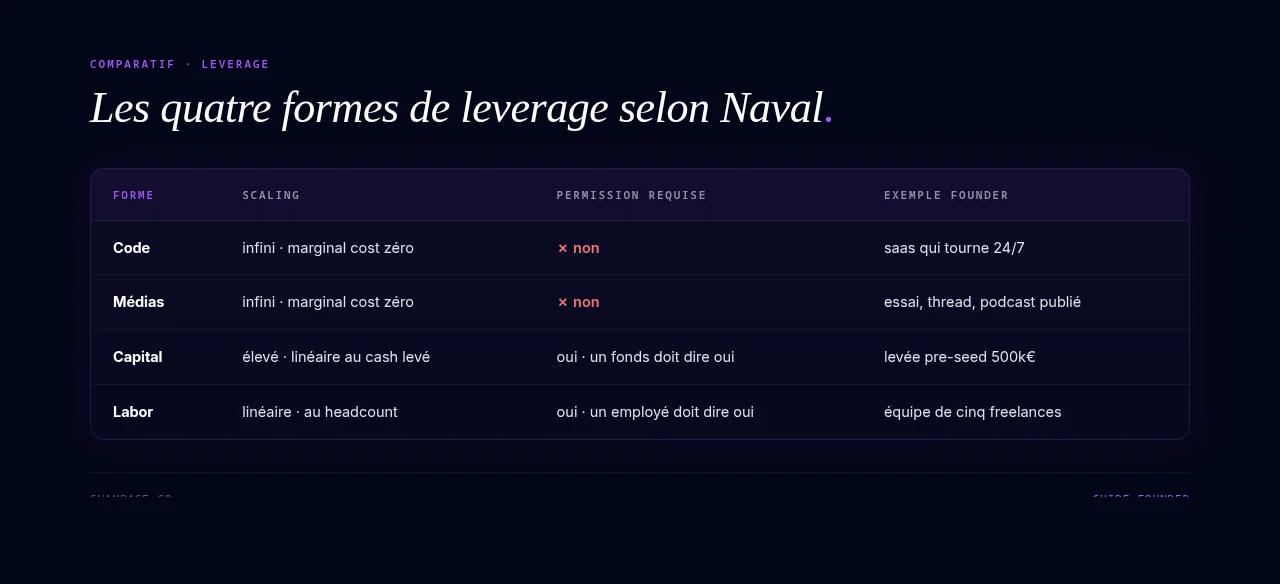
Four forms. Two old: capital (the money entrusted to you) and labor (the people who work for you). Two new: code (software that runs while you sleep) and media (content that duplicates for free).
Founder application: why code and media scale without permission
Naval distinguishes leverage with permission from leverage without permission.
"Capital and labor are permissioned leverage. Everyone is chasing capital, but someone has to give it to you. Code and media are permissionless leverage."4
Raising capital: a fund has to say yes. Hiring: a dev has to say yes. Shipping code to production or publishing a thread: nobody does. You hit enter.
The new fortunes no longer look like the old ones. Joe Rogan lives off code (Spotify) and media (his voice). Marc Andreessen wrote before he invested. YC coders pivot to their Substack when the startup wobbles.
Concrete founder decision: where to put your hours this week
Every Monday morning, out of forty hours, how many go into:
- permissionless leverage (writing code, publishing an essay, recording a podcast, shooting a demo)?
- permissioned leverage (chasing a fund, hiring a freelancer, prospecting a client)?
Not zero permissioned. But if the balance tilts 90/10 the wrong way three weeks running, you're working full-time on other people's decisions.
Pull-quote
Leverage in 2026 is binary: what scales without asking permission, and everything else.
Principle 2: Specific knowledge (the expertise you can't teach)
Naval's definition
"The first thing to notice about specific knowledge is that you can't be trained for it. If you can be trained for it, somebody else can be trained for it too."5
Specific knowledge is the expertise that fits neither in a course, nor a book, nor an algorithm. It's built through personal obsession and stays, by definition, impossible to replicate at scale.
"Specific knowledge is found by pursuing your curiosity. It's specific to the individual, to the problem, and it can only be built as part of a larger obsession."5
How to spot it in yourself (3 concrete signals)
Three questions, in order:
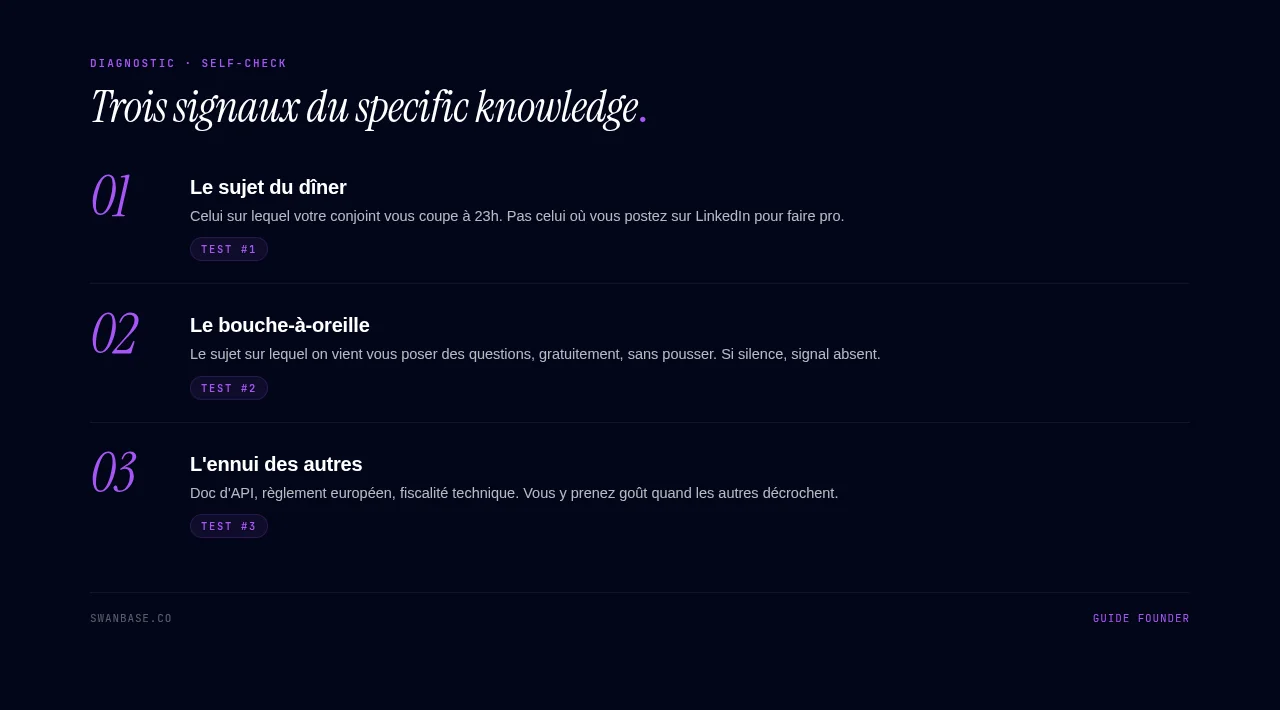
- What subject can you talk about at a dinner without watching the clock? Not the one you force yourself to post on LinkedIn to look professional. The one your partner cuts you off about at 11 p.m.
- What subject do people come to you with questions about, for free, unprompted? Word of mouth is the radar. If there's none, your specific knowledge isn't recognized yet.
- What subject do you read about that others find boring? API docs, an EU regulation, a tax article. If you enjoy it while others tune out, that's a strong signal.
Application: it's what your ICP needs and what sets you apart from an outside dev
For a solo founder or a duo, specific knowledge is the only defensible moat at seed. No pricing power, no network effect, no capital. Just your obsession and the precision with which you understand a problem nobody has dug into as deeply.
It's also what sets you apart from a freelance dev coding the same feature. He executes. You know why the feature exists, for whom, and how it will evolve in six months.
Pull-quote
Specific knowledge is what can't be taught to you. It's also the only thing that sets you apart at seed.
Principle 3: Build wealth, not status (why the second pulls you away from the first)
Wealth = assets that earn money while you sleep
"Seek wealth, not money or status. Wealth is having assets that earn while you sleep. Money is how we transfer time and wealth. Status is your place in the social hierarchy."4
Naval separates three things people confuse in France: wealth (assets that produce in your absence), money (the medium of exchange), status (your perceived social rank). The trap: believing you're chasing wealth when you're actually chasing status.
Status = zero-sum game (Twitter, YC rankings, Forbes 30 under 30)
"Wealth is not a zero-sum game. Status is a very old game, hierarchical, zero-sum. We've been playing it since monkey tribes."6
Every status medal one person takes is a medal another loses. Forbes 30 under 30 has 30 spots. A YC cohort has 200. A Maddyness cover, one. An elimination game.
While you play it, the competitor who abstains is building their product, their recurring revenue, their moat. They're playing the wealth game. You're playing the awards-ceremony photo.
Founder application: choosing a job vs choosing to be a founder = wealth vs status choice
Many become founders for the title, ranked higher than "employee" in certain social hierarchies. But becoming a founder for status is playing a harder game to win what you'd have gotten faster at a fashionable fund.
If wealth is the goal, the real question is "what puts me fastest in a position to own assets that produce without me?".
Pull-quote
You can't win both games at once. Pick the one that pays in compounding, not in photos.
Principle 4: Positive-sum games (long term, trusted partners, reputation)
Naval's definition
"Play long-term games with long-term people. All returns in life come from compound interest in long-term games."7
The real returns, in wealth, relationships, or knowledge, come from compounding. And compounding only works in iterated games with the same people.
Founder application: co-founder choice, angel/VC choice, client choice
Three critical decisions for a founder:
- The co-founder. You'll spend more hours with them than with your partner for three years. The choice is made on a ten-year horizon, not three months.
- The business angels and funds. An angel who puts in 20K and vanishes has nothing to do with one who'll follow on at Series A and open their network to you. (To go deeper: how to find business angels.)
- The clients. Three clients who stay five years beat a wave of media-friendly logos that churn in six months.
"Compound interest in long-term relationships"
"Compounding in business relationships is very important. They are trusted because the relationships they've built and the work they've done has compounded."7
Reputation is the only asset that builds slowly and gets destroyed in a day. Trust can't be hacked. It accumulates, by default, by doing what you said you'd do, over ten years.
The opposite of the classic Twitter game, where the incentive is to capture maximum attention in six months by selling courses.
Pull-quote
Trust is compounding. It can't be hacked. It accumulates, by default, over ten years.
Principle 5: Scarcity (doing what others can't, not what they won't)
Difference from the trivialized "do what you love"
"Escape competition through authenticity. No one can compete with you on being you."8
The Instagram-ification of "do what you love" has cheapened the advice. Naval says something else: doing what only you can do.
"The great founders tend to be authentic iconoclasts."8
Founder application: what you alone can do that no one else can
The brutal question: if you disappeared tomorrow, what would your startup lose that no one could replace in six months?
If the answer is "nothing" or "a bit of commercial continuity," you're interchangeable. You operate. You're not the founder, you're the first manager.
If the answer is "half the product vision, the specific network of early users, the editorial angle of the content, the read on the market," then you're building something that could only exist because it's you.
Pull-quote
No one can be you. It's the only thing that can't be commoditized.
Applying it to 5 concrete founder decisions
Co-founder choice (Principle 4 + Principle 2)
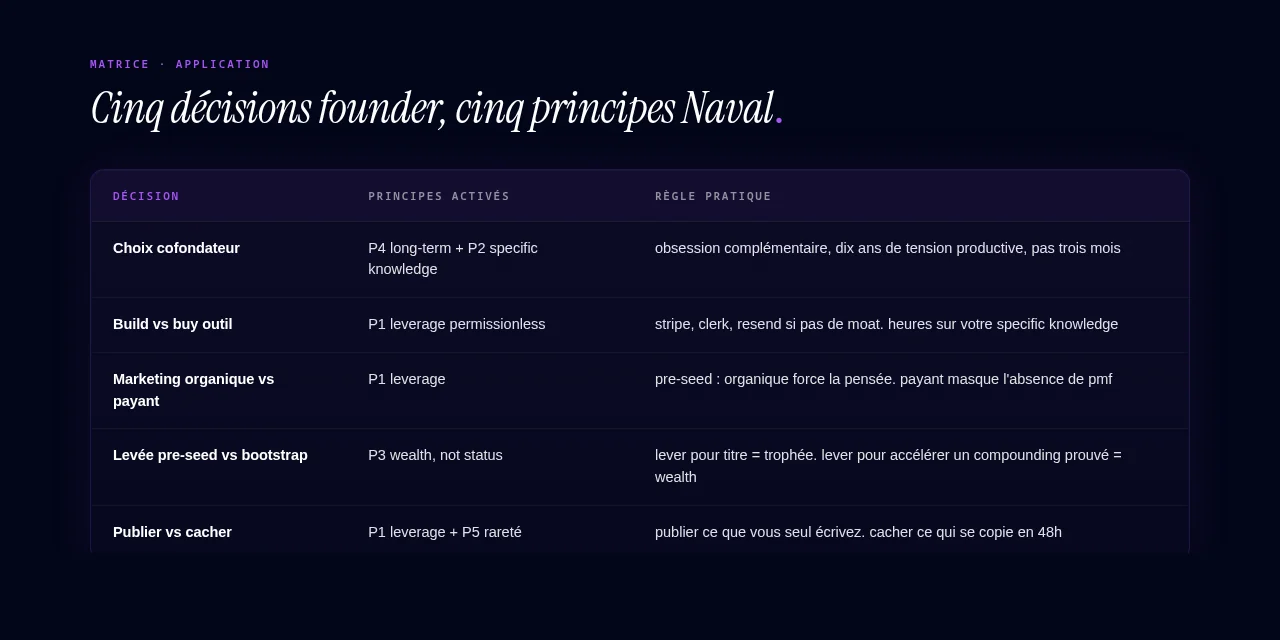
Long term + specific knowledge. Not "someone who shares my vision" (a vague formula), but someone whose obsession is complementary to yours and with whom you can picture ten years of productive tension. If the profile is good but long-term trust is missing, don't sign the pact.
Build vs buy a tool (Principle 1)
Permissionless leverage. If the tool you want to build is a moat-less wrapper over an existing API (payment, auth, mailing), pay Stripe, Clerk, Resend. Your hours go into the code that is your specific knowledge. Not the bandwidth to rebuild what already exists as SaaS at 30€/month.
Organic vs paid marketing (Principle 1)
Paid is permissioned leverage (you buy permission from Meta or Google to show up). Organic is permissionless but slow. Naval's rule: at pre-seed and seed, paid masks the lack of product-market fit. Organic forces you to publish real thinking, and so to discover what resonates. (See: founder-led content.)
Pre-seed raise vs bootstrap (Principle 3)
Wealth, not status. Raising for the title "I raised from X" is a status trophy. Raising because capital is the only way to accelerate a compounding that already works, that's wealth. Without clear signals (retention, growing MRR, qualified intent), capital only accelerates the burn. Bootstrap first. Raise when the money unlocks something you've proven without it.
When to publish vs hide (Principle 1 + 5)
Publishing = media leverage + scarcity at the same time. Hiding = a stealth posture. Naval's implicit rule: publish early what you alone can write (your specific read, your instructive failure, your counterintuitive method). Hide what can be copied in 48h (a precise product roadmap, your exact tech stack, client contracts).
The interactive widget
Link /fast-tracks/naval-ravikant/: explore more than 80 quotes sorted by theme
swanbase hosts a widget that compiles more than 80 of Naval's quotes, sorted by theme (leverage, wealth, happiness, decision-making, relationships). Filter, search, go from quote to application in one click.
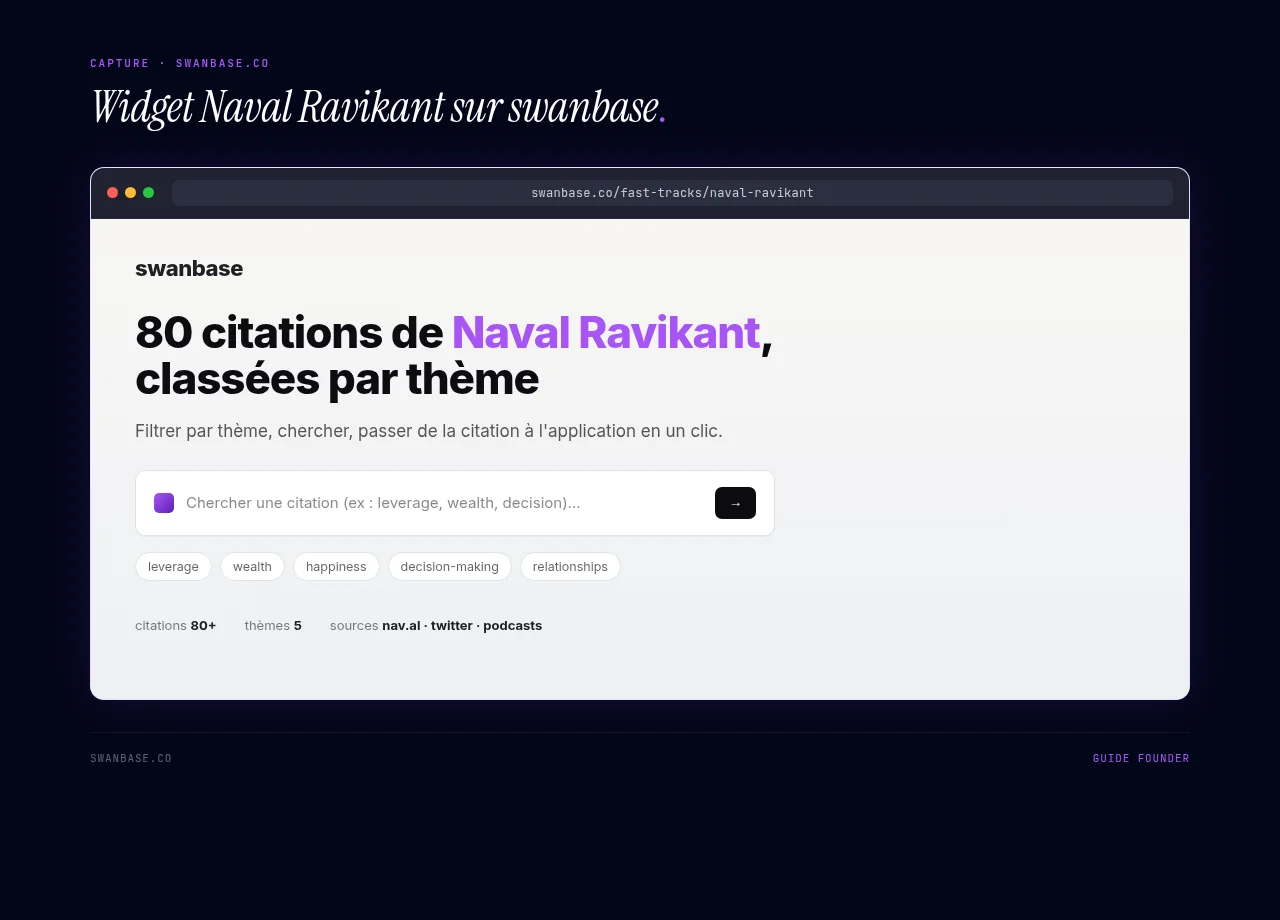
Access the Naval Ravikant widget.
How to use it (filters, search)
A useful reflex: no linear reading. Open it with a question in mind ("how do I decide between raising and bootstrapping?"), filter on wealth, read two or three quotes that shed light on the day's decision. A dictionary of tools, not a book to finish.
What Naval says that does NOT apply (anymore) in 2026
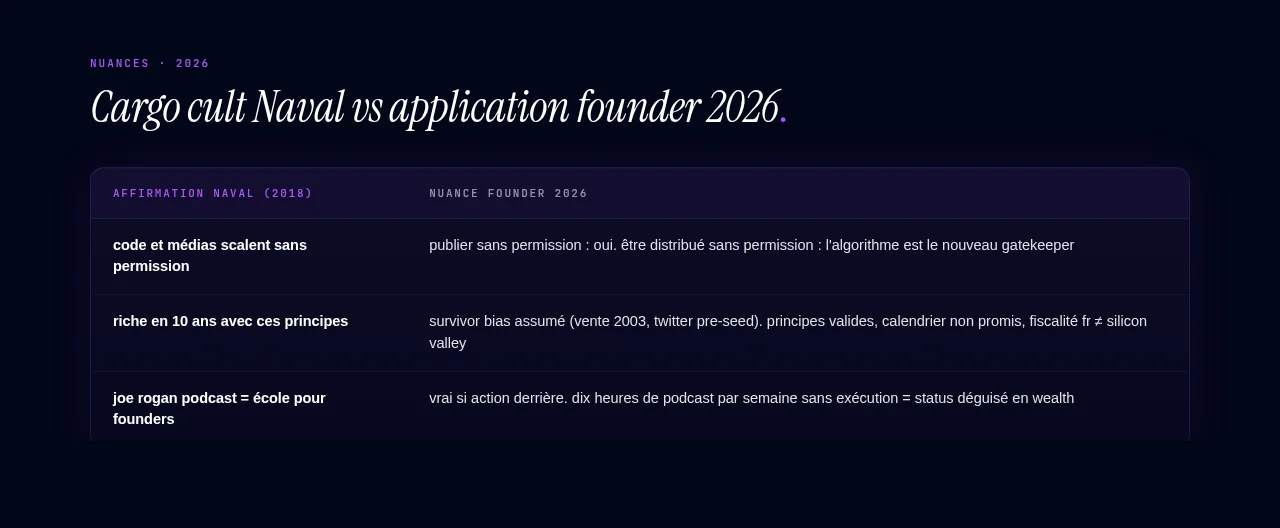
Three things to qualify before applying Naval blindly.
"Code and media scale" (true, but 2026 algorithms are more brutal than 2018)
The idea that content scales "without permission" was written before the collapse of organic reach on Instagram, the LinkedIn short-video pivot, and TikTok fragmentation. Publishing without permission is still true. Being distributed without permission has become much harder. Distribution is the new gatekeeper, disguised as an algorithm.
"You'll be rich in 10 years" (survivor-bias selection, to be qualified)
"How to Get Rich" is written by someone who sold in 2003 and invested before Twitter: an admitted survivor bias. The principles hold, the timing promise doesn't. No one can promise wealth on a ten-year calendar, and even less so in France, where taxes, the market, and risk culture differ from Silicon Valley.
"Joe Rogan podcast = school" (true for Naval, not a founder cargo cult)
Naval often cites long-form podcasts as a learning method. True for him: he turns listening into action. For most people, listening to ten hours of podcasts a week is a substitute for execution. Status (looking informed) disguised as wealth (being informed). The test: what did you do with the last three podcasts you listened to?
Going further
The almanac (Valor FR edition, Jorgenson)
The Almanack of Naval Ravikant, compiled by Eric Jorgenson, published in 2020, sold more than a million copies worldwide, free online at navalmanack.com.3 French edition: Valor Editions, foreword by Tim Ferriss.
3 essential podcasts (Joe Rogan 2019, Tim Ferriss, Knowledge Project)
Three ways into Naval on audio:
- Joe Rogan Experience #1309 (June 4, 2019). Two hours that cover the entire mindset.9
- The Tim Ferriss Show #473 (October 2020): happiness, anxiety, crypto strategies.10
- The Knowledge Project by Shane Parrish. The podcast that sparked the Almanack idea for Eric Jorgenson.11
Naval's Twitter archive 2015-2020 (the founding period)
Naval's densest period of public thinking runs from 2015 to 2020. The "How to Get Rich" threads date to 2018. Raw material compiled by the almanac. Worth exploring to see the thinking in flow, not in book form.
AngelList and reading the business model
AngelList isn't just a platform. It's a living demonstration of Principle 1: code leverage in a market previously dominated by labor leverage (VCs making intros one by one). Reading AngelList as a business case is understanding Naval in action.
FAQ
Has Naval Ravikant published a book himself?
No, not as a direct author. The Almanack of Naval Ravikant (2020) was compiled by Eric Jorgenson from Naval's tweets, podcasts, and essays. Naval validated and facilitated the project but never published a conventional book. His output takes the form of podcasts (Nav.al), Twitter threads, and short texts on nav.al.
Is Naval Ravikant still active in 2026?
Yes. Avlok Kohli has run AngelList day-to-day since 2019, but Naval remains chairman. In 2023, he co-founded Airchat, a voice-first social network. He keeps publishing on Nav.al and stays active on X, at a slower cadence than between 2015 and 2020.
Should you follow all of Naval's principles or only some?
Be selective. Naval himself invites you to practice authenticity, not copying. The universal principles (long-term games, specific knowledge, leverage) stand the test of time. The specific recommendations (this crypto, that podcast, this routine) are dated and personal. Take the structural frameworks, ignore the tactical details that don't apply to your life in France in 2026.
What's the best entry point to discover Naval Ravikant?
Fifteen minutes: the 2018 "How to Get Rich (without getting lucky)" tweetstorm on nav.al/rich. Two hours: episode 1309 of the Joe Rogan Experience. One book: The Almanack of Naval Ravikant by Eric Jorgenson, free on navalmanack.com or in French from Valor Editions. Thematic exploration: swanbase's Naval Ravikant widget, which sorts more than 80 quotes by theme.
swanbase is an accelerator based in Paris (its Sentier space opening in May 2026) and open remote worldwide, backing early-stage founders over the long term for 2% equity. Naval Ravikant's principles are part of the foundation we share with the startups we support.