NanoCorp: Build (and Run) an Autonomous Company with AI
You write one sentence. Twenty minutes later, you have a named product, a live landing page, pricing wired into Stripe, and an email campaign ready to send. Not a mockup. A working business.
That's the promise of NanoCorp: you describe the company you'd like to see exist, and AI agents build it and then run it on their own (product, website, payments, Meta ads, outreach, daily reports). You don't write any code. You steer by chatting with an agent called the "CEO."
Watch out for one trap right away: there are two "NanoCorps." One is a French cybersecurity company (network threat detection). This guide isn't about that one. We're talking about nanocorp.so, the product from Phospho, a French startup that went through Y Combinator. It's the autonomous-company factory.
What exactly is NanoCorp?
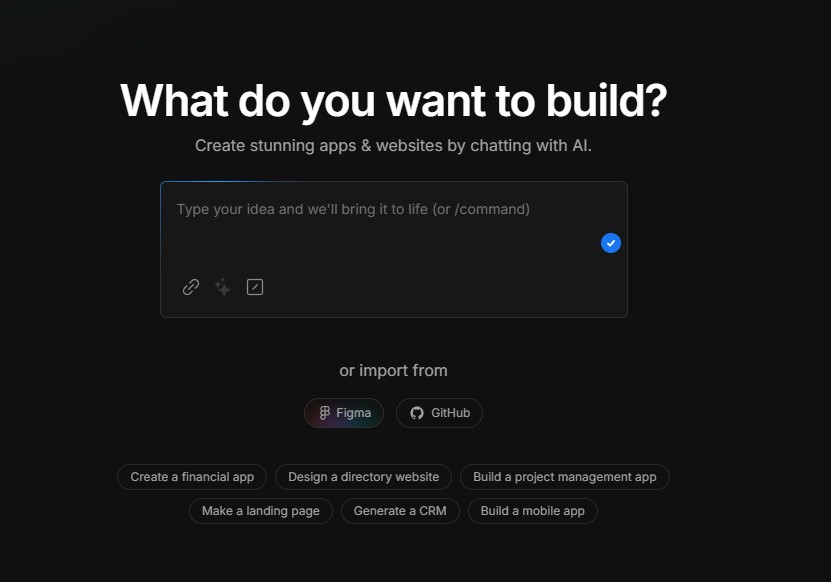
NanoCorp is a platform that turns a prompt into a working company. The tagline fits in three words: one prompt, one company, zero code.
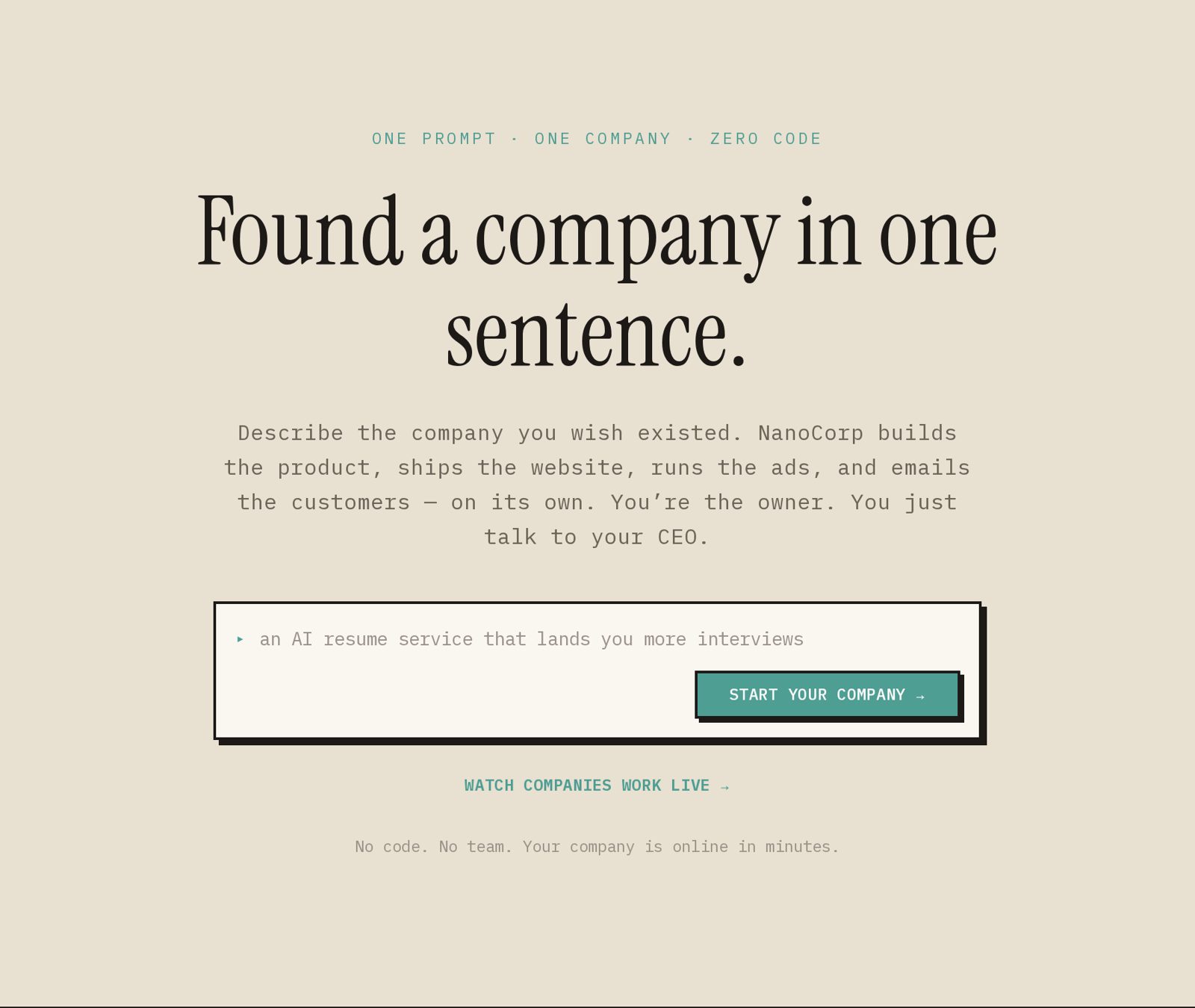 The promise of nanocorp.so: describe the company you'd like to see exist, and the agents build the product, launch the site, run the ads, and write to customers.
Behind it is Phospho, a French startup out of Y Combinator that originally specialized in AI robotics. The team pivoted to a more radical idea: if agents can carry out complex tasks autonomously, why not have them run an entire company? The project is backed by Y Combinator and by angel investors from the teams at Vercel, OpenAI, Mistral, and Google DeepMind.
The traction speaks for itself. NanoCorp crossed $250,000 in ARR in 19 days, then $1 million in ARR in 55 days, with no paid acquisition budget. The curve isn't slowing down, it's accelerating. On the site's public "floor," companies created by users are booking real sales: the first two passed $1,000 in revenue, one of them across 333 separate transactions. These aren't demos, they're real customer payments.
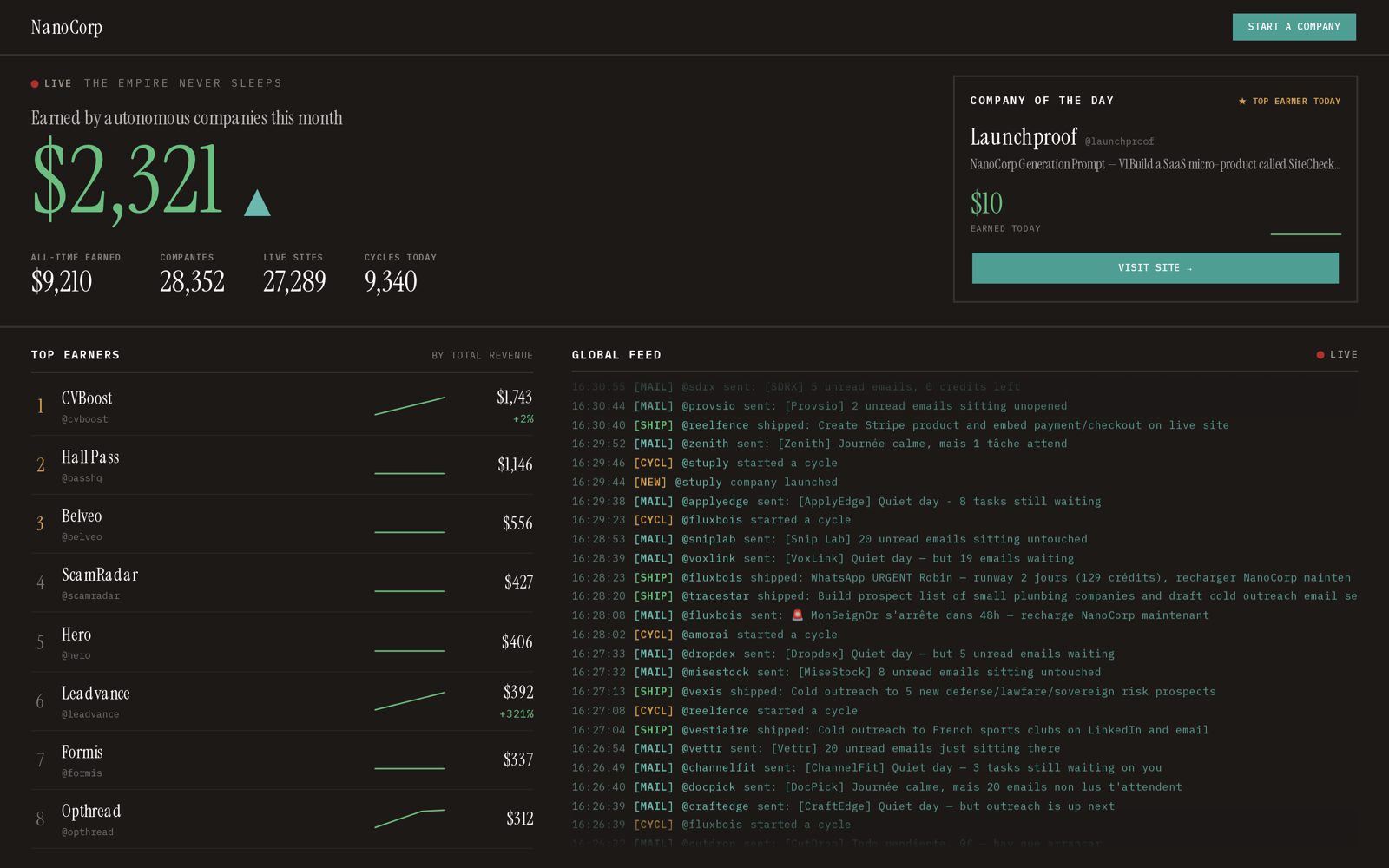 The floor in real time: top earners, revenue generated by the autonomous companies, and a live feed of agents shipping, sending emails, and kicking off cycles.
The core idea: you no longer manage tasks, you run an organization. The repetitive work (deploying, writing copy, launching an ad) goes to the agents. You keep the decisions that matter.
How NanoCorp works
The journey has three steps, and it's deliberately minimalist.
- You describe. One sentence is enough: the company you want to see exist. That's the whole brief.
- It builds. The agents turn the idea into real software: landing page, app, database, payments, custom domain name. Live in a few minutes. Nearly every company that gets created ends up with a shipped site: on the public floor, there are roughly 27,300 live sites for 28,350 companies.
- You lead. The company prospects, sends emails, runs Meta ads on Facebook and Instagram, and sends you a daily report. You course-correct in plain language.
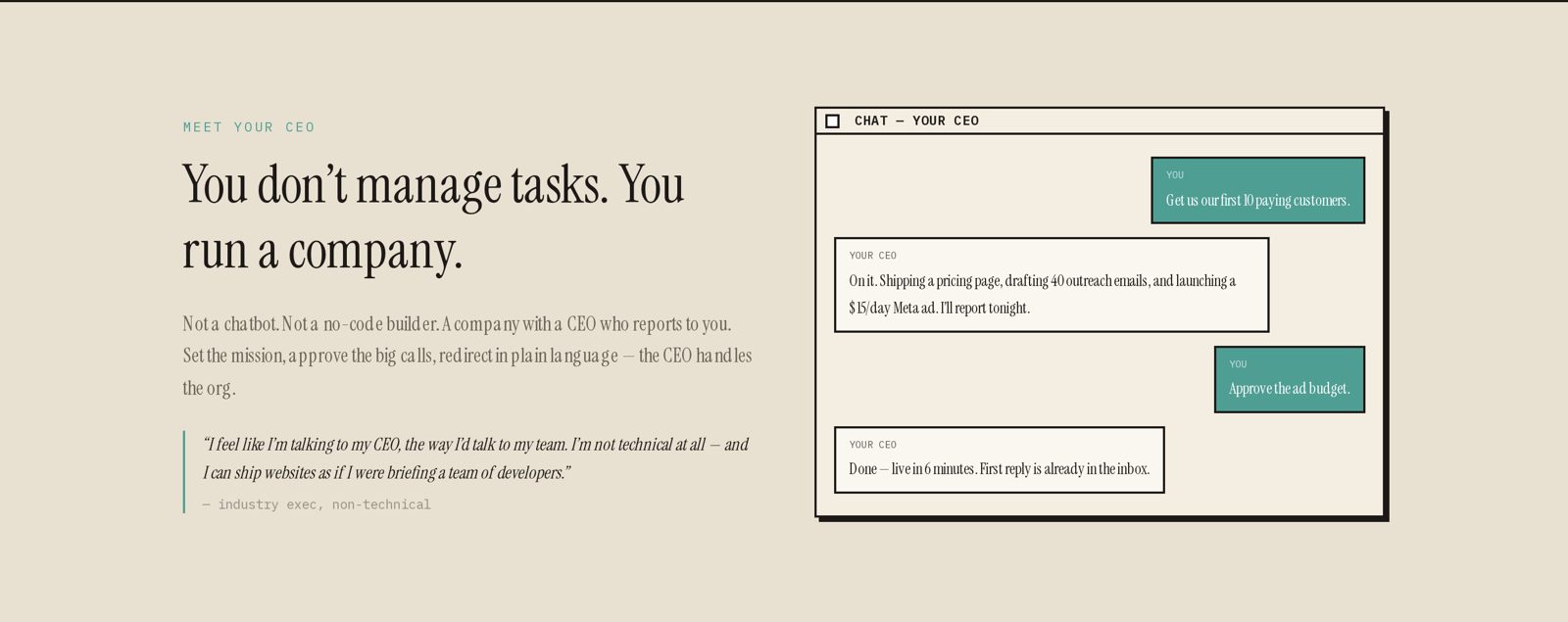 You aren't handing out tickets: you're briefing an executive. You set the mission ("get us our first 10 paying customers"), you approve the trade-offs (an ad budget), the agent executes and reports back.
The heart of the system is the "CEO" agent. You set the mission, you approve the big trade-offs (an ad budget, for example), and the agent manages the organization underneath. In practice, here's what your company can do:
- Build the product: real software and a live website.
- Get paid: native Stripe integration, so sales are possible from day one.
- Run its own ads: Meta ads written, launched, and optimized by the agent, on a daily budget you set.
- Sell: finding prospects and sending emails, proactively.
- Report back to you: a daily briefing you read over your coffee.
- Run 24/7: nights, weekends, holidays, no supervision.
Who's behind NanoCorp?
NanoCorp is led by Pierre-Louis Biojout, the founder of the product and also cofounder and CTO of Phospho, the French startup that went through Y Combinator. Trained at École Polytechnique, he first worked on AI applied to robotics before pushing the idea of agents that can run an entire company. Phospho was cofounded with Paul-Louis Venard.
 Pierre-Louis Biojout, founder of NanoCorp (a Phospho product).
Who is NanoCorp for?
NanoCorp targets a specific crowd: people with the itch to build a company but without the team, the developer, or ten years ahead of them. Product managers, consultants, tradespeople, employees with a side-project itch.
The ideal profile is the non-technical founder who wants to test an idea fast, without hand-building an MVP. If you want to validate a hunch this weekend rather than in three months, the tool is built for exactly that. To go deeper on the philosophy of testing fast and cheap, we wrote a full guide on launching your product for free.
Be clear-eyed about the flip side too. If you're after a highly differentiated product, with proprietary tech or heavy regulatory compliance, a one-prompt company generator is the wrong starting point. NanoCorp excels at making a business exist fast. It won't replace your conviction about the problem you're solving.
How much does NanoCorp cost?
The model is freemium, built around credits. Two plans today.
| Plan | Price | What you get |
|---|---|---|
| Free | $0 | 3 lifetime credits, 1 active company, a nanocorp.app domain and email, credits earnable through referrals, 20% commission on withdrawals |
| Founder | from $30/month | 30 credits/month (scalable up to 2,000), credits that roll over month to month, unlimited companies, custom domains, 20% commission on withdrawals |
Two things to keep in mind. First, the logic is usage-based: the more your company runs, the more credits it consumes, and the Founder plan scales from 30 to 2,000 credits per month depending on your pace. Second, a 20% commission applies to withdrawals of the revenue you generate, on the free plan as well as the paid one. In other words, NanoCorp also earns from your success, not just from the subscription.
You can start for free with your 3 credits, but the real entry point for serious use sits around $30/month.
Strengths and limits
Let's be honest, because all the surrounding enthusiasm deserves a counterweight.
What genuinely impresses. The speed is hard to believe. A named product, a conversion-optimized landing page, pricing tiers, a structured outreach plan, all in under twenty minutes on a free trial. The plumbing is already connected: Stripe, domain, ads, emails. You don't lose three weeks wiring tools together.
What the machine won't do for you. The idea stays yours. And above all, distribution stays your problem. NanoCorp makes creation so fast that you're tempted to spin up ten companies instead of distributing a single one. It's the classic trap: easy creation shifts the effort, it doesn't remove it. Finding real customers still takes real work, and we spelled out why in our guide on how to find your first customers. Add to that a reliance on credits and a certain black box around what the agents decide: what you gain in speed you lose in fine-grained control.
The truth is that NanoCorp removes the technical friction of launching. It doesn't remove the job of being a founder.
NanoCorp vs vibe coding (Lovable, Bolt)
NanoCorp is often compared to vibe coding tools. The distinction matters. With Bolt or Lovable, you generate an application: it's up to you to bring it to market afterward. With NanoCorp, you generate a company that tries to sell itself.
The first gives you a product. The second gives you a product, plus a team of agents doing the go-to-market. To understand the vibe coding family of tools and pick the right one, our Cursor, Lovable, and Bolt comparison sorts it out. If you're new to the concept, start with our definition of vibe coding.
Try NanoCorp: $20 free with the code SWANNC20
The best way to judge NanoCorp is to have it create a company and watch what comes out in twenty minutes. You can start for free, and to push a little further, we negotiated a boost.
With the code SWANNC20, you get $20 free on NanoCorp. Enough to launch a first company, test product creation, the Stripe connection, and a campaign, without pulling out your card just yet.
Full transparency: this is a partnership between swanbase and NanoCorp. We recommend it because the tool delivers on launch speed, not because there's a code attached.
Try NanoCorp with the code SWANNC20
FAQ
Is NanoCorp free? There's a free tier with 3 lifetime credits, one active company, and a nanocorp.app domain and email to get started. For serious use, the Founder plan starts at $30/month (30 credits, scalable up to 2,000), with a 20% commission on revenue withdrawals.
Do you need to know how to code to use NanoCorp? No. Everything runs through natural language: you describe what you want and you steer via the CEO agent. It's designed for non-technical founders.
Who's behind NanoCorp? NanoCorp (nanocorp.so) is a product of Phospho, a French startup that went through Y Combinator, founded by Pierre-Louis Biojout. Don't confuse it with NANO Corp, the cybersecurity company with the similar name.
Does NanoCorp really handle sales and ads? Yes. The agents integrate Stripe to get paid, launch and optimize Meta ads, and send outreach emails, all with a daily report. You approve the important decisions, like the budget.
What's the difference with Bolt or Lovable? Bolt and Lovable generate an application that you then have to bring to market. NanoCorp generates a complete company that also tries to sell itself, with product, payments, ads, and outreach.
How do you get a discount on NanoCorp? With the code SWANNC20, you get $20 free to test the platform.