An early-stage startup picks its pricing from 4 models: cost-plus (cost plus margin, the accounting baseline), value-based (price set against the economic value created for the customer, ideal for B2B SaaS), tier-based (2 or 3 plans for a market with established conventions), and usage-based (billing per event, per seat, or per API call). That last model already accounts for 20% of SaaS in production according to the Maxio 2025 report, and its share climbs every quarter. The right model depends on your segment, the maturity of the market, and the value metric your product moves.
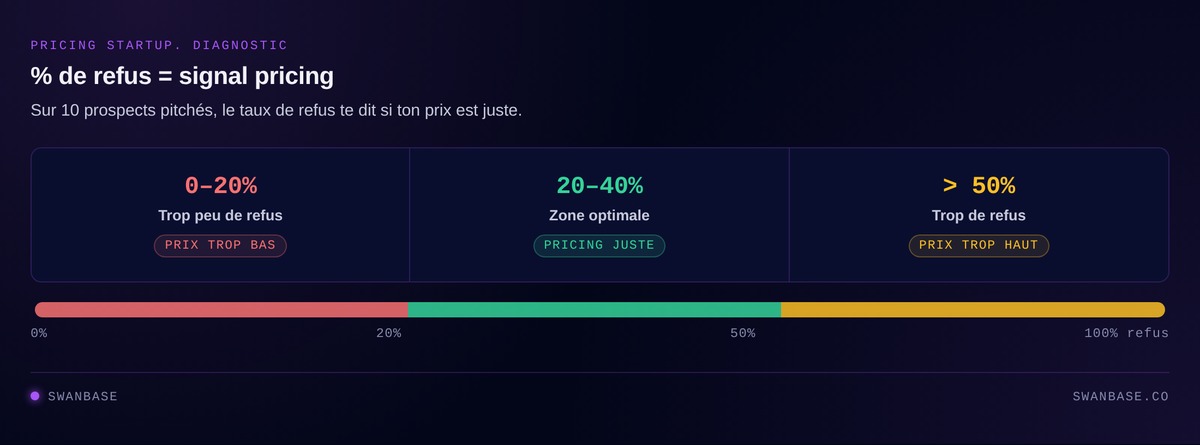
To set your first price without data, the simplest protocol is the pricing power test over 10 sales: if nobody says no, you're underselling; if more than 50% say no, you're overshooting. The sweet spot sits between 20 and 40% rejections. To calibrate your starting range, 6 public pricing pages from French SaaS companies (Lemlist, Pennylane, Aircall, Akeneo, Lago, Spendesk) give concrete reference points for each model. Pricing is a decision you make; it isn't whatever's left over once you've built the product.
Why most founders get their first price wrong
September 2023. A team walks out of Demo Day with a product that works. The first customer signs at €99/month. Why 99? "Because that's what the competitor charges." Six months later, they find out that competitor loses money on every account.
Pricing is one of the few early-stage decisions where most people improvise. Three traps account for the bulk of the mistakes.
The "I'll copy the competitor" trap
Copying the competitor means adopting their cost structure, their margins, their early-days mistakes, and their market constraints without any of the underlying knowledge. The competitor you're watching may be sacrificing pricing to grow fast, raising rounds to cover the monthly deficit. You don't know that.
Their price tells you something about the market's psychological ceiling, not about the right price for you. Calibrate against their range, never against their exact number.
The "I'll just do my cost + 30%" trap
Cost-plus guarantees the margin. Its flaw: it ignores the value the customer gets from the product. A tool that generates an extra €50k of pipeline per month for a team of 5 salespeople shouldn't cost €99/month just because it costs €68 to produce. The cost-plus-margin formula works for commodities. For a differentiated B2B SaaS, it consistently leaves value uncaptured.
The "I'll update it later" trap
"Provisional" pricing has a shelf life: your first 10 customers become the benchmark for everyone who follows. Early adopters talk to each other. Any price increase becomes a churn event rather than a natural evolution, because you anchored the reference point too low from day one. Starting low to "validate" often costs more than a solid pricing decision made upfront.
The 4 pricing methods (and when to use which)
1. Cost-plus: cost + margin, the accounting baseline
You calculate the full cost of production (infra, support, proportional overhead) and add a target margin between 30 and 70% depending on the sector. It's the default model for agencies, managed services, and low-differentiation products.
When to use it. A mature market with established price conventions, or when you don't yet have the data to calculate the value created for the customer. It's a starting point, not a long-term strategy.
Critical limit. Your cost of production will fall (cheaper infrastructure, automation). If you're anchored in cost-plus, you don't capture the extra value created. You permanently underprice as your product improves.
2. Value-based: cost avoided or revenue created for the customer, the B2B SaaS ideal
You start from the economic value your product generates for the customer (time saved, churn reduced, additional revenue) and set the price at a fraction of that value. The rule: 10 to 30% of the measurable economic value.
When to use it. When you can measure the impact (ROI, hours saved, leads generated). It's the dominant model in B2B SaaS: your software replaces a manual process or improves a conversion funnel.
Why founders avoid it. It takes deep conversations with customers to quantify the value. That's uncomfortable. The result: most default to cost-plus. And that's exactly where the margin is hiding.
3. Tier-based: 2-3 plans, when the market already has conventions
You offer 2 or 3 distinct plans with different features or usage limits. The middle plan is calibrated to be the one most people pick (classic anchoring). Beyond 3 plans, the decision gets more complex for the buyer. Below 2 (flat rate), you lose the anchoring effect.
When to use it. When the market already understands this model (most SMB B2B SaaS), when you have several ICP profiles with distinct budgets and usage patterns.
4. Usage-based: per event/seat/API call, the 2026 shift
The customer pays based on what they consume: emails sent, active seats, API calls, contacts enriched. 20% of SaaS already used a pure usage-based model in 2025 according to Maxio, up steadily since 2023. The model went mainstream with tools like Lago that let you implement it without a dedicated engineering team.
When to use it. When value is directly correlated with usage (infrastructure, data, enrichment). When you target enterprise accounts that want to control their budget and avoid fixed commitments.
The trap. Usage-based makes revenue less predictable. Implementing a monthly minimum (floor) is essential to secure your base MRR.
How to set your first price when you have no data
The "pricing power" test over 10 sales (0% rejections = too low, >50% = too high)
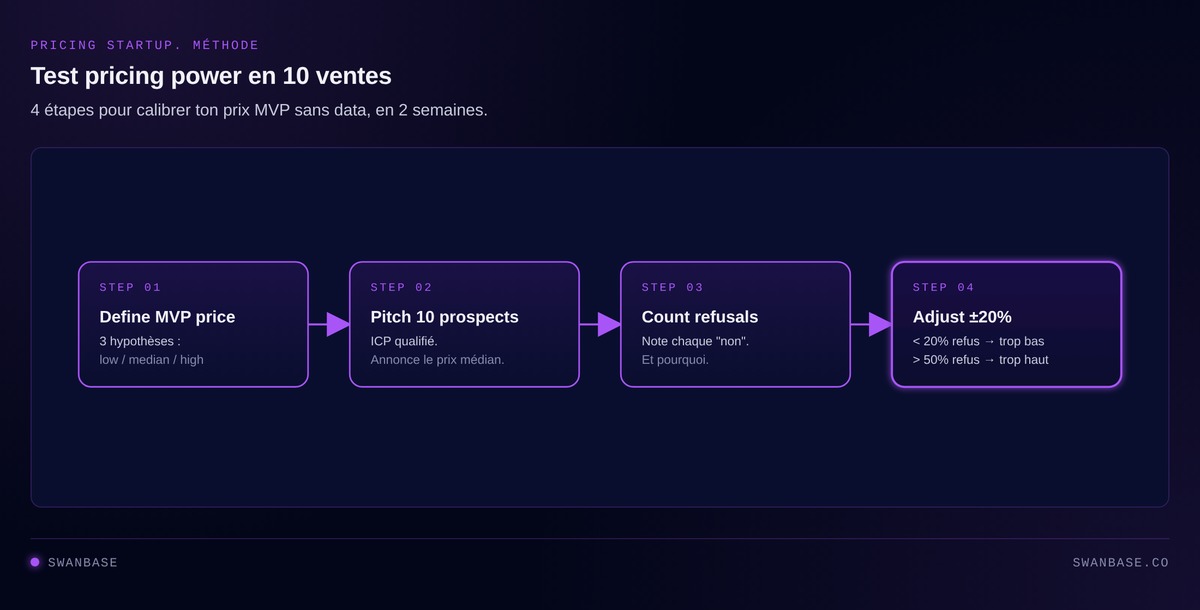
The protocol comes down to 4 steps: set a first price, pitch 10 qualified prospects in your ICP, count the rejections tied to price (not to the product, not to timing), adjust in 20% increments.
- 0 to 20% rejections: you're underselling. Raise by 20 to 30%.
- 20 to 40% rejections: optimal zone. You maximize volume without sacrificing margin.
- More than 50% rejections: you're overshooting, or you're targeting the wrong segment. Come down or reframe the ICP.
A secondary indicator: if everyone accepts without negotiating, you don't just have a price problem, you have a positioning problem. A well-positioned product generates objections. A complete absence of price objections often signals fuzzy perceived value.
The 10x rule: minimum price = 1/10 of the value generated
If your tool saves 5 hours a week for a salesperson whose loaded cost is €6k/month (€37.50/hour), you generate roughly €2,400/month in time value. Your price floor: €240/month. Below that, you leave margin on the table. Above €720/month (30% of the value), you'll hit ROI resistance at every close.
The 10x rule applies to B2B SaaS where value is measurable and recurring. For B2C or a commodity, the mechanics are different.
Should you display the price or ask for a quote?
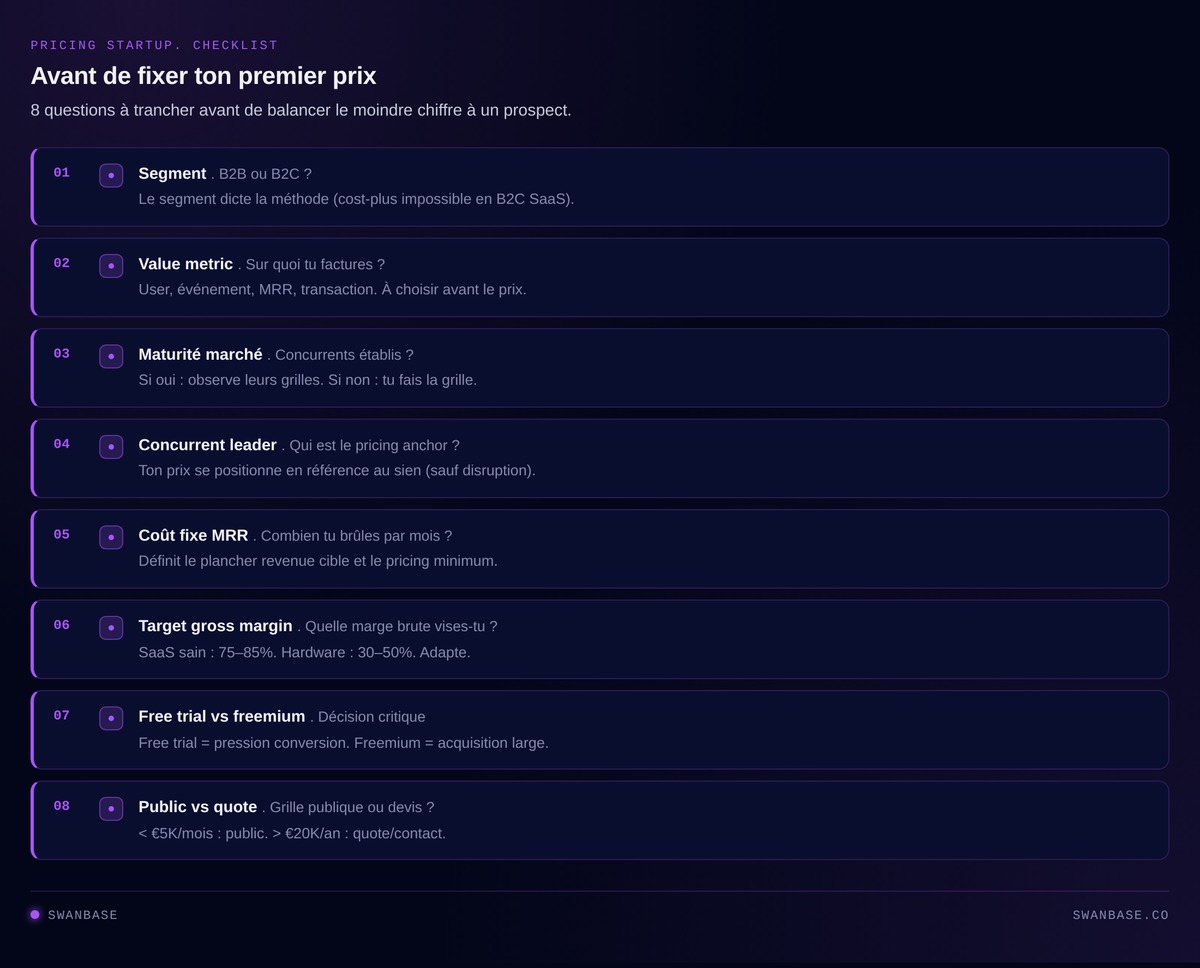
Display it if you're targeting SMBs: short cycle, individual decision, no multi-level approval. Switch to "request a quote" if you're targeting enterprise: long cycle, customization, multi-stakeholder negotiation.
The hybrid structure, the most common in B2B SaaS: SMB plans displayed + an Enterprise plan on quote. It captures the self-serve bottom of the market without sacrificing flexibility at the top. Practical tip: if you're on the fence, display first. The absence of a price on an SMB B2B site drives bounce.
6 public pricing pages from French startups (worth studying)
Rather than theorize, let's look at what SaaS companies do in production. Six examples, six different models.
Lemlist: 3 per-seat tiers
Lemlist (B2B cold outreach) offers 3 plans (Standard, Pro, Outreach Scale) on per-seat pricing. Each tier unlocks additional automation features: multichannel sequences, A/B testing, advanced CRM integrations. The middle plan is calibrated to convert teams of 2 to 5 salespeople.
What's instructive: Lemlist started flat rate, then migrated to tier-based as customer usage patterns diverged. The decision was data-driven, not theoretical. Source: lemlist.com/pricing
Pennylane: per-user + modules
Pennylane (French accounting) combines a per-user price with add-on modules. The hybrid model serves solopreneurs (1 user, minimal modules) and accounting firms (multi-user, advanced modules) with a coherent structure. The per-user + modules approach works when usage varies widely across customer profiles. Source: pennylane.com/fr/tarifs
Aircall: per-seat with an annual commitment
Aircall (cloud telephony) lists 3 plans (Essentials, Professional, Custom) with per-seat pricing and a mandatory annual commitment. That commitment is a deliberate choice: it reduces monthly churn and improves MRR predictability, at the cost of some friction at signing. If your sales cycle runs longer than 30 days, an annual commitment can make sense even at early stage. Source: aircall.io/pricing
Akeneo: value-based enterprise (price on request)
Akeneo (enterprise PIM) doesn't display a price: a contact form replaces the pricing table. That's not an omission, it's a positioning choice. At this level of the market (five-figure annual enterprise tickets), value varies enough by product catalog, channels, and integrations that a displayed price would be counterproductive. "Price on request" signals that the product sells in consultative mode, with ROI calculated customer by customer. Source: akeneo.com/compare-packages
Lago: usage-based open-core
Lago (open-source billing infrastructure) offers 3 plans: Self-Hosted Free (free), Cloud Premium (usage-based on Lago Cloud), and Enterprise (custom). The free self-hosted tier is an acquisition strategy: teams that outgrow their DIY capacity migrate to Cloud or Enterprise. It's the open-core model in its purest form. You give away the base value to create functional dependency, then you monetize on convenience or complexity. Source: getlago.com/pricing
Spendesk: per-seat B2B finance
Spendesk (B2B corporate spend management) shows how a finance SaaS aligns its pricing with team size: a per-seat model with tiers differentiated by features (virtual cards, advanced reporting, ERP integrations). What's instructive: per-seat in the finance vertical grows ARR as the customer's team grows, with no renegotiation of the base contract. Expansion revenue is automatic.
When and how to raise your prices
The 3 signals to raise (margin, demand, added value)
Three situations justify a price increase, often at the same time:
- Margin signal: your gross margin drops below 60-65% (the B2B SaaS benchmark). Pricing has to compensate.
- Demand signal: you've been closing 80% or more of your deals with no friction on price for 3 months. The pricing power test tells you you're in undervalued territory.
- Value signal: you've shipped a significant feature or proven measurable ROI that you weren't pricing for. The value went up, the price follows.
When all three land at once, the increase is urgent.
How to announce an increase without massive churn
The minimum protocol for a clean increase:
- Notice: 45 to 60 days before it takes effect.
- Justification: one sentence on what changed (a major feature, increased value). No apology, no "sorry for the inconvenience".
- Long-term opt-in: offer to lock in the current price by switching to annual before the deadline.
Churn on a price increase rarely comes from the amount. It comes from the communication: too short, too abrupt, no explanation. Customers understand value if you explain what they've received.
Grandfathering: what to offer early customers
Grandfathering (keeping the historical price for existing customers) creates an "early adopter" status that drives loyalty and referrals. Its limit: if your early customers make up a significant fraction of your ARR at a discounted price, grandfathering becomes a CAC/LTV problem as you scale.
Practical rule: grandfather for 6 to 12 months maximum, then step up gradually with notice. A common middle-ground option: grandfather the current plan, but require the new pricing on upgrades.
FAQ: Startup pricing
Should you do freemium at early stage?
Freemium has a hidden cost: you serve free users who will never convert, which weighs on support, infra, and product focus. Before solid product-market fit, freemium scatters your energy. If you can't explain precisely which trigger moves a free user to paid, and within what timeframe, avoid freemium. A time-limited free trial (14 days) is often more effective at early stage: it creates urgency without generating permanent costs.
How do you price a B2B product vs B2C?
In B2B, price is a rational decision: ROI, budget, approval cycle. You can justify a high price if you quantify the value created. In B2C, it's an emotional and comparative decision, where the reference is the competitor's price on the App Store. A B2B SaaS at €500/month is unremarkable. A B2C SaaS at €50/month is already perceived as expensive. The acceptable models, tolerable margins, and decision cycles are fundamentally different: don't transpose your benchmarks from one segment to the other.
Public pricing or on request for Enterprise?
If your average ticket exceeds €12k annually, pricing on request is often a better fit: it lets you customize by scope and handle multi-level negotiations without locking yourself into public tables that weaken your position on big deals. Below €12k annually, public pricing speeds up self-serve and lowers your acquisition cost. The hybrid structure (SMB displayed + Enterprise on quote) addresses both segments without sacrificing one for the other.
How many pricing plans should you offer?
Two or three. Two if your market splits into two clear profiles (startups vs. large accounts). Three if you have a middle segment to capture, with the middle plan designed as the "default" option that 60% of your customers will choose. Beyond three plans, choice paralysis lowers your conversion rate. Below two (flat rate), you lose the anchoring effect and the natural upsell path to the higher plan.
Want to go further on your GTM model: find your first customers or look at how to validate an idea before you build. If you're torn between two pricing models for your next enterprise customer, that's exactly what we debrief 1:1 at swanbase.