The BIC (Business & Innovation Centre) of Montpellier Méditerranée Métropole is a public incubator founded in 1987, ranked in the TOP 5 public incubators worldwide by UBI Global since 2014 and, in February 2026, named to the European TOP 10 of the Financial Times' "Europe's Leading Start-Up Hubs 2026" at tenth place. It supports more than 170 active projects, has helped create 515 innovative companies since it opened, and generates 4,400 direct jobs for a cumulative revenue of €607M. Survival rate: 90% at 3 years according to BIC data (vs. 75% national average), 88% at 3 years and 75% at 5 years according to French Tech Méditerranée (national INSEE rate: 66.9%). Support is delivered across 3 sites totaling 12,300 m²: Cap Alpha (greentech), Cap Omega (digital) and MIBI (international). The official offering is structured in 4 phases: Première Marche (2 months, project in the thinking stage), Embarquement (1 year, launch and first customers), Propulsion (2 years, revenue and first raise), Conquête (1 year, scaling from €500K in revenue). Apply via the official form, the email [email protected] or by phone at 04 67 13 69 82.
BIC Montpellier by the numbers
The BIC's key figures are scattered across four different sites: the official site, French Tech Méditerranée, Entreprendre Montpellier, Innov-hub. This section consolidates them into a single read, dated April 2026.
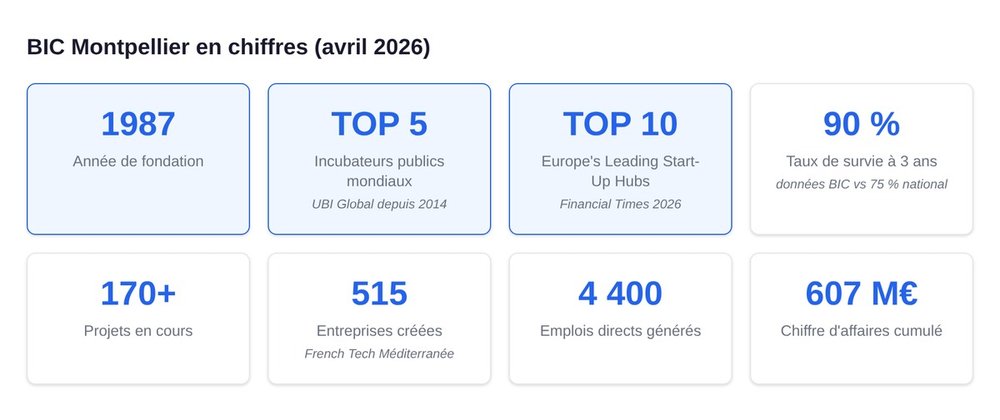
- 1987: year of founding. CEEI (European Business and Innovation Centre) label in 1988. ISO 9001 certified since 2008.
- 170+ projects supported simultaneously in 2026.
- 515 innovative companies created since the BIC opened (source: French Tech Méditerranée).
- 4,400 direct jobs generated.
- €607M in cumulative revenue.
- 90% 3-year survival rate according to BIC data (vs. 75% nationally).
- 88% still operating at 3 years, 75% at 5 years according to French Tech Méditerranée (vs. national INSEE rate of 66.9%).
- TOP 5 worldwide on UBI Global (public incubator ranking) continuously since 2014.
- European TOP 10 of the Financial Times "Europe's Leading Start-Up Hubs 2026," tenth place, announced in February 2026.
The rankings that matter
Two rankings are enough to place the BIC on the world map. The first is the UBI Global Benchmark, which measures the performance of public incubators internationally. The BIC has been in the TOP 5 since 2014 and was reconfirmed as a global TOP 5 in 2019. The second, more recent, is the Financial Times' Europe's Leading Start-Up Hubs 2026 ranking, published in February 2026, where the BIC takes tenth place in Europe alongside Station F and Berlin- and London-based structures. Back in 2007, the BIC had already received the NBIA Award (US) for "Best Incubator Worldwide."
The survival rate, explained
90%, 88%, 75%: the figures vary depending on the source and time horizon. Two readings:
- BIC reading (historical, 3-year horizon): 90% of startups incubated at the BIC are still active 3 years after leaving. French benchmark: 75%.
- French Tech Méditerranée reading (more recent survey, 3- and 5-year horizons): 88% at 3 years, 75% at 5 years. National INSEE benchmark (SINE survey): 66.9% at 3 years, across all companies.
The gap comes from the selection at entry and 24 to 36 months of support. Statistically, your startup stands a better chance of surviving after going through the BIC than after launching on its own. That isn't an admission argument, it's a combined filter.
What is the BIC Montpellier?
Status: Business & Innovation Centre, a public structure
The BIC Montpellier is a "Business & Innovation Centre," a European CEEI label obtained in 1988. In practice: it's a public structure, attached to Montpellier Méditerranée Métropole, with mixed funding (local authorities, Europe, service fees). No equity is taken from startups. Nor is there a "short paid accelerator" model. The format is that of a long-form generalist incubator, with offices, support and network access over 12 to 36 months depending on the program.
History: from 1987 to today
- 1987: the BIC is created. One of the oldest French public incubators still operating.
- 1988: CEEI accreditation from the European Commission.
- 2004: opening of Cap Omega, a site dedicated to digital.
- 2007: NBIA "Best Incubator Worldwide" award (US National Business Incubation Association).
- 2008: NBIA "Soft Landings" award (best incubation for foreign startups). ISO 9001 certification the same year.
- 2011: opening of MIBI (Montpellier International Business Incubator), dedicated to foreign startups setting up in France.
- 2014: entry into the UBI Global worldwide TOP 5, never left since.
- 2026: entry into the Financial Times' European TOP 10.
Positioning: generalist with a strong health focus
The BIC supports every sector, but roughly one project in four falls under health / medtech / biotech. Cap Alpha focuses on greentech, Cap Omega on digital and deeptech, MIBI on the international. The current director is Isabelle Prevot, who leads a team of six permanent staff and a broader network of mentors.
The BIC's support programs
Several programs run in parallel, each targeting a specific maturity level.
Main incubation program
The core of the offering. Aimed at innovative projects in the structuring phase: business model validation, technical proof points, first customers, seed round. Duration: 12 to 24 months depending on the case. Offices on one of the 3 sites, support from a dedicated account manager, access to the mentor and investor network.
French Tech Tremplin
An entrepreneurship access program for underrepresented profiles (priority neighborhoods, minimum-income recipients, priority urban districts). A national French Tech partnership. Duration: 6 to 12 months, with a seed grant and targeted support.
Conquest Program (scale-up)
An acceleration program for startups in the growth phase, co-run with the Village by CA (Crédit Agricole) and the French Tech Méditerranée Accelerator. Aimed at companies that have moved past product validation and are looking to scale their go-to-market.
PEPITE Deeptech
For deeptech projects coming out of research (universities, labs). A PEPITE partnership (Student Hub for Innovation, Transfer and Entrepreneurship). High density of projects in biotech and green chemistry.
The BIC support journey: 4 official phases
The official site presents the offering in 4 distinct phases, each calibrated to the startup's maturity stage. A single company can move through the phases in sequence, or join just one. Source: the official page "Innovative entrepreneur, together let's bring ambition to your project."
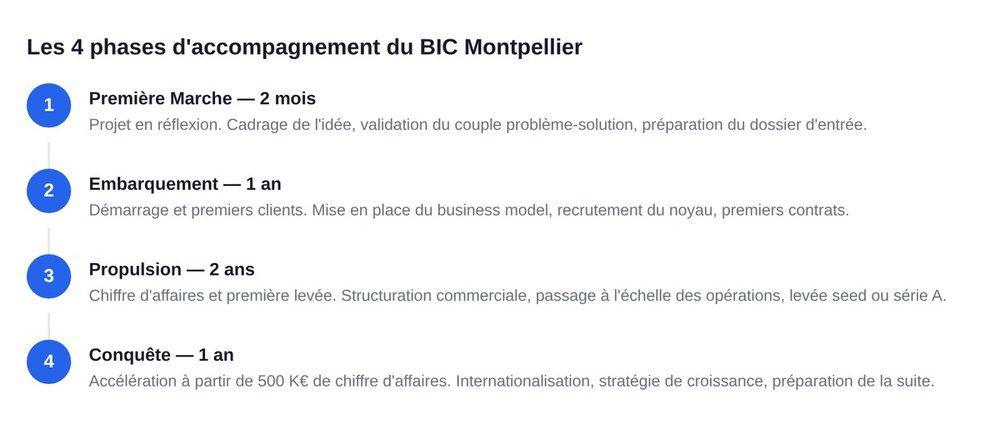
Phase 1: PREMIÈRE MARCHE (2 months)
Who it's for: an innovative company project in the thinking stage, pre-launch. Format: 2 months, 15 themed workshops covering 7 essential areas (team, market, product, business model, impact, communication, finance). Access to the BIC's coworking spaces. Group exchanges with other entrepreneurs. Deliverable: a structured project, clarified positioning, a local network in motion.
Phase 2: EMBARQUEMENT (1 year)
Who it's for: an innovative company at launch, with first customers. Format: 1 year to lay the groundwork for launch. An initial 3 months to challenge the company across the board within a cohort of 10 to 12 companies. Individual follow-up from a dedicated account manager, an expert committee, access to coworking spaces. Deliverable: an organized commercial strategy, a structured team, operational foundations in place.
Phase 3: PROPULSION (2 years)
Who it's for: a company already launched, with growing revenue, preparing its first fundraise. Format: 2 years with à la carte training programs (Objectif Invest, Objectif Business, Objectif Management, Objectif Marketing Digital, and more). On-site hosting and personalized follow-up. Access to the BIC's business angel club. Deliverable: a fundraise prepared and completed, cross-functional skill-building (HR, sales, press, finance, marketing).
Phase 4: CONQUÊTE (1 year)
Who it's for: a company in the acceleration phase, with €500K in revenue in the last fiscal year and proven commercial traction. Format: 1 year aimed at mid-cap companies. A 360° diagnostic run by the experts at the Village by CA to identify priority acceleration levers. Dedicated individual support from a lead account manager. In-depth themed programs. Quarterly review committees bringing together all partners. Deliverable: clearing growth milestones, strengthening the financial structure, a mid-cap trajectory.
How to apply
Three official channels, with no mandatory prior information session published:
- Online form: the "Would you like to be supported by the BIC?" page on
bic-montpellier.com. There you describe your project, your progress and how you heard about the organization. - Email:
[email protected]. - Phone:
04 67 13 69 82.
From the submitted application, the BIC team directs you to the right phase (Première Marche if the project is in the thinking stage, Embarquement if launching, and so on) and kicks off the internal interview steps. The entry criteria are not published in a formalized way on the site: the guidance is based on the stage and the coherence of the application.
Which founders the BIC is the right choice for
The BIC is an excellent incubator for certain profiles, and a poor fit for others. The official site doesn't say so. We do.
Profiles that thrive
- Deeptech, medtech and biotech founders coming out of Montpellier research (the University, INRIA, INSERM, Cirad). The BIC is equipped for long cycles, lab partnerships and hardware.
- Complete teams (2 to 4 cofounders, a mix of tech + business + domain expertise), full-time, ready to set up locally.
- Projects with regional roots that benefit from the Occitanie network (French Tech Méditerranée, the Region, BPI Occitanie, local investors).
- Foreign startups setting up in France: MIBI was designed for exactly this (soft landing).
- Greentech and impact projects looking for a structured physical incubator with access to public support schemes.
Profiles better served elsewhere
- Solo early-stage founders with no cofounder and no traction: the committee requires a team. Go through the PEPITE student program or a Build Program first.
- Remote-first B2B SaaS that has no need for physical offices and optimizes for speed: a short accelerator (Station F Founders, Techstars, swanbase remote) will be a better match.
- Early projects under 6 months of maturity: the BIC does accept early-stage work, but a minimum proof of concept is expected from the application form onward.
- Founders looking for funding as the main deliverable: the BIC does not invest. It supports you, opens doors, prepares you to raise. For direct cash, look to BPI, JEI, regional schemes or VCs.
BIC Montpellier vs. other incubators in the metro area
No independent comparison exists online. Here is the real landscape.
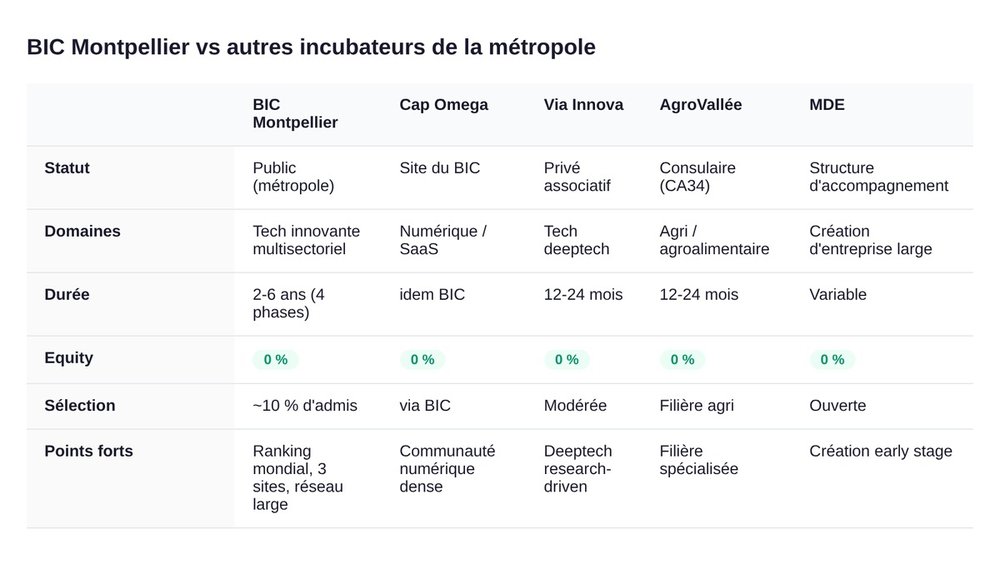
- BIC Montpellier: a generalist public incubator, health-leaning, 12-24 months, no equity, international reach through MIBI. High selectivity.
- Cap Omega: not a separate incubator, but one of the BIC's 3 sites, dedicated to digital. This common confusion is worth clearing up.
- Via Innova: a sector-focused incubator oriented toward agri-agro, backed by Transferts LR and Occitanie. Complements the BIC for foodtech / agtech projects.
- AgroVallée Incubation: a program run by Agropolis, specialized in agronomic research. For projects coming out of INRAE and Cirad labs.
- Maison de l'Entreprise (MDE): a CCI program for conventional (non-innovative) business creation. Not a startup incubator in the strict sense.
When to choose another Montpellier incubator
Foodtech or agtech coming out of lab research: AgroVallée then the BIC. A local farming project without heavy R&D: Via Innova. Conventional business creation with no distinctive innovation: MDE. In every other case for a tech startup in Montpellier, the BIC remains the pivotal structure.
BIC Montpellier vs. accelerator: what's the difference?
Incubator and accelerator are two distinct models. Confusing them costs time.
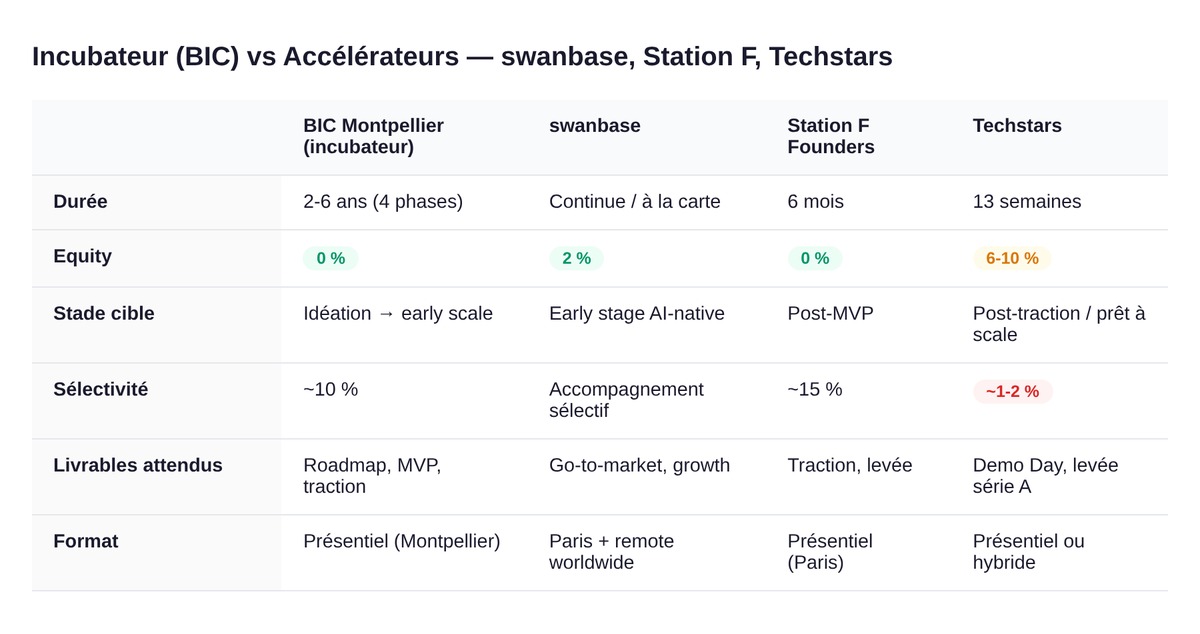
| Dimension | Incubator (BIC) | Typical accelerator |
|---|---|---|
| Duration | 12 to 36 months | 3 to 6 months |
| Equity | 0% | 5 to 10% typically |
| Stage | Ideation to post-MVP | Post-MVP to seed |
| Selection | Guidance by the BIC team based on stage, rolling intake | Annual cohorts, batches |
| Main deliverable | Structuring + network + office | Accelerated growth + raise |
| Format | Physical (metro area) | Often hybrid or remote |
After the BIC: the next accelerators
A startup leaving the BIC with an MVP, traction and a consolidated team is an excellent candidate for an accelerator. Three common routes:
- French Tech Méditerranée Accelerator (local, ecosystem continuity).
- Station F Founders Program (Paris, national network, very selective).
- swanbase: a Paris-based, 100% remote worldwide accelerator that follows the Montpellier ecosystem closely, where the BIC is a reference player. swanbase rounds out the post-BIC stage for startups that want to scale in distributed mode, tap into an international network and shorten their go-to-market.
Testimonials and incubated startups
In 2025, 3 startups that went through the BIC appear in the Top 100 Challenges "Startups to invest in" ranking:
- AI Stroke: medtech, AI-driven stroke detection and support.
- Opale Care: a connected health solution for patient monitoring.
- Breedge: a high-growth tech platform (SaaS sector).
These three cases illustrate the health focus and the growing penetration of AI in the BIC portfolio. Beyond this Top 100, the BIC counts more than 170 active projects and 515 companies created over its history, among them several regional mid-caps from the 1990s and 2000s still in business today.
Going further
- Incubators and accelerators in Montpellier: the guide
- Accelerators and incubators in France: the complete overview
- Incubator or accelerator: what are the differences?
- swanbase, an acceleration program in Paris + remote worldwide
FAQ: BIC Montpellier
How do you apply to the BIC Montpellier?
Three official channels: the online form "Would you like to be supported by the BIC?" on the official site, the email [email protected] or the phone number 04 67 13 69 82. The team then directs your project to one of the 4 phases of the journey (Première Marche, Embarquement, Propulsion or Conquête) based on your maturity stage. There is no formalized public selection grid: the guidance depends on the application and how well the stage fits the program.
How much does incubation at the BIC cost?
The BIC Montpellier is a public incubator. It does not charge incubation fees in the way a private accelerator does. Office services and support are funded by the Métropole, the Region, Europe and ancillary services. Certain targeted services (training, market studies) may be co-financed.
Does the BIC take equity?
No. The BIC Montpellier takes no stake in the capital of the startups it incubates. That is a major structural difference from private accelerators, which typically take 5 to 10% equity.
How long does incubation last?
The main incubation lasts 12 to 24 months for most projects, and can extend to 36 months for deeptech projects with long cycles (biotech, medtech, hardware). The pace of support adapts to the startup's stage.
What's the difference between the BIC Montpellier and an accelerator?
The BIC is a long-form public incubator (12-36 months, no equity, focus on structuring). An accelerator is a short program (3-6 months), often with an equity stake (5-10%), focused on rapid growth and preparing to raise. The two are complementary: incubation first, acceleration next.
Can you apply from outside the Montpellier metro area?
Territorial roots in the metro area are a structuring dimension of the support. A 100% remote founder with no intention of setting up locally is not the target. That said, MIBI (Montpellier International Business Incubator) is specifically designed for foreign startups setting up in France via Montpellier. For French founders in other regions, look to remote accelerators (swanbase, for example) or the incubators in your own area.