For a small team prospecting in France, the best parallel dialer is Skipcall. It dials 4 numbers at once, uses AI to screen out voicemail, includes a full business phone system and has the lowest published entry price on the market: €60 per rep per month excl. VAT, billed annually. Flunter, Minari, Paradial and Ubic are the other French or European tools worth a look, at €89 to €200 per month. Orum and Nooks, the US benchmarks, are sold on quote, with a 9-seat minimum at Orum.
A parallel dialer calls several numbers from your list at the same time and hands you the first human who picks up. It multiplies your conversations per hour, and it comes with three risks to understand before you sign: dead air when two prospects answer at once, numbers flagged as spam, and falling pickup rates as your prospects get more and more calls.
Almost every parallel dialer comparison online is written by a dialer vendor, who ranks itself first. swanbase doesn't sell a dialer. One disclosure: Skipcall was a partner of Game of Phones, the calling day we ran with GROF on November 6, 2026.
What is a parallel dialer?
A parallel dialer is outbound calling software that dials several numbers at the same time (usually 3 to 5 lines) and connects the rep to the first prospect who answers. The other calls drop. Voicemail, answering services and numbers that ring out disappear without the rep ever hearing them.
The gain comes from cutting dead time. When you dial manually, a large share of each session goes to dialing, ringing and voicemail. With 4 parallel lines, the rep stops hearing those misses and only talks to people who picked up.
Parallel dialer, power dialer, predictive dialer: the difference
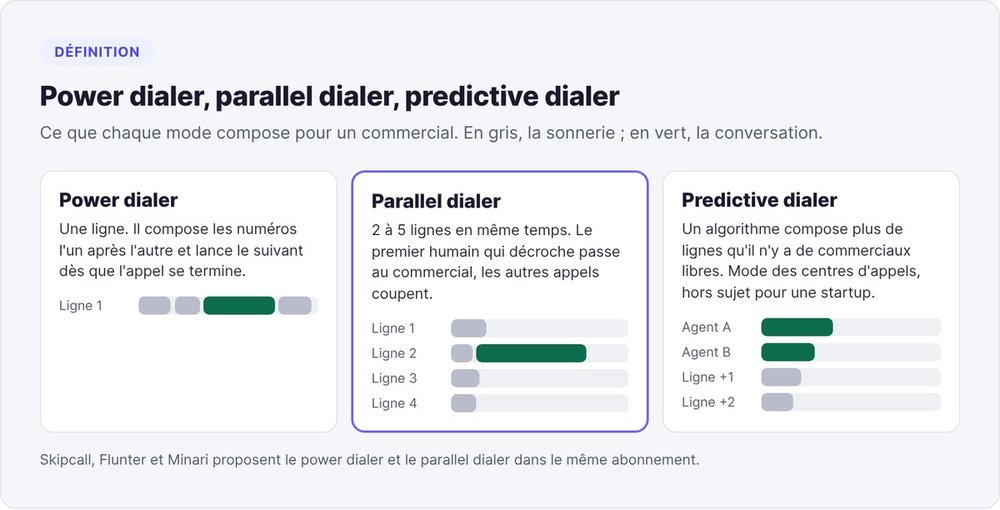
A power dialer dials the numbers on your list one by one, automatically: as soon as a call ends, it starts the next one. It removes manual dialing, but you still wait for each call to ring.
A parallel dialer dials several numbers at once for a single rep and transfers the first answered call to them.
A predictive dialer is built for call centers: an algorithm dials more numbers than there are available agents, betting on the answer rate. It's the mode that produces the most abandoned calls, and it has no place in a startup.
Skipcall, Flunter and Minari offer both power dialing and parallel dialing in the same plan. Ringover, Aircall and Allo are cloud phone systems first: their dialers call one number at a time, which is why Flunter leaves them out of its own parallel dialer comparison.
How many lines at once
The tools on the market dial between 3 and 5 lines: 3 for Ubic, 4 for Skipcall, up to 5 for Flunter, Minari and Paradial. Orum advertises up to 10 lines on its top plan.
More lines don't mean more meetings. Each extra line raises the odds that two prospects answer in the same second, and one of them then hears silence before the call drops. That's why Skipcall stops at 4 lines, and lemlist considers the risk low at two or three lines.
The 8 best parallel dialers in one table
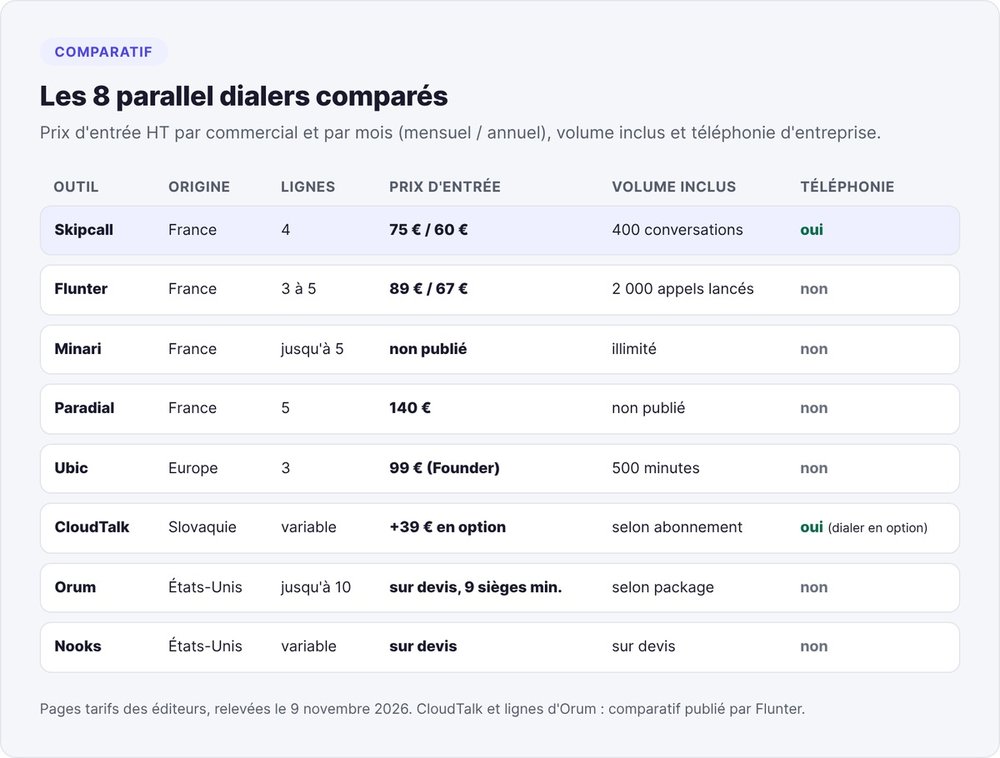
| Tool | Lines | Entry price (excl. VAT, per rep per month) | Business phone system included |
|---|---|---|---|
| Skipcall | 4 | €75 monthly, €60 annually | yes |
| Flunter | 3 to 5 | €89 monthly, €67 annually | no |
| Minari | up to 5 | not published | no |
| Paradial | 5 | €140 per month | no |
| Ubic | 3 | €99 (Founder plan) | no |
| CloudTalk | varies | €39 add-on billed annually, on top of the subscription | yes (the dialer is an add-on) |
| Orum | up to 10 | on quote, 9-seat minimum | no |
| Nooks | varies | on quote | no |
Prices taken from the vendors' pricing pages on November 9, 2026, and from Flunter's comparison for CloudTalk and Orum's line count.
The 8 tools, one by one
Skipcall, a full phone system on top of the dialer
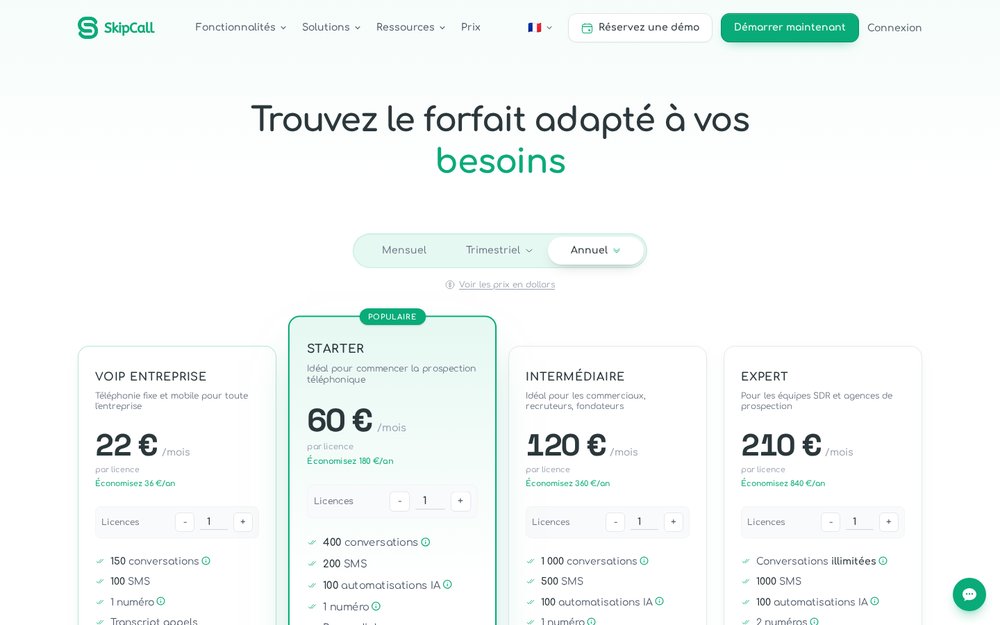
Skipcall is a French vendor that combines a business phone system (landline and mobile, iOS and Android apps) with a prospecting tool: power dialer, 4-line parallel dialer with AI voicemail detection, pre-recorded voicemail drop, SMS, AI transcription and summary of every call, phone number enrichment and an open API. The Starter plan costs €75 per month excl. VAT, or €60 billed annually, with 400 conversations. Intermediate goes up to 1,000 conversations for €120 billed annually, and Expert makes them unlimited. The VoIP-only plan, without the dialer, costs €22 per month billed annually.
Skipcall suits founders who make their own calls and small sales teams in France. From 6 reps up, it offers an Enterprise plan. Waalaxy names it the favorite pick of its comparison, and it shows up in growthhacking.fr threads among the "tried and tested" tools.
Flunter, up to 5 lines
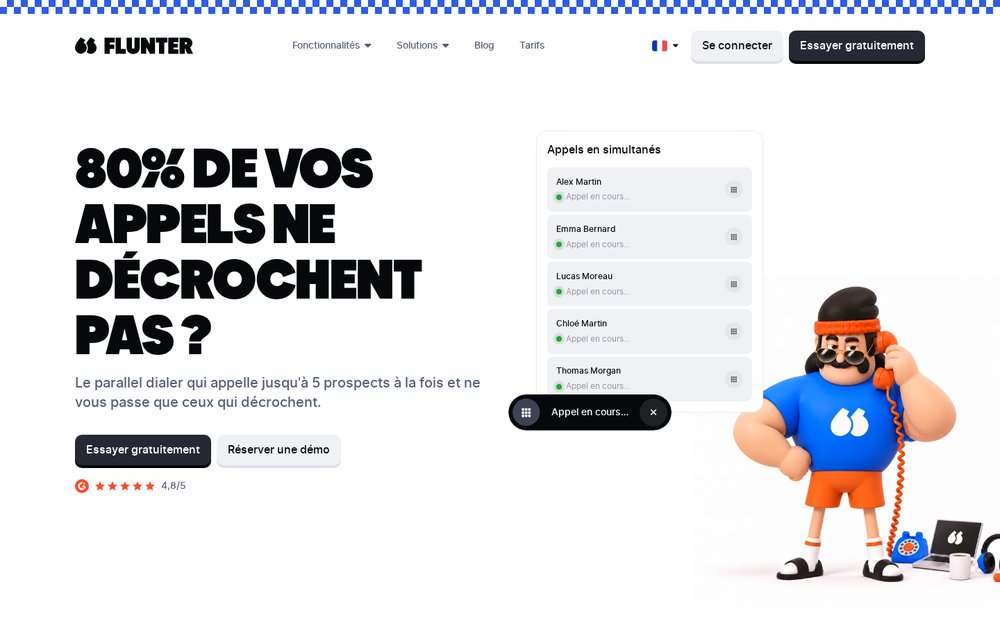
Flunter dials 3 to 5 lines depending on the plan, with voicemail detection and an AI summary of every transcribed call. Starter costs €89 per month excl. VAT with 2,000 call credits (one credit per call placed, answered or not), Hunter costs €159 with 5,000 credits, and Pro costs €249 for unlimited calls, capped at 60 hours of conversation per month. Annual billing takes 25% off, and the trial lasts 7 days with no credit card.
The per-call-placed credit model needs some math: a 3-hour session on 4 lines burns through several hundred credits fast.
Minari, voicemail detection
Minari sells a single plan with no published price: up to 5 lines, unlimited calls, AI voicemail detection, automatic voicemail drop, 2 numbers per rep, a "virtual sales floor" for calling as a team, and sync with Salesforce, HubSpot, Pipedrive and lemlist. Minari says its voicemail detection also filters out iOS call screening, the assistant that answers on behalf of the iPhone's owner. Minari has no minimum license count. On growthhacking.fr, one member sums it up: "we're all Minari fans."
Paradial, French phone numbers
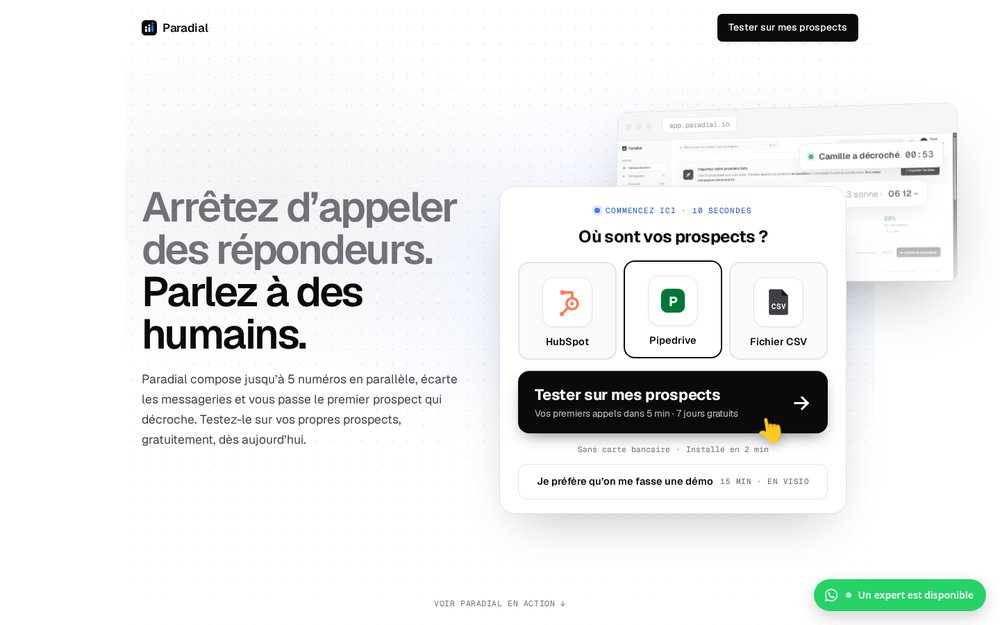
Paradial dials up to 5 lines and shows a simple price: €140 per month, no commitment, after a 7-day free trial. Its main pitch is pickup rates in France: the vendor emphasizes the quality of its French numbers and its automatic voicemail qualification.
Ubic, 24 CRM integrations
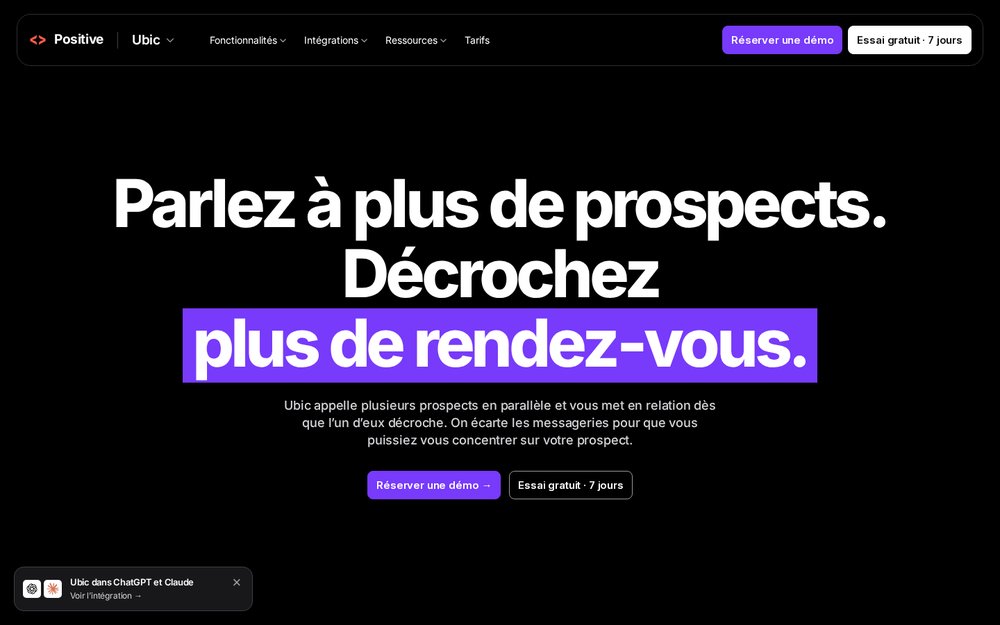
Ubic dials up to 3 calls in parallel, to French landlines and mobiles. Its Founder plan, designed for founders who do their own prospecting, costs €99 per month excl. VAT with 500 call minutes billed by the second, 200 SMS and 200 AI briefs per month. The next plan up costs €200. Flunter credits it with the largest number of CRM integrations on the French market: 24, including HubSpot, Salesforce, Pipedrive and Boond Manager.
CloudTalk, the dialer as an add-on
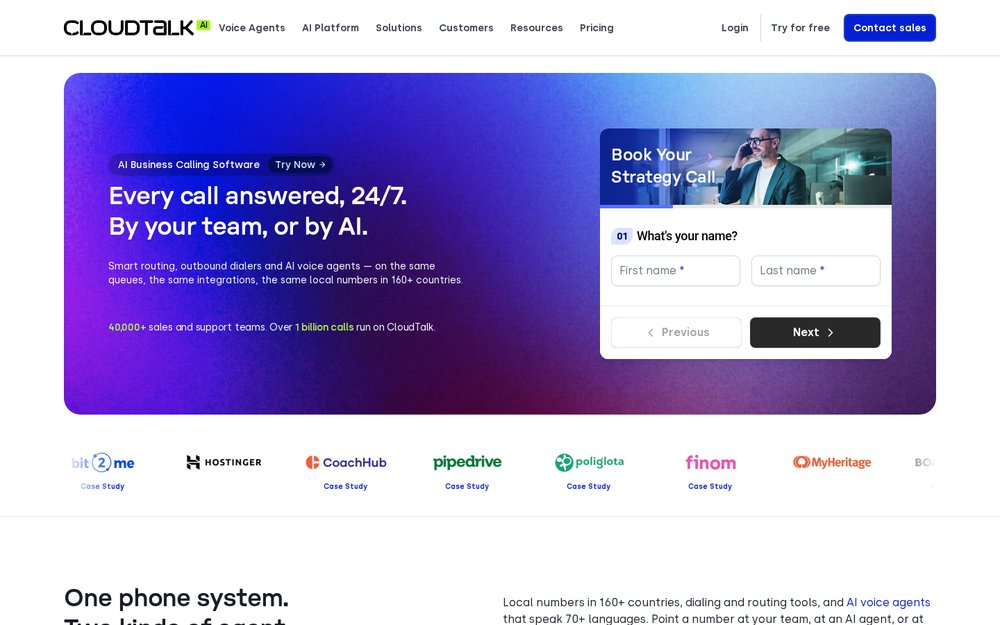
CloudTalk is a Slovak cloud phone system for call centers and sales teams. Its parallel dialer is an add-on at €39 per user per month billed annually, on top of the phone subscription. It makes sense for a team already running on CloudTalk. For a startup starting from scratch, the two combined cost more than an all-in-one tool.
Orum, the US benchmark
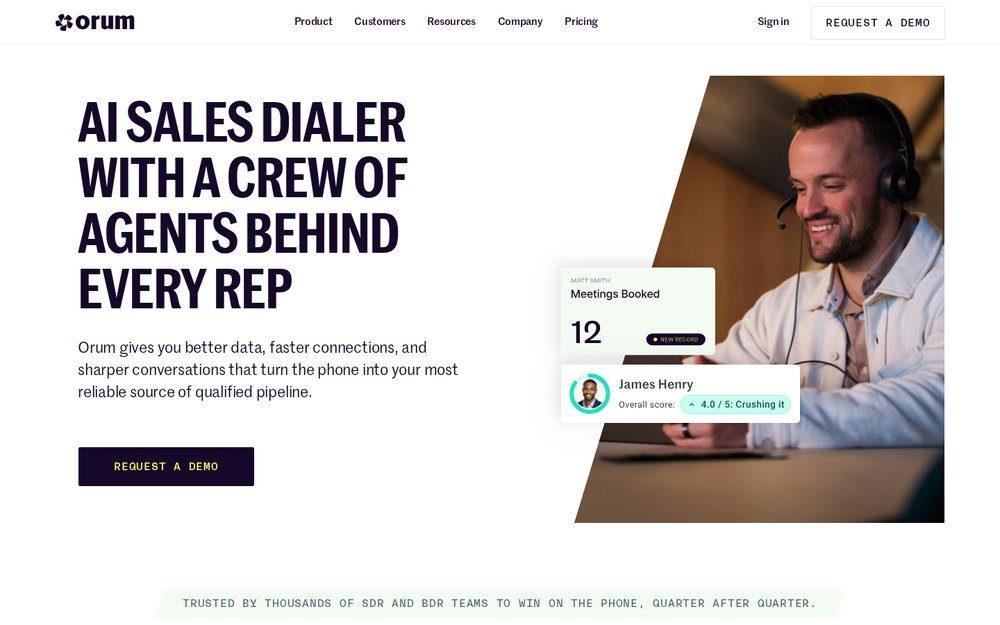
Flunter cites Orum, along with Nooks, as the US benchmark for parallel dialing. Orum dials up to 10 lines on its top plan, adds AI coaching (role-plays, scorecards) and sells on quote, with a 9-seat minimum. Orum is built for teams of 9 reps or more. For smaller teams calling into France, Skipcall, Flunter and Minari are the closest Orum alternatives.
Nooks, the virtual sales floor
Nooks combines a parallel dialer with a virtual calling floor where reps call together. It sells on quote, with no listed price. Like Orum, it targets structured US SDR teams.
Where Skipcall stands out from other parallel dialers
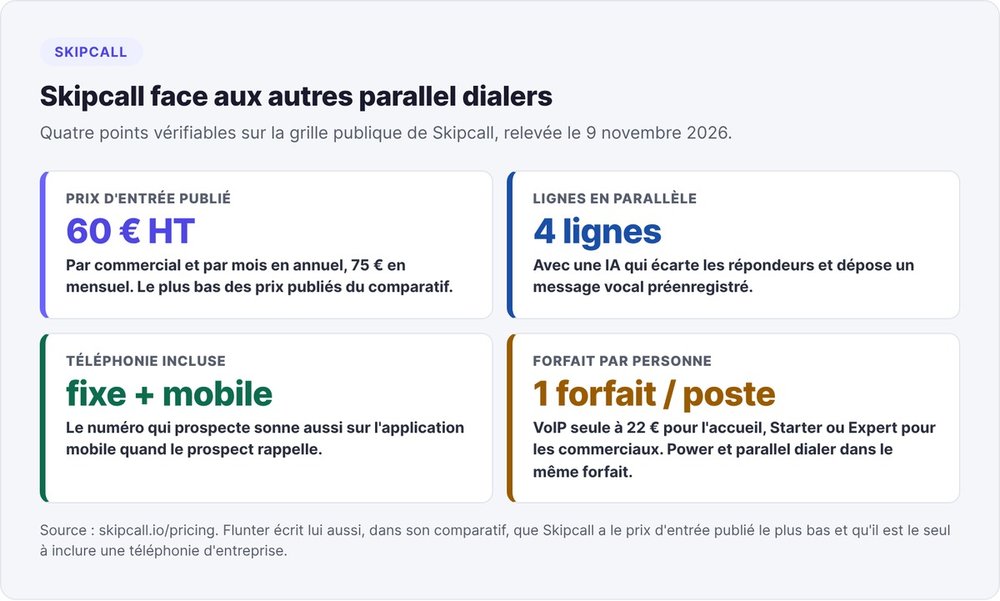
Skipcall stands out on three verifiable points, and one of its competitors acknowledges them: in its own comparison, Flunter writes that Skipcall has the lowest published entry price and is the only one to include a business phone system.
One landline and mobile number for the whole team, dialer included
The other parallel dialers in this comparison do prospecting and only prospecting: to take callbacks from prospects, handle reception or run support, you need a second phone system. Skipcall provides both. The number that calls out through the parallel dialer is also the one that rings on the rep's mobile app when the prospect calls back at 6 p.m., and every inbound and outbound call lands transcribed in the same history.
The lowest published entry price: €60 per month excl. VAT, billed annually
At €60 per rep per month excl. VAT billed annually (€75 monthly), Skipcall's Starter plan includes the 4-line parallel dialer, 400 conversations, 200 SMS and phone number enrichment. Flunter starts at €67 billed annually, Ubic at €99, Paradial at €140. Minari, Orum and Nooks don't publish prices. Skipcall counts conversations, while Flunter counts calls placed: during a 4-line session, calls placed far outnumber conversations, so Skipcall's quota lasts longer.
A different plan for each team member
Skipcall lets you pick a different plan for each team member: the rep who prospects takes Starter or Expert, while the person at reception takes VoIP only at €22. All three calling modes (manual, power dialer, parallel dialer) are available in the same plan, and reps switch between them depending on the list: parallel dialer for a cold list of 300 small businesses, power dialer for 20 quote follow-ups.
How much does a parallel dialer cost?
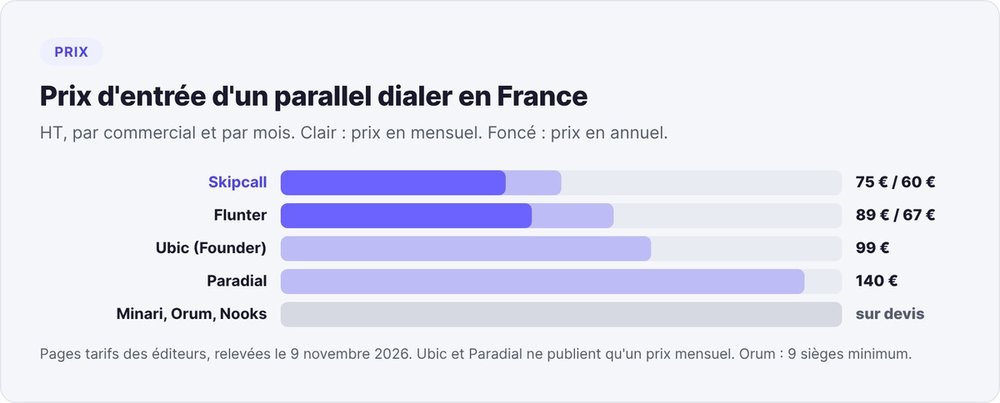
In France, a parallel dialer costs between €60 and €280 per rep per month excl. VAT, depending on the tool, the included volume and the commitment length. Entry plans range from €60 (Skipcall billed annually) to €140 (Paradial). Orum and Nooks are negotiated on quote, with a 9-seat minimum at Orum.
To compare two offers, bring the price back to your actual usage:
- Count each rep's real calling hours per month.
- Check the quota unit: conversations (Skipcall), calls placed (Flunter), minutes (Ubic) or unlimited (Minari, Paradial).
- Add a phone system if the tool doesn't include one, plus any extra numbers.
- Divide the total by the number of meetings booked during the free trial.
In the end, the only number that matters is cost per meeting. It depends more on your list than on the tool.
The risks of a parallel dialer
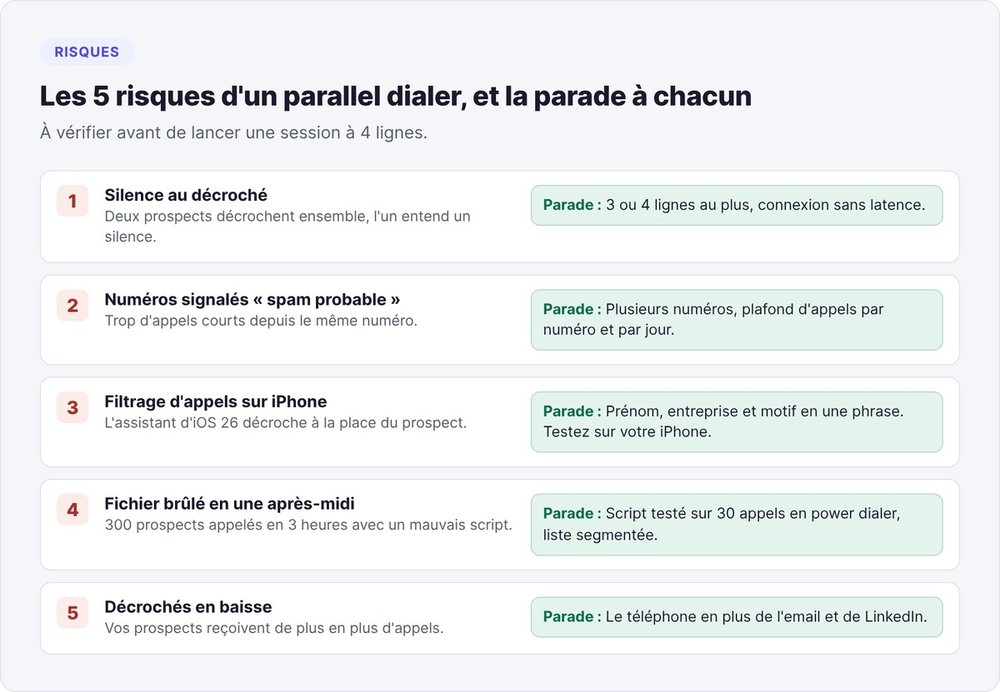
A parallel dialer multiplies your conversations, and it multiplies your mistakes too. Among vendor comparisons, only lemlist devotes a section to the risks. Check these five points before you launch a 4-line session.
Dead air on pickup and abandoned calls
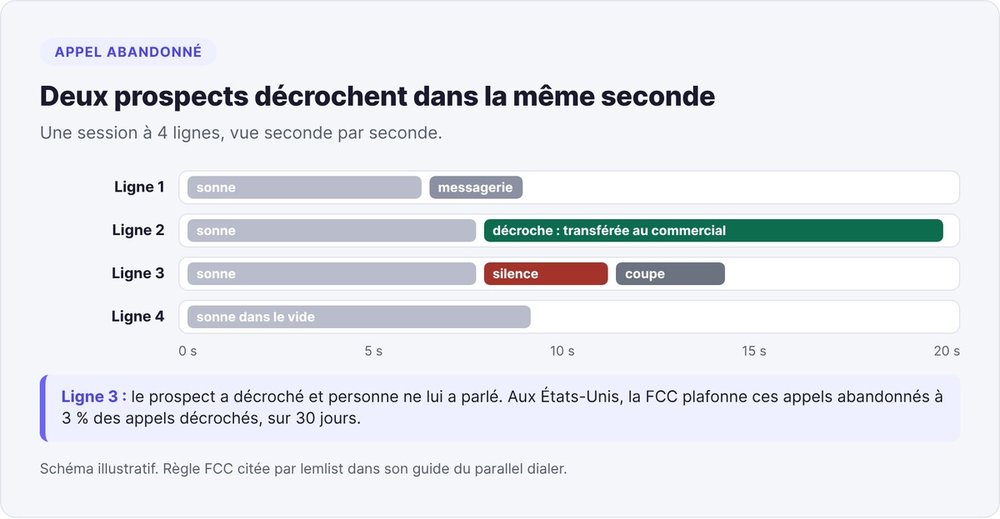
When two prospects answer in the same second, the rep can only talk to one of them. The other hears silence, then the call drops. They saw your number, they picked up, and nobody spoke: that's the worst first impression possible. lemlist points out that in the US, the FCC caps these abandoned calls at 3% of answered calls, over 30 days and per campaign. The rule gives a useful benchmark for France too.
How to counter it: 3 or 4 lines at most, and a tool that connects with no lag. A one-second gap between the prospect's "hello" and the rep's voice is enough to make them hang up.
Numbers flagged as "spam likely"
Carriers monitor how calling numbers behave. A number that places hundreds of calls a day, with lots of hang-ups under two seconds, looks like a robocaller to them. Once the number is flagged, the prospect's phone shows "spam likely" instead of your number, and your pickup rate collapses.
How to counter it: spread calls across several numbers, cap the number of calls per number per day, and retire any number whose pickup rate drops. Minari and Skipcall include 1 or 2 numbers per license, and you can add more.
iPhone call screening
Since iOS 26, the iPhone can screen unknown callers: an assistant answers on the owner's behalf, asks for the caller's name and reason for calling, and displays the answer before the person decides whether to take the call. To a parallel dialer, this assistant looks like a human picking up. Minari says its voicemail detection also filters out this assistant. With any other tool, test this during the trial by calling your own iPhone.
How reps can handle it: when the assistant puts you through, give your first name, your company and the reason for your call in one sentence. The prospect decides based on those words.
A list burned in one afternoon
With 4 lines, a list of 300 prospects is gone in one session. If your opener is bad, you've burned 300 prospects in three hours, instead of burning them over a week of manual dialing. A parallel dialer speeds everything up, including a bad script.
How to counter it: test the script on 30 calls in power dialer mode before switching to parallel, segment the list by industry, and log every "call me back" in the CRM so you can handle them by hand. A list with mobile numbers instead of switchboards also changes the outcome: we measured how much a LinkedIn URL improves the rate of mobile numbers found in our comparison of phone number enrichment tools.
Falling pickup rates as everyone adopts dialers
The last risk comes from the market itself. In a growthhacking.fr thread opened in September 2026, one member warns: "as more people use them, it'll go the way of the US and pickup rates will drop." In the US, tools like TitanX already sell a score that predicts whether a number will answer, for $15,000 a year according to the same thread.
The more calls your prospects get from reps using dialers, the less often they answer unknown numbers. How to counter it: make the phone one channel among several. A prospect who has opened your email three times is more willing to pick up, as we explain in our B2B cold email method.
Parallel dialers and French law: B2B, B2C since August 2026, Bloctel
In B2B, phone prospecting with a parallel dialer is still allowed. The CNIL distinguishes between calls placed by a human, calls placed through a parallel dialer, and automated calling systems that play a recorded message. For business-to-business prospecting, it sets two obligations: inform the person, and respect their right to object to prospecting. Log every refusal in your CRM and remove the number from future sessions.
For calls to consumers, the rule changed on August 11, 2026. Since that date, cold calling a consumer is prohibited without their prior consent, except when the call relates to an existing contract (Law No. 2025-594 of June 30, 2025). The Bloctel opt-out system, which allowed you to call any consumer who hadn't registered, gives way to this consent requirement. A parallel dialer is therefore mainly a B2B prospecting tool.
Two more precautions: tell the person before you record a call, and call professionals about topics related to their line of work.
How to choose your parallel dialer
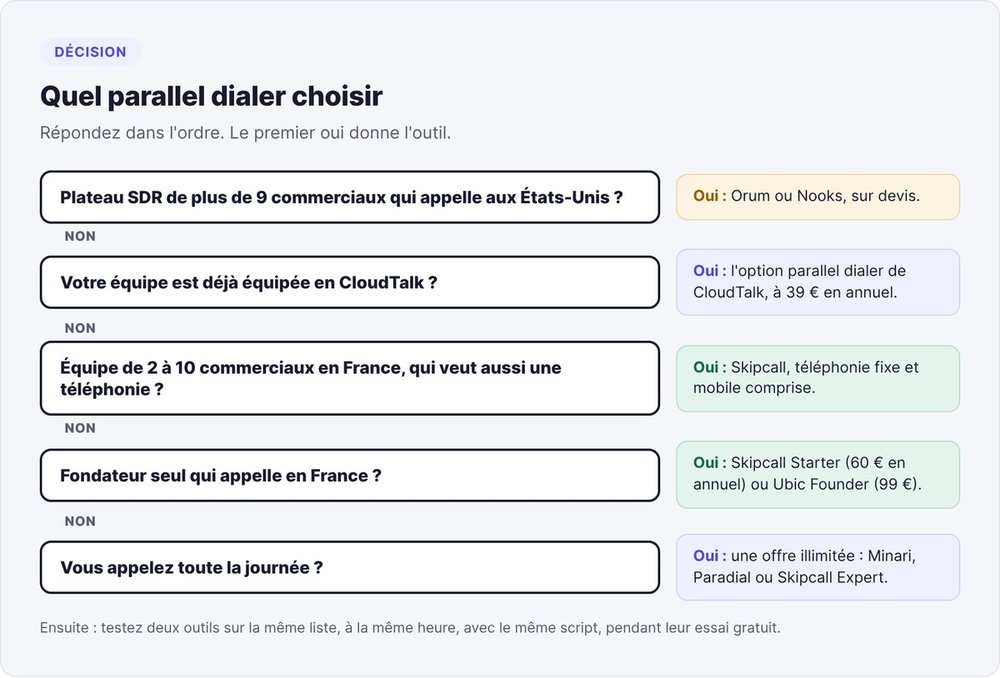
Four questions will point you to the best parallel dialer for your team:
- Where are you calling? In France: a French vendor with French numbers (Skipcall, Flunter, Minari, Paradial). In the US: Orum or Nooks.
- Do you already have a phone system? No: Skipcall saves you a second subscription. Yes, on CloudTalk: CloudTalk's dialer add-on.
- How many reps? Fewer than 9: rule out Orum. A solo founder: Skipcall Starter or Ubic Founder.
- How do you call? In 2- or 3-hour sessions: a quota in conversations or minutes. All day long: an unlimited plan (Minari, Paradial, Skipcall Expert).
Then test two tools on the same list during their free trials, at the same time of day, with the same script. Compare the number of useful conversations per hour, and call your own iPhone to check how each handles call screening.
FAQ
Is a parallel dialer worth it for a small team?
Yes, as soon as you call cold lists every week. At €60 per month with Skipcall billed annually, one extra meeting a month pays for the tool if a meeting is worth more than €60 to you. For the occasional follow-up, a power dialer or manual dialing is enough.
Can you leave a voicemail?
Yes. Skipcall drops a pre-recorded voicemail when it reaches an answering machine, and Minari does it automatically. The rep records the message once, and the tool leaves it on every voicemail while the rep talks to another prospect.
Which parallel dialer should you choose for France?
For a team calling into France, choose a French vendor: Skipcall, Flunter, Minari or Paradial. Skipcall has the lowest published entry price (€60 per month excl. VAT billed annually) and is the only one to include a business phone system. Flunter, Minari and Paradial go up to 5 lines.
Do you need a list of mobile numbers for a parallel dialer?
Yes, if you want results. A parallel dialer that calls switchboards runs into gatekeepers, and the speed advantage disappears. Enrich your list with mobile numbers before the session: we compare the tools that do it, with rates we measured on 2,371 contacts, in our ranking of phone number enrichment tools.