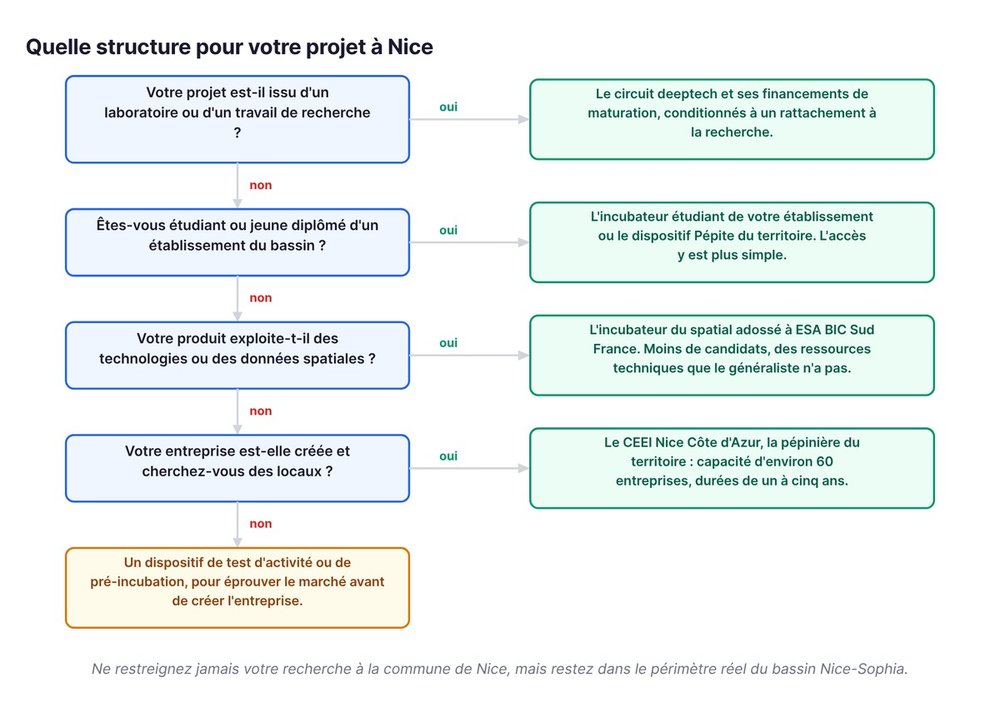
Picking an incubator in Nice depends first on your project's stage and sector. The specific organization comes second. General-purpose incubators take projects at the idea stage, research-backed deeptech programs target lab spinouts, and school incubators are reserved for students and alumni. Nice and Sophia Antipolis form a single economic area, so if you leave Sophia out, you miss the deeptech and space programs. Some organizations listed for Nice are actually based elsewhere or no longer accept applications. This guide flags them, and compares each organization on entry criteria, business model, equity stake, and duration, with sources.
Which incubator to choose in Nice: the quick answer
By project stage
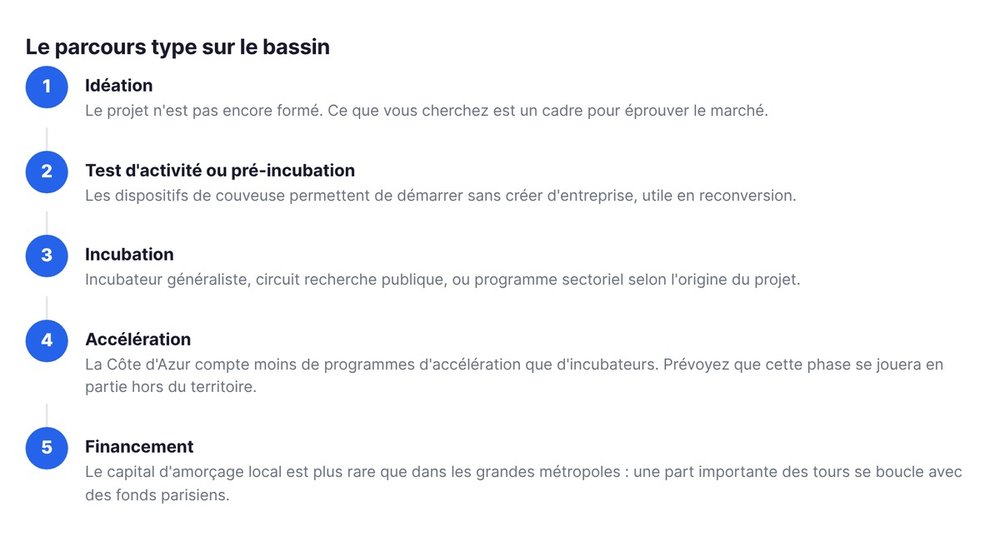
Unvalidated idea, no company yet. Look for an activity-testing scheme or a pre-incubation program. At this stage, what you need is a framework for testing the market.
Project underway, company incorporated or in progress. This is the core audience for general-purpose startup incubators and the area's business nursery.
Project born in a lab or out of research. You belong on the deeptech track, with its own maturation funding, rules, and timelines.
Company with traction and revenue. You've outgrown incubation. Look for a sector-specific accelerator or go straight to fundraising.
By sector
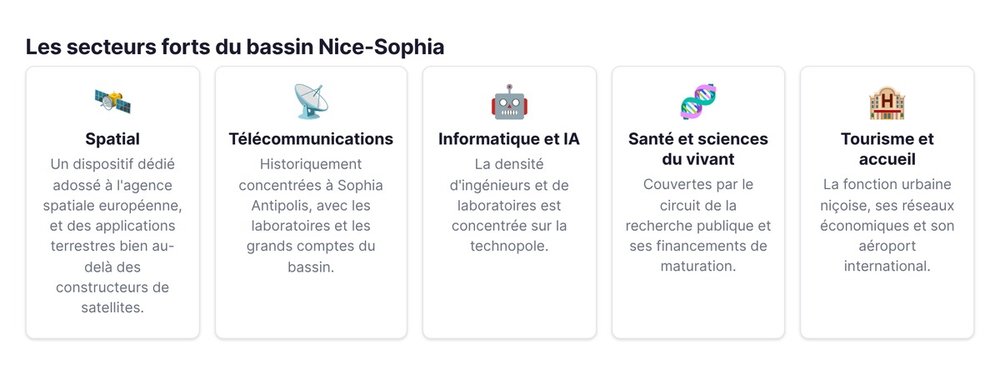
The area has distinct specializations, and each one fits a different kind of project. Space has a dedicated program backed by the European Space Agency. IT and telecoms have historically clustered in Sophia Antipolis. Health and life sciences are covered by the public research track. For sectors outside these specialties, the general-purpose organization remains the right entry point.
Brochures won't show you a region's real specialization, because everyone claims to cover every sector. Instead, read the list of supported companies that each organization publishes on its website. If none look like yours, that doesn't rule you out. You'll just have to explain why you're there, and you won't have peers who have already worked through your problems.
By profile: student, employee, researcher
Student or recent graduate: start with your school's student incubator or the local Pépite program, where access is easier.
Employee changing careers: activity-testing schemes let you get started without incorporating a company and without immediately giving up your current status.
Researcher: the public research track gives access to maturation funding reserved for projects that come out of a lab.
Nice and Sophia Antipolis: one ecosystem
If you limit your search to the city of Nice, you'll overlook the deeptech and space programs, which are based in Sophia.
What Sophia Antipolis brings
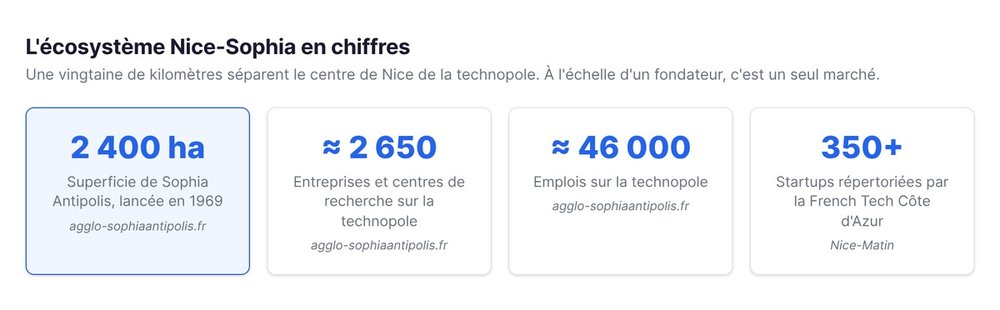
Sophia Antipolis was founded in 1969 and covers 2,400 hectares. The technology park is home to about 2,650 companies and research centers, which together account for roughly 46,000 jobs.
Most of the area's engineers, labs, and large tech companies are in Sophia, while central Nice has far fewer. If you need to hire specialized technical talent, find a research partner, or land a first industrial customer, Sophia is where to look.
Nice offers something different: city amenities, traditional business networks, the chamber of commerce, the international airport, and the metropolitan area's support programs.
The area's actual geography
Central Nice is about twenty kilometers from the technology park, and the organizations of the Alpes-Maritimes department cover the whole area. For a founder, it all works as one labor market, one investor pool, and one network of people who can refer you.
So don't restrict your search to the city of Nice, and don't stretch it to Toulon or Marseille either, because those areas have different programs and different networks.
General-purpose incubators
Incubateur Provence Côte d'Azur
This is the area's flagship organization, formerly known as Incubateur PACA Est. It runs several programs:
- the public research incubator, with the French Ministry of Higher Education and Research
- an entrepreneurial maturation scheme, run with the technology transfer offices of research institutes and universities
- a space incubator backed by ESA BIC Sud France
- a student-entrepreneur incubator, run with Pépite Méditerranée
The cumulative results published by the organization show how much weight it carries:
- €375 million raised by the projects it has supported
- €157 million in revenue, 40% of it international
- 1,550 direct jobs in the region
- 145 active companies and 280 projects
The key point before you apply: it focuses on innovation with a strong technology component, with a clear tilt toward public research. A service business without a technology angle will be a better fit elsewhere.
CCI Nice Côte d'Azur programs
CEEI Nice Côte d'Azur is the area's business nursery. It received its official label in 2012 and hosts and supports innovative companies, with room for about 60 of them, for one to five years. It also hosts French Tech Côte d'Azur, so it's a useful entry point even if you don't need office space.
A business nursery gives you hosting with support rather than a place in a selective cohort. You get a long stay, rent to pay, shared services, and introductions.
That means you prepare a different kind of application. A business nursery won't ask for a five-year vision. It checks that your business is viable and that you can pay for your space. Your application is judged on financial and operational details, while an incubator application is judged on potential and team.
Boréal Innovation
Boréal Innovation shows up in lists of Nice incubators, but it's actually a Marseille-based business and employment cooperative. It runs an online couveuse (a scheme for testing a business before you launch it) that people in Nice can join too. You test your activity under a business project support contract before creating any company.
It's useful, and it's often the right choice for someone changing careers. Just know that it's neither an incubator nor part of the Nice ecosystem.
Deeptech and research incubators
Organizations backed by the university and research labs
The public research track is the most structured in the area, and the least known outside academia. It relies on two mechanisms. Maturation funds the step from a lab result to a working demonstrator. Incubation supports the creation of the company. The requirement is strict: your project must be based on research work, because that's a condition for getting the funding.
Incubators in Sophia Antipolis
In the technology park, support comes through the universities, schools, and research institutions on site: engineering schools in telecoms and computer science, plus a business school. Several of them run their own programs for students, graduates, and researchers.
The space program deserves a separate mention. ESA BIC Sud France is one of the few programs in France built specifically for companies that use space technology or data, including companies that apply it in other sectors.
That criterion opens the program to far more candidates than you might expect. People tend to picture a program for satellite manufacturers. In practice, many of the projects use space data to solve problems on Earth: crop monitoring, water management, infrastructure monitoring, logistics, parametric insurance. If your product uses satellite imagery or positioning data, check this program before you apply anywhere else. Sector programs get fewer applicants and offer technical resources that general-purpose incubators don't have.
School incubators
EDHEC and other institutions in the area
EDHEC runs an incubation program for its students and alumni, with a presence in Nice and activity beyond the campus as well. The area's other institutions, including engineering schools and the university, run similar programs for their own communities.
At every school, your affiliation is the first filter, and it often still counts several years after you graduate. Check your school's alumni policy before applying elsewhere.
French Tech Côte d'Azur and public programs
French Tech Côte d'Azur runs the local startup network and lists more than 350 startups. It doesn't incubate companies. Its job is to award the French Tech label, make introductions, and run national programs locally.
There's one recent change to know about before you plan your applications. The French Tech Tremplin program, which ran locally for years, is being discontinued. The fifth cohort, announced in June 2026, will be the last, and the program ends in June 2027. Mission French Tech is replacing it with French Tech Nova, which focuses on scaling up rather than the early stage. If you find a page inviting you to apply to Tremplin, it's out of date.
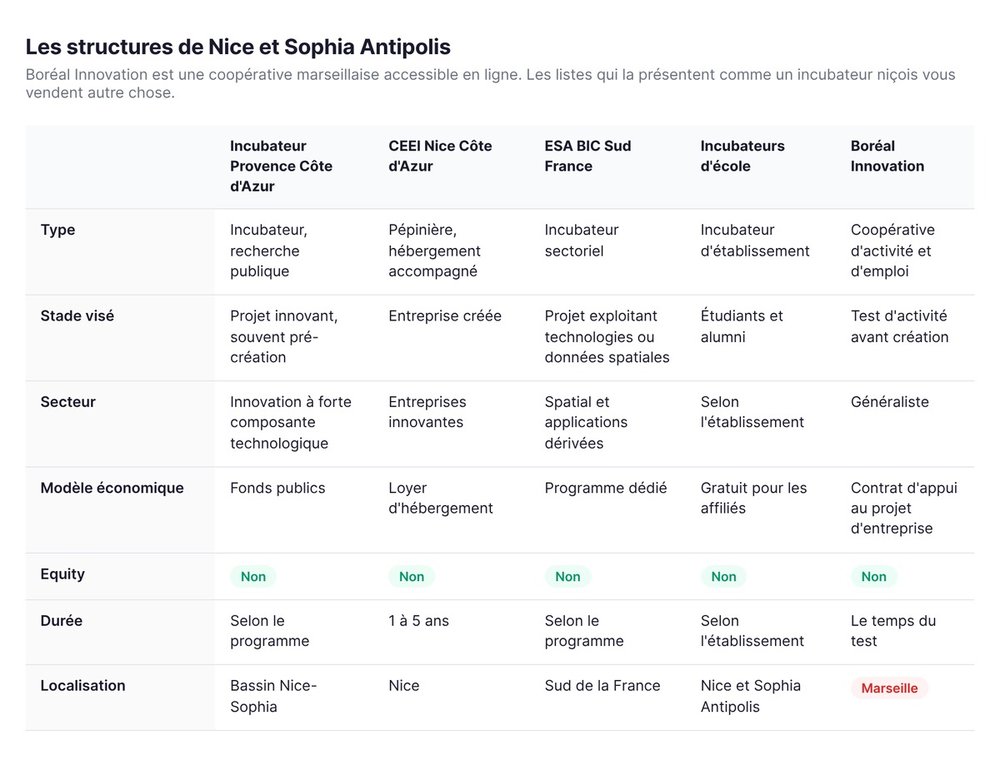
Comparison table: criteria, cost, equity, duration
| Organization | Entry criteria | Model and equity stake | Duration |
|---|---|---|---|
| Incubateur Provence Côte d'Azur | innovation with a strong technology component, often from public research | public incubator backed by the French Ministry of Research, no equity taken | not published |
| ESA BIC Sud France, via Incubateur Provence Côte d'Azur | space technology, know-how, or data, including for uses outside the space sector | public sector-specific program, no equity taken | not published |
| CEEI Nice Côte d'Azur (CCI) | innovative company already incorporated, room for about 60 companies | rent and shared services, no equity taken | one to five years |
| EDHEC incubator | student or alum of the school | school program, no equity taken | not published |
| Boréal Innovation (Marseille-based couveuse, online access) | founder at the pre-incorporation stage, including career changers | business project support contract, no company created, no equity taken | twelve months, renewable twice |
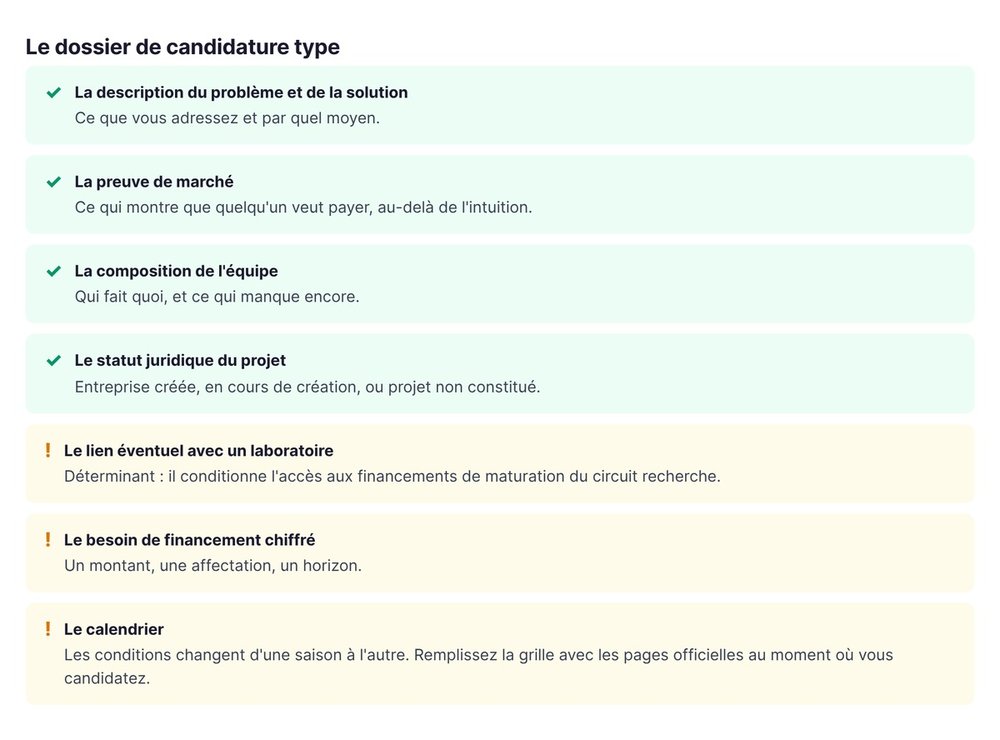
Public and semi-public organizations dominate this area. They take little or no equity, and in exchange they set stricter eligibility criteria. Before you sign, check the equity terms in the agreement. Also reread the official pages when you apply, because conditions change from one year to the next.
After the incubator: acceleration and funding
Accelerators in the area
The Côte d'Azur has fewer accelerator programs than incubators, and many are sector-specific or run by large companies in the technology park. At this stage, some startups in the area join national programs while keeping their local base.
Build this into your plan: expect part of your acceleration phase to happen outside the region.
There are two ways to handle this. The costly way is to move the whole company and lose access to the engineers, labs, and industrial partners that were the reason you set up here. The better way is to keep the technical team in place and have your sales and finance people do the traveling. The technology park's pool of engineers is a rare asset, and founders often give it up without needing to.
Investors active on the Côte d'Azur
There is less seed capital available locally than in France's major cities, and some funding rounds in the area are completed with Paris-based funds. So you need to leave your incubator with two things: the proof of execution that investors expect everywhere, and a network that extends beyond the local area.
To see how the area's organizations compare with those in other cities, read our guide to accelerators and incubators in France. Marseille has its own programs, separate from Sophia's, covered in our guide to incubators and accelerators in Marseille. Since part of the acceleration phase happens outside the region, our overview of incubators and accelerators in Paris covers the capital's programs.
FAQ
Incubator, business nursery, or accelerator: what's the difference?
An incubator supports a project early on, often before or just after the company is incorporated, and selects projects based on innovation. A business nursery hosts companies that are already incorporated and provides office space and shared services for long periods, up to five years. An accelerator works with companies that already have traction, over a short and intensive period, often in exchange for equity.
Do incubators in Nice take equity?
In most cases, no. The main organizations in the area are public or semi-public and take no equity, but they have stricter eligibility criteria. Private accelerators, on the other hand, may take a stake. Check the agreement for each organization before you sign.
How much does an incubator in Nice cost?
Models vary. Some programs are publicly funded and cost you nothing directly, some charge an annual membership fee, and business nurseries charge rent. There's no single price list for the area, and not every organization publishes its fees. Before comparing two offers, ask for the total cost over the full program, including office space.
Can you be incubated remotely?
For some programs, yes. Couveuses and activity-testing programs often provide support remotely. Most incubation programs in the area, however, require regular attendance and rely on access to local equipment and networks. If location is a constraint for you, ask before you apply rather than after.