In Grenoble, choosing an incubator starts with a question other French ecosystems rarely ask: is your project a technology transfer play or not? Two tracks run side by side here, and they serve different founders. The technology transfer track, led by the SATT Linksium and the research-backed structures around it, targets projects that come out of a lab. It unlocks dedicated maturation funding, with an average investment of around €180,000 per project. The generalist track, with inovallée's Tarmac, Le Village by CA and the school incubators, takes innovative projects with no academic affiliation required. Knowing which side you fall on saves you months of applying in the wrong place. This guide compares each structure by track, stage, cost and equity, and flags one piece of outdated information that still shows up in search results.
How to join an incubator in Grenoble
The answer depends entirely on which track you enter.
The two tracks: generalist and technology transfer
The technology transfer track. Built for projects that exploit a technology developed in a public research lab. You come in through the region's technology transfer acceleration company, with a funded maturation phase that starts before the company even exists. Expect a long timeline, substantial technical resources, and a license on the intellectual property as the trade-off.
The generalist track. Built for every other innovative project: a classic startup incubator or accelerator, with selection by application and interview, shorter programs, and no claim on your intellectual property.
Projects can't move freely between the two. Eligibility for the deeptech track hinges on where the technology originated. Ambition has nothing to do with it.
What stage to apply at
The deeptech track accepts projects very early, before a company exists: maturation is designed to turn a research result into a working demonstrator. The generalist track expects at least a thought-through business model and a team. Some structures accept projects at the idea stage, while others require an incorporated company with early traction.
The smart move is to be honest about where you stand on three axes: does the technology work, has anyone paid for it, and is the team complete? Three noes point you toward pre-incubation.
A selection panel sees dozens of applications per round and quickly spots a project pitched above its real stage. The cost goes beyond the rejection itself: you walk away with no useful feedback, because the panel assessed a project that doesn't exist yet. Applying at the right stage guarantees you, at the very least, feedback you can act on.
Grenoble's structures talk to each other. A poorly pitched application gets around, and you don't want your first contact with the ecosystem to be an application that never belonged there.
Who can get support
- Researchers and PhD students: the technology transfer track.
- Students and graduates of a Grenoble institution: the school incubator, with eligibility extended to alumni and external candidates depending on the program.
- Founders with no academic ties: generalist incubators and accelerators.
- Founders of social-impact projects: the incubator dedicated to the social and solidarity economy, which applies its own criteria and formats.
Deeptech or generalist: the first filter
Grenoble is France's leading deeptech hub outside Paris. Yet each structure's website describes its own program without telling founders whether they belong on the technology transfer track.
The SATT, the centerpiece of Grenoble's ecosystem
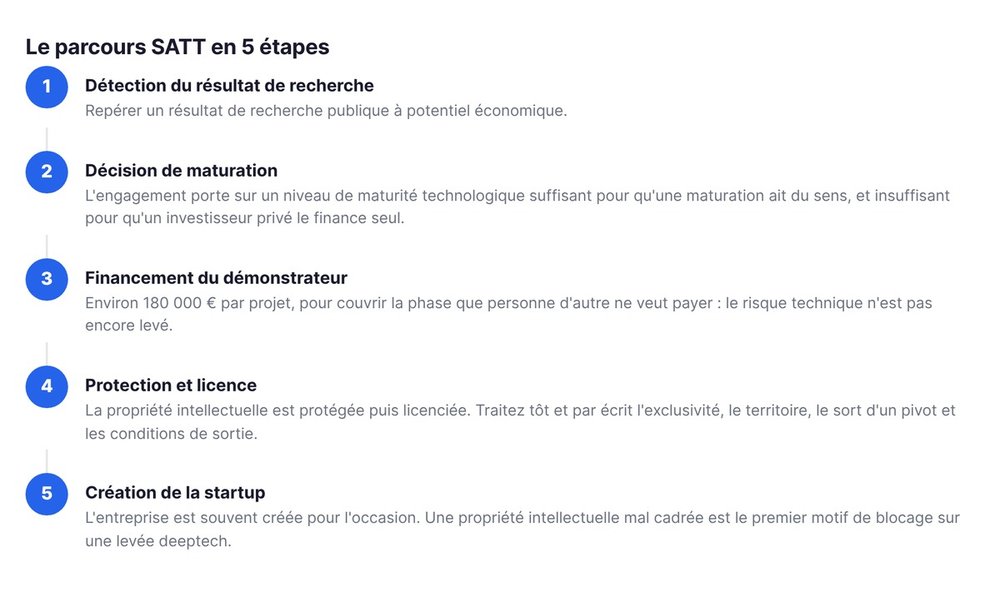
A SATT is a technology transfer acceleration company. Its job: spot public research results with commercial potential, fund their maturation to a demonstrable stage, protect the intellectual property, then license it to a company, often one created for that purpose.
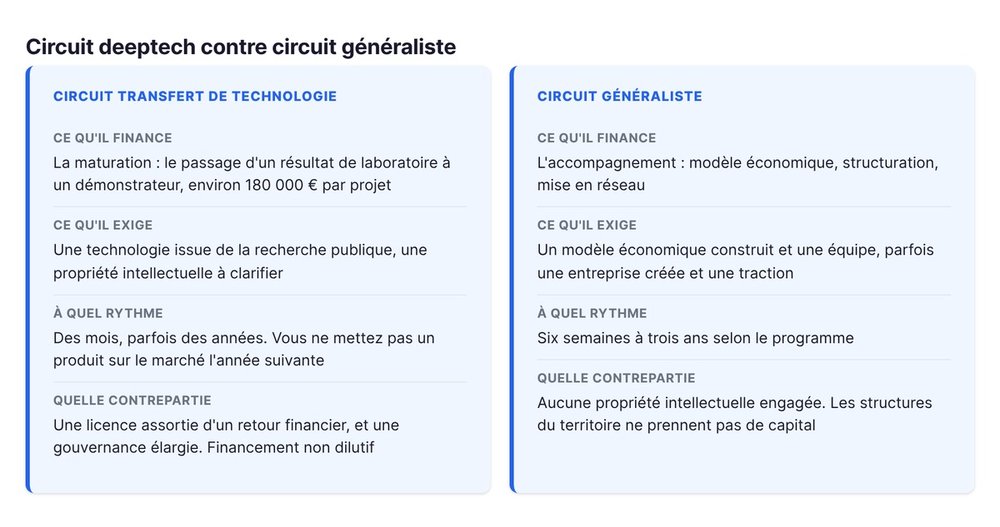
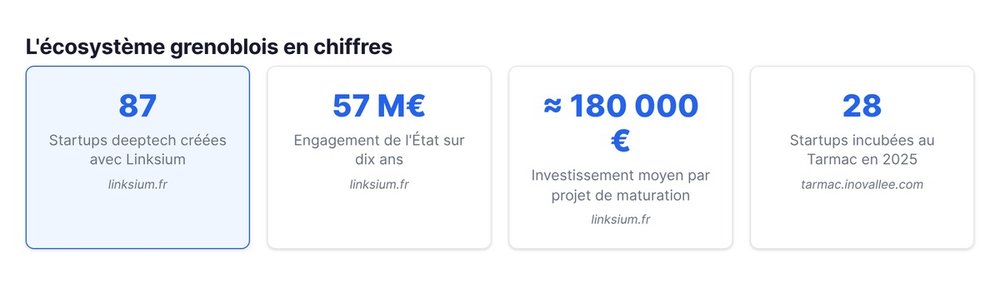
In the Grenoble area, that role belongs to Linksium, which has helped launch 87 deeptech startups and benefits from a €57 million, ten-year commitment from the French state. The average investment in a maturation project is around €180,000, aimed at building a lab demonstrator.
Why this matters especially here: the region's dense network of labs and research institutes means many high-potential projects are born in an academic setting. If you qualify for this track and skip it, you end up self-funding work that could have been funded for you.
Consider what that money actually covers. Maturation funding pays for the phase nobody else wants to finance: the technology works in the lab, but nothing proves it will hold up outside ideal conditions. Private investors stay away because the technical risk hasn't been cleared, and customers won't order because there's nothing to evaluate yet. Many deeptech projects die right there, for lack of funding suited to that exact moment.
And this funding is non-dilutive. A software startup carrying the same level of risk would already have given up a share of its equity.
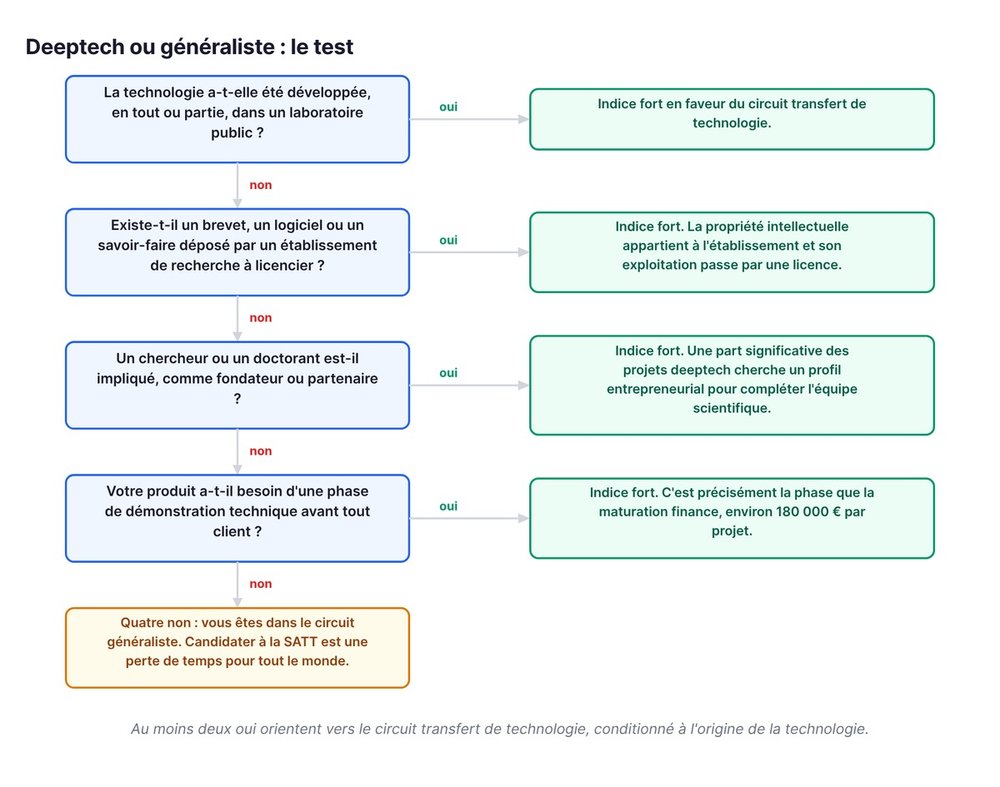
The test: does your project qualify for technology transfer?
Four questions. You need at least two yeses.
Was the technology you're using developed, in whole or in part, in a public research lab?
Is there a patent, software or know-how filed by a research institution that you'll need to license?
Is a researcher or PhD student involved in the project, as a founder or partner?
Does your product need a technical demonstration phase before it can even be offered to a customer?
If you answer no to all four, you belong on the generalist track, and applying to the SATT wastes everyone's time.
The trade-offs of the deeptech track
Time. A maturation phase takes months, sometimes years. You won't bring a product to market next year.
Shared value. The intellectual property belongs to the institution, and using it requires a license with financial returns attached. Terms are negotiated project by project and never published.
Broader governance. Institutions, the transfer company and any industrial partners all have a say. A deeptech startup rarely starts life with a simple cap table.
In return, you get non-dilutive funding for the riskiest phase, equipment and technical expertise you couldn't access otherwise, and protection for your technology.
The issue to tackle early, and in writing, is the exact scope of the license. Three questions before you commit: is the license exclusive, and in which territory? What happens if the company pivots to an application the license doesn't cover? What are the exit terms if the project stops? The answers shape your room to maneuver for years, and they're far easier to negotiate before incorporation than after your first round.
A Series A investor will start right there, too: poorly defined IP is the number one deal-breaker in a deeptech fundraise.
Deeptech and research incubators
Linksium
The linchpin of the track: it funds maturation and incubates deeptech projects, with support covering technology, market and team building.
The typical entry profile: a project out of a local lab, with an identified technology, a need for a demonstrator, and often a researcher who won't become the CEO.
That last point matters. A significant share of deeptech projects are looking for an entrepreneurial profile to round out the scientific team. If you're a founder with startup experience but no technology of your own, this track is also a way in, through recruitment rather than an application.
Incubation at Grenoble INP
The institution runs its own incubation program, with formal entry requirements and a clear focus on projects with a technological and scientific component.
As with every academic program, the first filter is your connection to the institution, researchers and students included.
Entry requirements and available grants
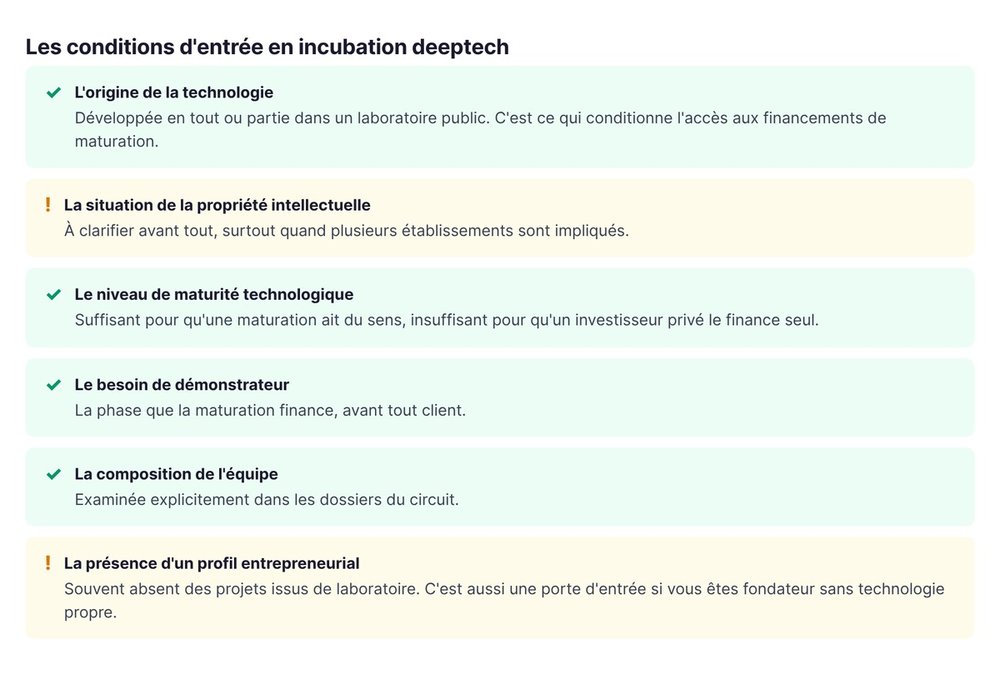
Three elements come up again and again in deeptech applications. Technology readiness: advanced enough for maturation to make sense, yet too early for a private investor to fund it alone. IP status, which needs to be cleared up first, especially when several institutions are involved. Team composition, where panels explicitly look for an entrepreneurial profile.
On top of that, national innovation grants can be stacked in parallel, and the support structures know their calendars better than you do.
Generalist incubators and accelerators
Tarmac, inovallée
Tarmac is the incubator of the inovallée technology park, and its model stands out on one practical point: it runs without fixed cohorts. Support is tailored and you can join at any point in the year, so you won't wait six months for the next intake.
The full incubation journey spans three years. Within it, structured programs are available: Take-Off, a twelve-month program, focuses on securing your launch, while the GATE programs target growth acceleration. In 2025, 28 startups were incubated there.
It's the most straightforward option on Grenoble's generalist track for a tech founder without academic ties.
The absence of fixed cohorts is more than an organizational detail. In a cohort, you follow a shared rhythm, which works well when projects are similar and costs you when they aren't: a hardware startup preparing its first production run has little in common with the agenda of a software startup chasing its first ten users.
The flip side of continuous support is losing the cohort effect. If the peer group is what you're after, ask about shared sessions and events before you commit.
Le Village by CA Grenoble
Le Village by CA Sud Rhône Alpes hosts innovative startups under five years old, with a focus on acceleration and introductions to a network of partner companies.
The value of this kind of structure is commercial more than methodological: access to large accounts and regional members that a young company would otherwise take months to reach.
AlterIncub and social entrepreneurship
Alter'Incub Auvergne-Rhône-Alpes is the incubator dedicated to the social and solidarity economy, with an office in Grenoble. It offers two formats: Entreprendre Demain, six weeks to go from idea to concept, and Bâtir Demain, six months renewable up to twenty-four, to go from concept to launch.
The short format is rare and useful: six weeks to decide whether a concept holds up is exactly what many founders stuck at the early stage are missing.
School incubators
IncubaGEM, Grenoble École de Management
IncubaGEM supports projects led by students, graduates and school staff, and also accepts external candidates, which makes it more open than most school incubators.
The terms are public. Incubation lasts six to eighteen months, renewable twice. It includes eight hours of support per month across one-on-one coaching, workshops and networking, access to a network of experts and mentors, and the option to register the startup's address on the Grenoble or Paris campus. It's free, and the program takes no equity.
Selection happens over two recruitment rounds a year, with a pitch to a panel and a full business model required. That last requirement is a hard cutoff: showing up with an idea and plenty of enthusiasm won't get you in.
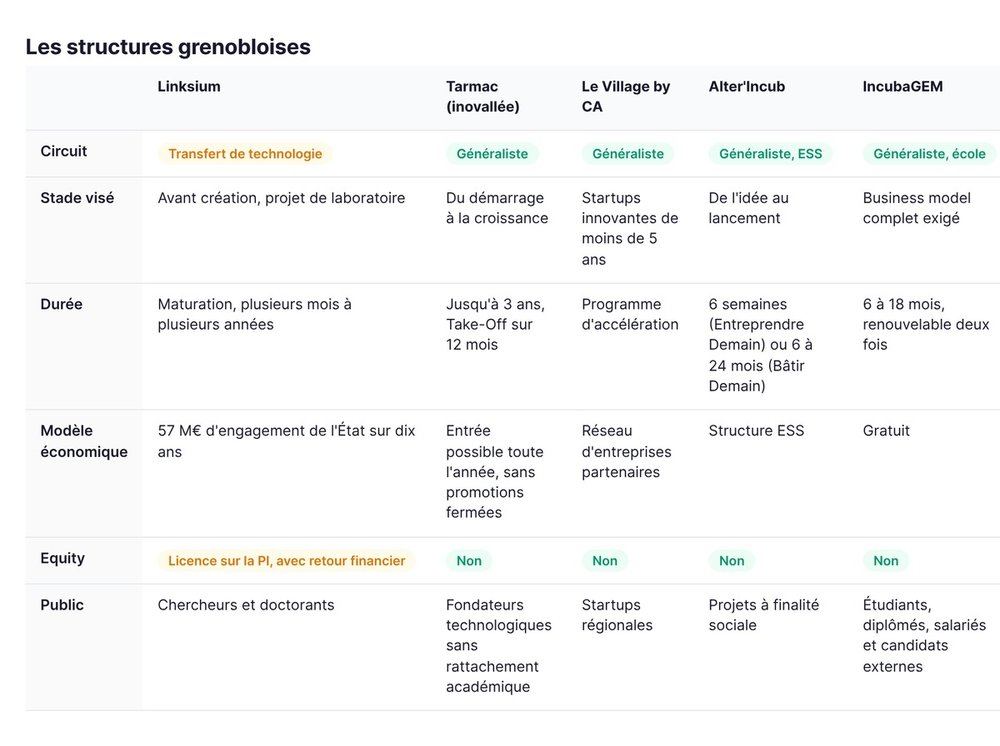
The comparison grid: track, stage, cost, equity, duration
Apply these five criteria the same way to every structure, since each website only talks about itself.
Track. Technology transfer or generalist. This is the first filter, and it shapes everything else.
Accepted stage. From the idea stage for short formats and academic programs, up to five years in business for accelerators.
Duration. Six weeks for the shortest format, twelve months for a launch-securing program, up to three years for a full incubation journey, and longer still for a deeptech maturation project.
Cost and business model. The region's school incubators are free for their eligible audiences. Public and semi-public structures take no equity. The deeptech track takes no equity for its support, but the intellectual property is licensed with financial returns, which is a different kind of trade-off.
Equity. Check this explicitly in every agreement. Taking no equity is the norm in this region, which doesn't rule out other forms of compensation.
What's changing in 2026
The end of French Tech Tremplin and its replacement
One update invalidates part of what you'll find online.
The French Tech Tremplin program, launched in 2019 to promote equal opportunity in entrepreneurship, is shutting down. The fifth cohort, whose winners were announced in June 2026, is the last, and the program ends for good in June 2027. It's being replaced by French Tech Nova, which focuses on scaling startups that have already launched, with early-stage seeding outside its scope.
For a Grenoble founder: if your plan relied on applying to Tremplin at the seed stage, that plan no longer exists, and its replacement targets a different stage. Local pages that still present Tremplin as active are out of date, including some that rank well.
To see where Grenoble's structures fit in the national landscape, our guide to accelerators and incubators in France gives you the full overview. For the rest of the Auvergne-Rhône-Alpes region, see our guide to incubators and accelerators in Lyon. And for the next step, our roundup of French venture capital funds identifies the investors active in deeptech.
FAQ
Do you need to come from a lab to get incubated in Grenoble?
No. Two tracks coexist: the technology transfer track, reserved for projects that come out of public research, and the generalist track, open to all innovative projects. inovallée's Tarmac, Le Village by CA and the school incubators all welcome founders with no academic ties whatsoever. Only the deeptech track and its maturation funding require a lab-originated technology.
At what stage can you apply?
It depends on the structure. Short formats and pre-incubation programs accept projects at the idea stage. School incubators generally require a full business model. Accelerators target incorporated companies, sometimes with an age limit, such as five years maximum for one of them. The deeptech track comes in before the company is even created.
How much does incubation cost in Grenoble?
The region's school incubators are free for their eligible audiences, and one explicitly states that it takes no equity. Public and semi-public structures don't take stakes. Detailed pricing isn't published in any consolidated form: ask for the total cost over the full program, including office space, before comparing two offers.
What is a SATT and what does it take in return?
A SATT is a technology transfer acceleration company. It funds the maturation of a public research result to a demonstrable stage, protects the intellectual property, then licenses it to a company. In return, it takes a license with financial returns attached in place of a classic equity stake, with terms negotiated project by project and never published.