Picking an incubator in Rennes means choosing between three families of organizations, each built for a different kind of founder. Generalist incubators, including the Incubation x Le Poool program backed by Emergys Bretagne, take innovative projects whatever the founder's background. The academic track, run through a shared program that brings together eleven institutions, is reserved for students and graduates. Business nurseries (known locally as "pépinières", a term used everywhere in Brittany) are first and foremost workspace for companies that already exist, with a network of eight sites managed on behalf of the metropolitan area. This guide compares each organization on cost, duration, equity and selection criteria, and flags one that has stopped taking new projects since 2023.
Which incubators are in Rennes: the quick list
Rennes organizations don't fit into the same categories, so this list sorts them first by stage, then by profile.
By project stage
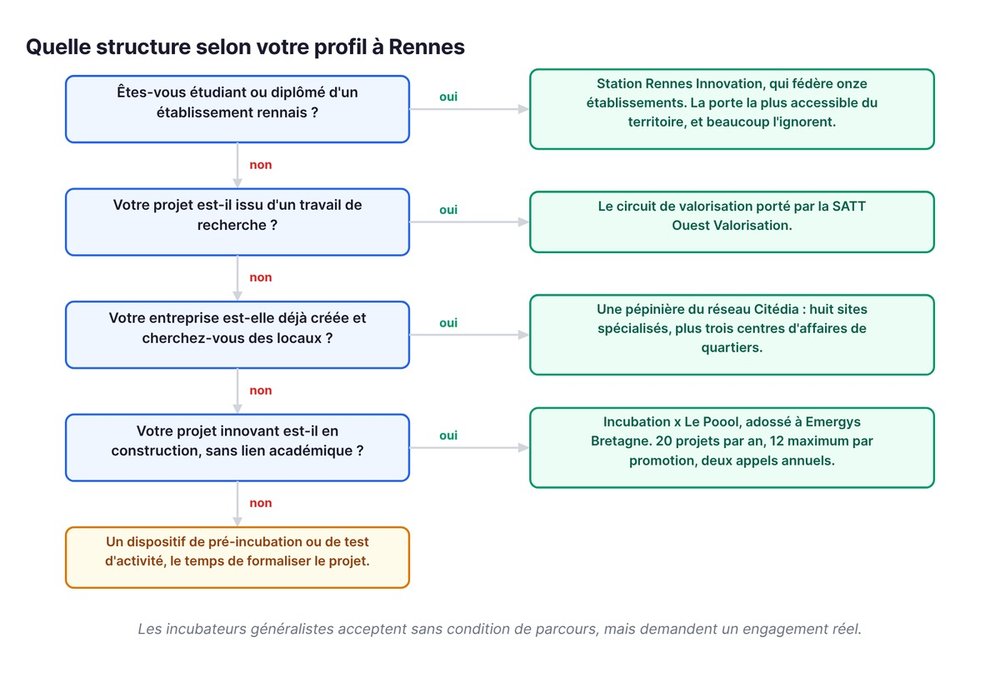
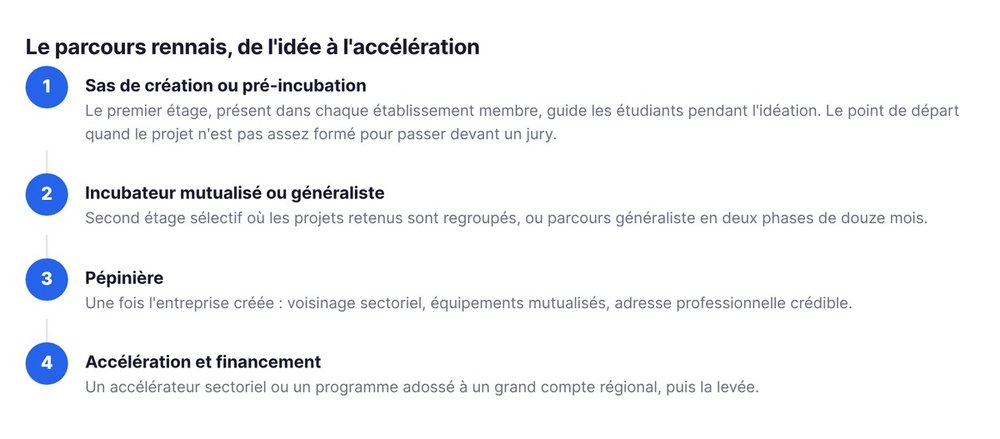
Idea still taking shape, no company yet. If you are a student or recent graduate of a Rennes institution, the first stage of the academic program is built for exactly this. Otherwise, look for a pre-incubation or business-testing program.
Innovative project under construction. This is the target of the region's generalist startup incubation program, which is selective and long.
Company already registered, needs premises and services. You belong in a business nursery.
Company with traction. A sector-specific accelerator or a program backed by a large regional corporate.
By profile: student, researcher, career changer
Student or recent graduate: the shared academic program is the most accessible entry point in the region.
Researcher: the research commercialization track, run by the technology transfer acceleration company for Western France (SATT Grand Ouest).
Employee changing careers: generalist incubators accept you regardless of background, but they expect genuine commitment.
Incubator, nursery, accelerator: the Breton vocabulary
The three words describe different services, and each calls for a different application.
What "pépinière" means in Brittany
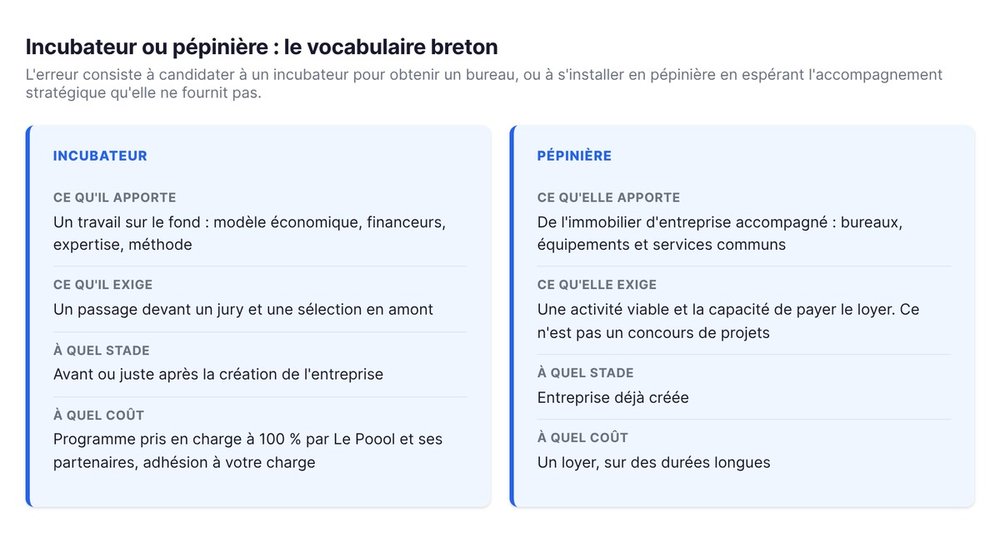
In Brittany, "pépinière" (business nursery) mainly refers to supported business real estate: companies that already exist, affordable offices, and shared equipment and services.
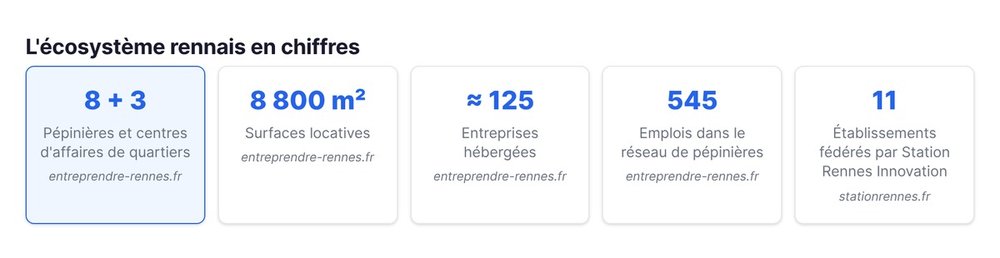
In Rennes, this network is large and well organized. The metropolitan area relies on eight nurseries and three neighborhood business centers, totaling nearly 8,800 square meters of rentable space, about a hundred offices and labs, roughly 125 hosted companies and 545 jobs. Each site has a specialty: business services at Haut-Blosne, Orchis and Les Laurentines; cybersecurity and digital at Numérique Square, La Maison de la Technopole and Cykred; biotech, chemistry, pharma and health at Le Biopôle; and the social and solidarity economy at Le Quadrium.
An incubator selects a project early and supports it: business model, funders, expertise, method. It works on your project itself, and office rental is a separate matter.
Incubator or nursery, depending on what's blocking you
If your problem is facing decisions alone that you don't know how to make, choose an incubator. If your problem is the cost and quality of your premises, with an activity already up and running, choose a nursery.
The two often go together: incubation first, hosting afterwards. The mistake is applying to an incubator to get an office, or moving into a nursery expecting strategic support it was never designed to provide.
Generalist incubators in Rennes
Le Poool and Emergys Bretagne
This is the region's flagship program. Incubation x Le Poool is backed by the Emergys Bretagne incubator and supported by the Brittany Region, the French Ministry of Higher Education and Research, and French Tech.
Its parameters are public. The program runs in two twelve-month phases: the first is intensive support to build the project, the second is individual support aimed at reaching meaningful revenue or starting a fundraise. It takes in 20 projects a year, with a maximum of 12 per cohort and two calls for applications annually.
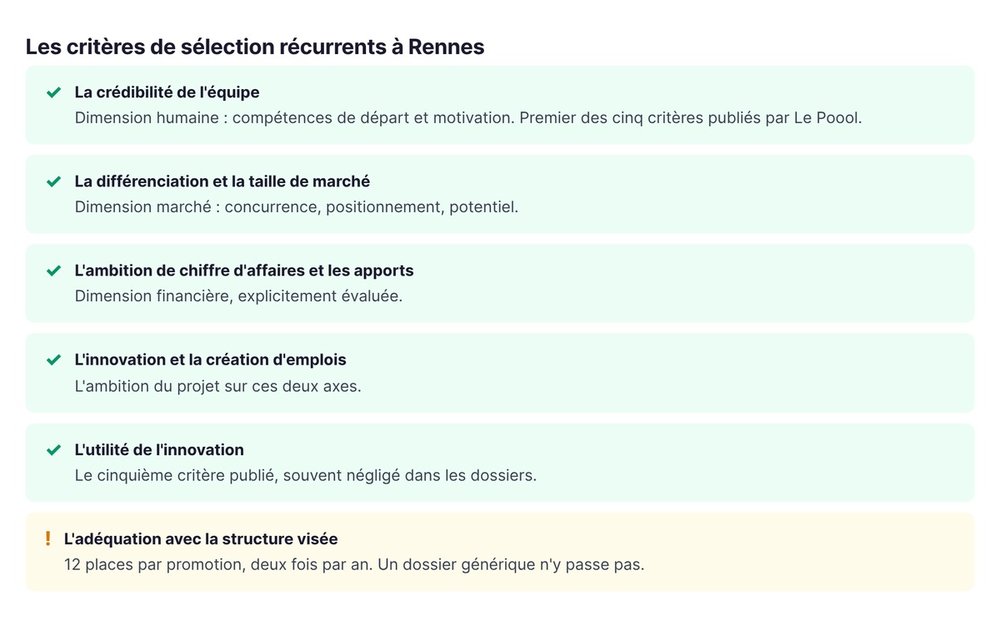
The five selection criteria are published too: the human dimension (team credibility, starting skills, motivation), the market dimension (differentiation, competition, size), the financial dimension (revenue ambition and capital contributions), the project's ambition in terms of innovation and job creation, and the usefulness of the innovation.
Finally, cost: Le Poool and its partners cover 100% of program costs, provided you become a member of Le Poool, and the membership fee is paid by the founder.
Two numbers worth keeping side by side: 12 spots per cohort, twice a year.
1Kubator Rennes
1Kubator is a network founded in 2016. Its original model was a ten-month program paired with a €25,000 investment in exchange for 10% of the company, rolled out in about ten French cities, Rennes included.
Since 2023, the organization has stopped incubating new projects and manages its portfolio of 300 funded startups, according to its website. If you come across a page inviting you to apply to 1Kubator Rennes, it is out of date.
Enzyme and The Land
Enzyme is the incubator run by The Land. It appears on the local authority's list alongside l'eclozr, Village by CA, NextMobility (run by Mobility Tech Green), the Ouest-France group's OFF7 accelerator, Les Premières Bretagne for women entrepreneurs, SATT Ouest Valorisation for research, and Tag35 for the social and solidarity economy.
Almost every organization on that list is either thematic or attached to an existing institution. So the question to ask yourself is: which of these organizations has a direct stake in my project succeeding?
The academic track
The Rennes academic pathway is the best-organized program in the region, as long as you read it as a whole.
INSA Rennes' Sas de création
The Sas de création at INSA Rennes is a pre-incubator launched in 2020 for the school's students and alumni at the ideation stage. It provides a dedicated workspace and guidance on prototyping, market research, business model and legal matters.
It is the starting point when a project isn't yet mature enough to pitch to a selection panel.
Innostart, Rennes School of Business
Innostart is the incubator of Rennes School of Business, open to the school's students and graduates. The program lasts six months, and a six-to-twelve-month Scale-up program, in Rennes or Paris, takes over for more advanced projects.
IMT Atlantique
The school runs its own incubator with the same affiliation logic: the first criterion is your connection to the school.
Station Rennes Innovation, the shared incubator
Station Rennes Innovation connects each school's Sas to a common incubator. Station Rennes Innovation brings together eleven Rennes higher education institutions around student entrepreneurship.
It works like a two-stage rocket. The first stage is the Sas de création, present in every member institution, which guides students through ideation. The second stage is a shared, selective incubator, where the chosen projects are grouped together to benefit from expert support, grants, and a mix of skills between founders from different disciplines.
So if you are a student or recent graduate of a Rennes institution, you don't have to choose between your school's incubator and a generalist one: the pathway moves you from one to the other, and the second stage puts you in touch with founders you would never otherwise have met.
Business nurseries and commercial real estate
The Citédia sites
The metropolitan nursery network is managed by Citédia, the Rennes urban services operator: eight nurseries and three neighborhood business centers, each with the specialty described above.
The entry criterion is a fit between your activity and the site's specialty, plus your ability to pay the rent.
What a nursery offers beyond the walls
A nursery brings three underrated benefits: sector neighbors, who generate business encounters you wouldn't have created yourself; shared equipment you couldn't fund alone, especially at lab-oriented sites; and a credible business address, which matters when your customers are established companies.
What it lacks: structured strategic support, investor access, and a cohort effect.
One question to ask during your visit: how long have the neighboring companies been there? A nursery whose tenants have stayed for eight years has turned into an office park. Real mixing depends on regular turnover, and ten minutes in the hallway will tell you whether it's happening.
Comparison table: cost, duration, equity, criteria
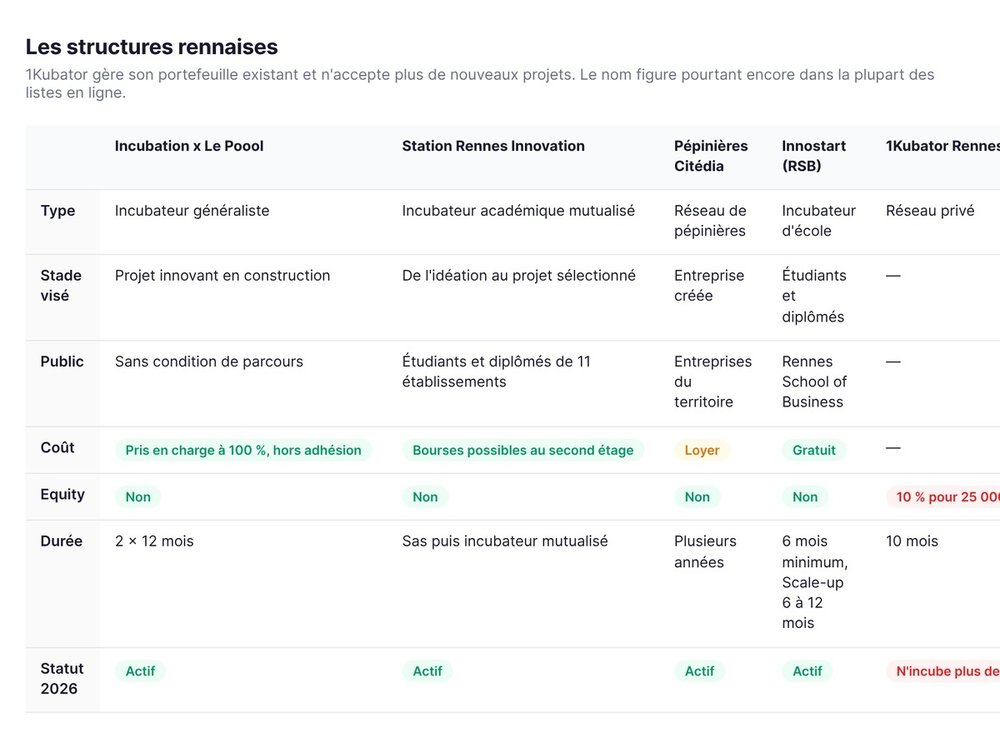
| Organization | Cost | Duration | Equity | Entry criteria |
|---|---|---|---|---|
| Incubation x Le Poool (Emergys Bretagne) | 100% covered, Le Poool membership paid by you | two twelve-month phases | none | five published criteria (team, market, finances, innovation, usefulness), 12 spots per cohort, two calls per year |
| Sas de création INSA Rennes | free for students and alumni | ideation phase, duration not published | none | connection to INSA Rennes |
| Innostart (Rennes School of Business) | free for students and graduates | six months, then Scale-up of six to twelve months | none | student or graduate of the school |
| Station Rennes Innovation | shared program of the member institutions | duration not published | none | student or graduate of one of the eleven institutions, selection by application |
| Citédia nurseries (eight sites) | rent | several years | none | activity matching the site's specialty, ability to pay rent |
| 1Kubator Rennes | €25,000 for 10% of the company (model until 2023) | ten months | 10% | no new projects since 2023 |
Public and quasi-public organizations in Rennes don't take equity; always check this point in the agreement. Only the generalist incubation program publishes its criteria, across five dimensions: use them as a preparation checklist, even when applying elsewhere.
Rennes or elsewhere in Brittany
Organizations in Brest, Lorient and Saint-Malo
Rennes has the highest density, but Brittany works as a regional network more than as a competition between cities. The regional incubator, the technology transfer acceleration company for Western France and regional programs cover the whole territory: a project based in Brest, Lorient or Saint-Malo has access to the same core funding.
Since the programs are regional, your location decision should come down to access to your customers, your hires and your industry ecosystem. A maritime startup has good reasons to be outside Rennes; a cybersecurity startup has excellent reasons to be there.
The nurseries' specialization, with three sites focused on cybersecurity and digital, tells you where the engineers you'll hire in eighteen months are, which referrers speak your language, and which large accounts buy what you sell. Choosing a location means choosing a labor market first and a support program second.
A startup with a national market and a distributed team has no strong reason to decide on this basis: in that case, pick the most demanding program.
You can compare Brittany's programs with those in other regions in our guide to accelerators and incubators in France. Nantes, the other major city in Western France, has a distinct ecosystem, with Atlanpole and a greentech specialty, covered in the guide to incubators and accelerators in Nantes. For a cybersecurity or digital startup looking for investors outside Brittany, the overview of incubators and accelerators in Paris lists the organizations in the capital.
FAQ
What is the difference between an incubator and a business nursery?
An incubator selects a project early and supports it in depth: business model, structuring, funding, introductions. A nursery hosts a company that already exists and rents it offices with shared services, over long periods. In Brittany, the word "pépinière" almost always means supported business real estate.
How much does an incubator in Rennes cost?
The region's generalist incubation program is 100% covered by the organization and its partners, with the membership fee paid by the founder. School incubators are free for their students and graduates. Nurseries charge rent, with prices that vary by site and floor space.
Do you need to be a student to join a school incubator?
You need to be affiliated with the institution, which in most cases includes graduates. The shared Rennes program brings together eleven institutions, which opens access to students and graduates of all eleven. Check your school's alumni policy before applying elsewhere; it is often broader than you'd expect.
Do Rennes incubators take equity?
The region's public and quasi-public organizations don't take equity. The equity-based model, historically offered by a private network at 10% for €25,000, has stopped accepting new projects since 2023. Always check this point in the agreement before signing.