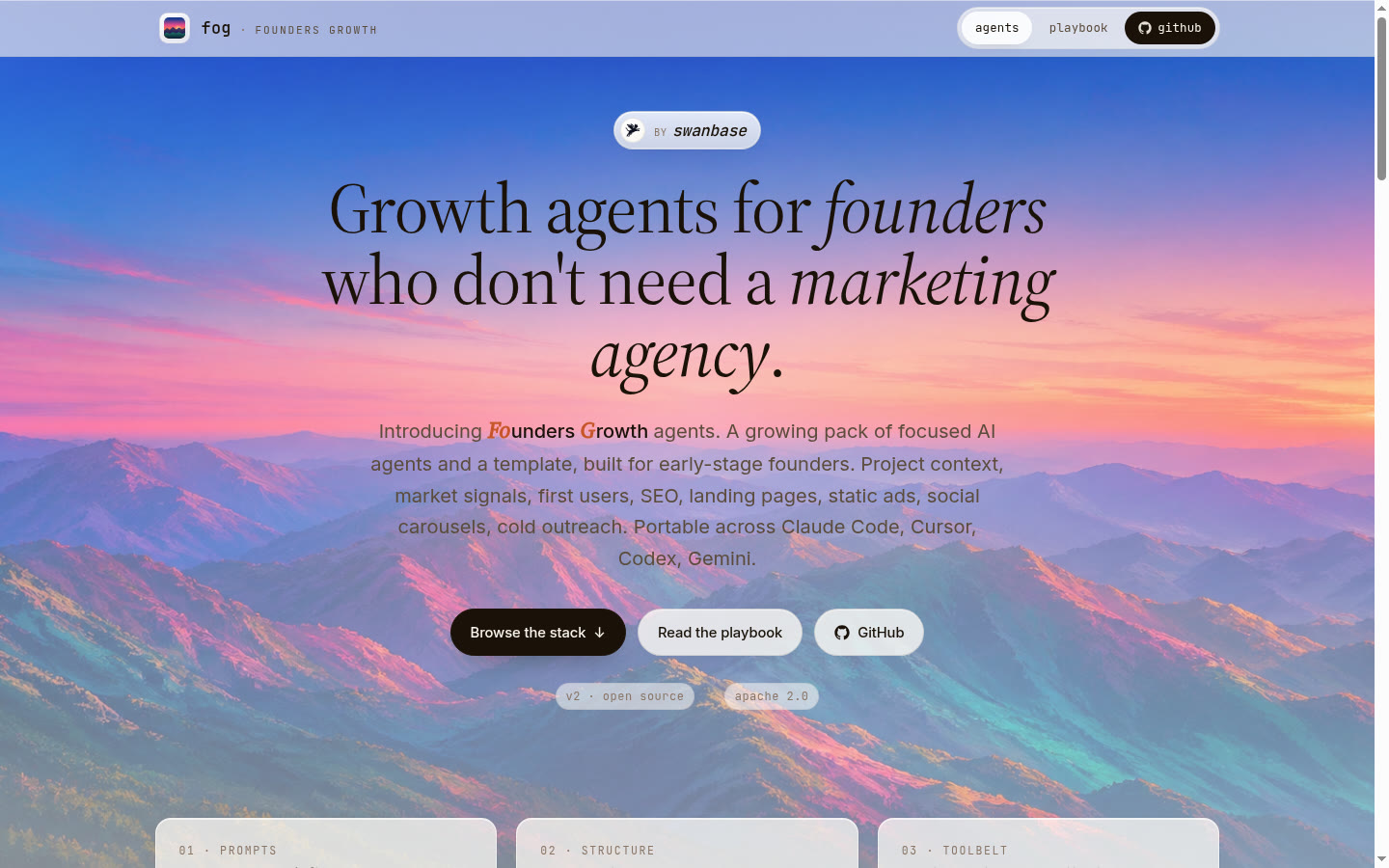
fog is a pack of AI marketing agents that you run from Claude Code, Cursor, Codex CLI or Gemini CLI. Each agent produces one specific deliverable: a market study, a list of acquisition channels, an SEO audit, a landing page audit, an outreach sequence, a carousel or a set of ad creatives. An agent fits in a folder of markdown files that you can read and edit, and its deliverables stay in your own project folder.
swanbase publishes the stack under the Apache 2.0 license. Version 0.2, released in June 2026, ships eight agents and a blank template for writing your own.
How it works
Setup takes three steps, listed on the site's home page.
- You clone the agents repository.
- You clone the shared cli-skills toolbelt and add the CLIs you need to your
PATH(exa, firecrawl, perplexity, instantly). - You set the API keys listed in each agent's README, then you start the agent in plain language inside your tool.
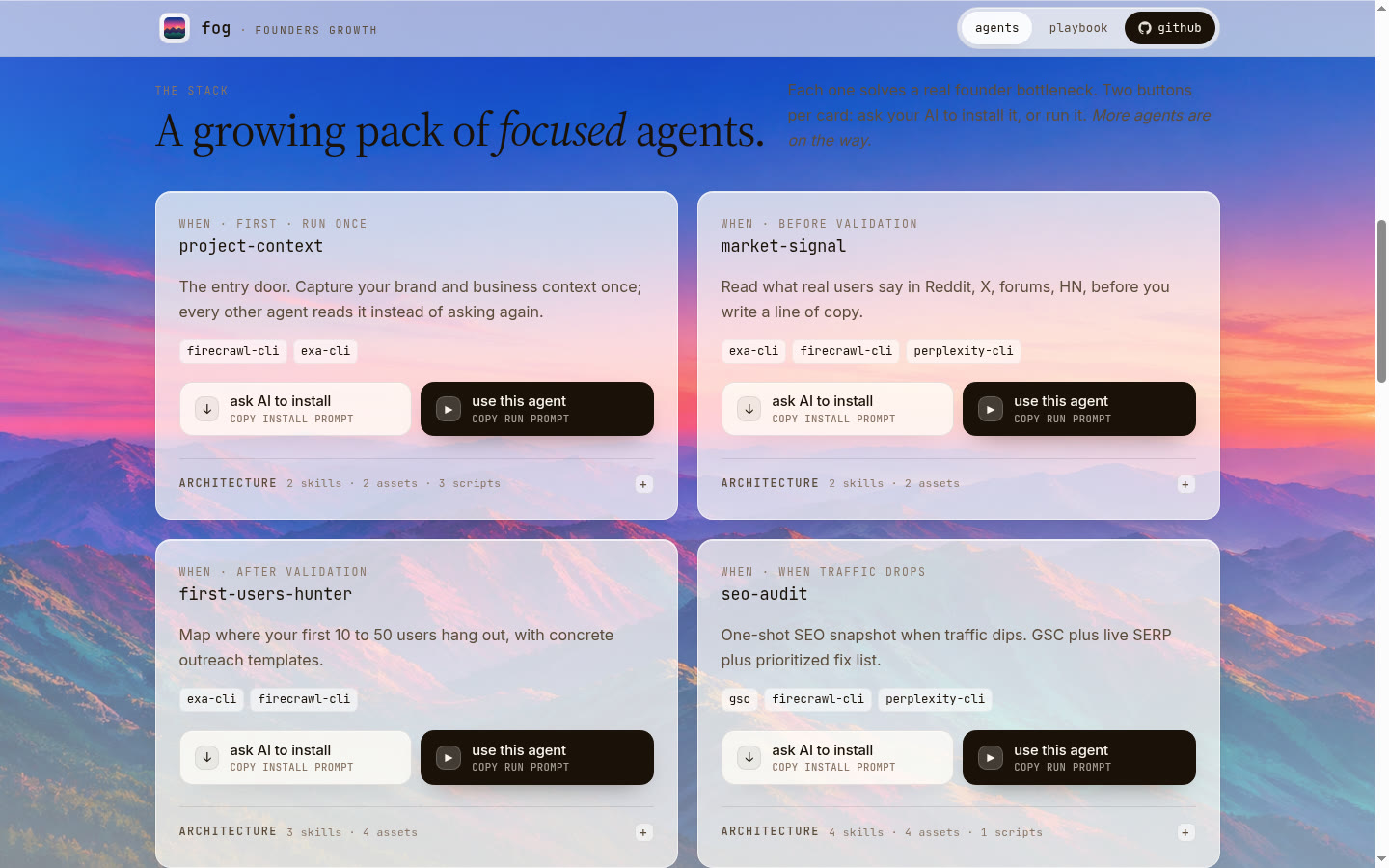
A typical command reads: "Run the market-signal agent at agents/market-signal/. Market: freelance invoicing tools for designers." Your tool reads AGENT_MARKET_SIGNAL.md, lists any missing inputs for you to fill in, runs the steps and writes the deliverable to your project folder as <project>/<agent>/<label>-<YYYYMMDD>.md. On each agent card of the site, two buttons copy the install prompt and the run prompt.
Every folder follows the same layout. The AGENT_<NAME>.md workflow file describes the inputs, the steps, the deliverable template and what to do when something fails. Next to it sit a README, a config.example.json copied into your project on the first run, and skills/ subfolders in Anthropic's Agent Skills format. The Marketing Agents Playbook covers this format and the portability rules across tools.
The eight agents
project-context runs first, once. From your site URL, the agent extracts colors, fonts, logo and images, then drafts your business context (offer, target customer, voice). You approve two checkpoints before it writes brand.json and context.json, which the other agents reuse. With no API key, the agent falls back to a short Q&A.
market-signal reads Reddit, X, Hacker News, forums and product reviews about your market. The report gives a sentiment breakdown, issues ranked by number of mentions, a psychographic profile, 15 to 20 verbatim quotes with their links and three recommendations.
first-users-hunter starts from your idea and your target user. The agent lists 8 to 12 communities, 5 to 8 niche platforms and 3 to 6 events, then filters out inactive communities. The agent scores each channel with the ICE method and turns the top three to five into 14-day experiments, with one message template per channel.
seo-audit combines Google Search Console, live Google results and citations in AI Overviews and Perplexity. The deliverable holds 10 to 15 prioritized fixes, with rewritten title and meta tags, and a 90-day content roadmap.
landing-page-analyzer captures a page on desktop and mobile, then scores it out of 100 with the LEVER grid (cost, trust, usability, comprehension, motivation). The agent also runs a 10-second comprehension test and ranks the five fixes to ship this week.
cold-outreach-builder writes a sequence of 4 to 7 messages for email or LinkedIn. The agent adds two personalization columns per prospect to your CSV file and writes the import instructions for Instantly.
carousel-builder turns a topic typed in the chat into a carousel of 5 to 15 slides in your brand colors, delivered as a PDF for LinkedIn and as PNG files for Instagram.
static-ads-builder writes a pool of Meta ad briefs split by funnel stage, then renders the ones you pick on fal.ai. Two approvals come before any spend: the choice of briefs, then the confirmation of model, resolution and estimated budget.
Use cases for an early-stage startup
- Before you write your landing page. market-signal collects the exact words your future customers use, which you can reuse in your headlines. project-context then stores your brand once.
- To find your first 50 users. first-users-hunter lists the active communities where your target users talk, then cold-outreach-builder drafts the messages for your first 50 to 200 conversations.
- Before you pay for ads. landing-page-analyzer flags the friction points on your page. Once you fix the page, static-ads-builder prepares Meta creatives with your real logo and product screenshots.
- When organic traffic drops. seo-audit lists lost queries, decaying pages and pages whose click-through rate sits below the average for their position.
- To post on LinkedIn every week. carousel-builder produces a carousel from a topic, with no Canva account.
Pricing and access
fog is free. The Apache 2.0 license lets you use, modify and redistribute it, commercial use included. If you redistribute the stack or build a product on it, keep the line "Built on the Founders Growth Agent Stack by swanbase", as required by the NOTICE file.
Costs come from third-party services, paid with your own keys:
- Exa and Firecrawl for search and scraping, used by most agents;
- Perplexity, optional, for market-signal and seo-audit;
- Serper for the Google results in seo-audit (the agent's README mentions a free tier of 2,500 queries per month);
- Instantly, optional, to send the outreach sequence;
- fal for images: carousel-builder caps generation at 3 images per run, so $0.45 at most with the default model, and static-ads-builder shows the estimated cost before each render.
Your Claude Code, Cursor, Codex CLI or Gemini CLI subscription stays on your side.
Limitations
- To use fog, you need to be comfortable in a terminal: cloning a repository, editing your
PATH, exporting environment variables. Several agents also need Python and Playwright. - For seo-audit, you need a verified Search Console property, a Google Cloud OAuth client and a Go build of the
gscbinary. - seo-audit delivers a snapshot. For continuous rank tracking, you need another tool.
- The agents produce files and publish nothing on your behalf. Only cold-outreach-builder can, as an option, push a campaign into Instantly.
- cold-outreach-builder targets personalized sends to 50 to 200 prospects. According to its README, mass sends to thousands of contacts fall outside the agent's scope.
- carousel-builder handles neither video nor X threads, ships one default style and stops at 15 slides.
Origin
swanbase built fog for early-stage founders who want to find their first users without hiring a marketing agency. According to the playbook, the agent format took shape across internal swanbase tools before swanbase opened the code. Version 0.1, released in May 2026, brought together five core agents (market-signal, first-users-hunter, seo-audit, landing-page-analyzer, cold-outreach-builder) and carousel-builder. Version 0.2 added project-context and static-ads-builder in June 2026.
For the reasoning behind vertical agents and the anatomy of an AGENT.md file, read our article fog, the open source AI marketing agents stack.